
Why Did Boy Names Starting With 'J' Dominate America for 100 Years? From John and James to Jason, Joshua, and Jacob
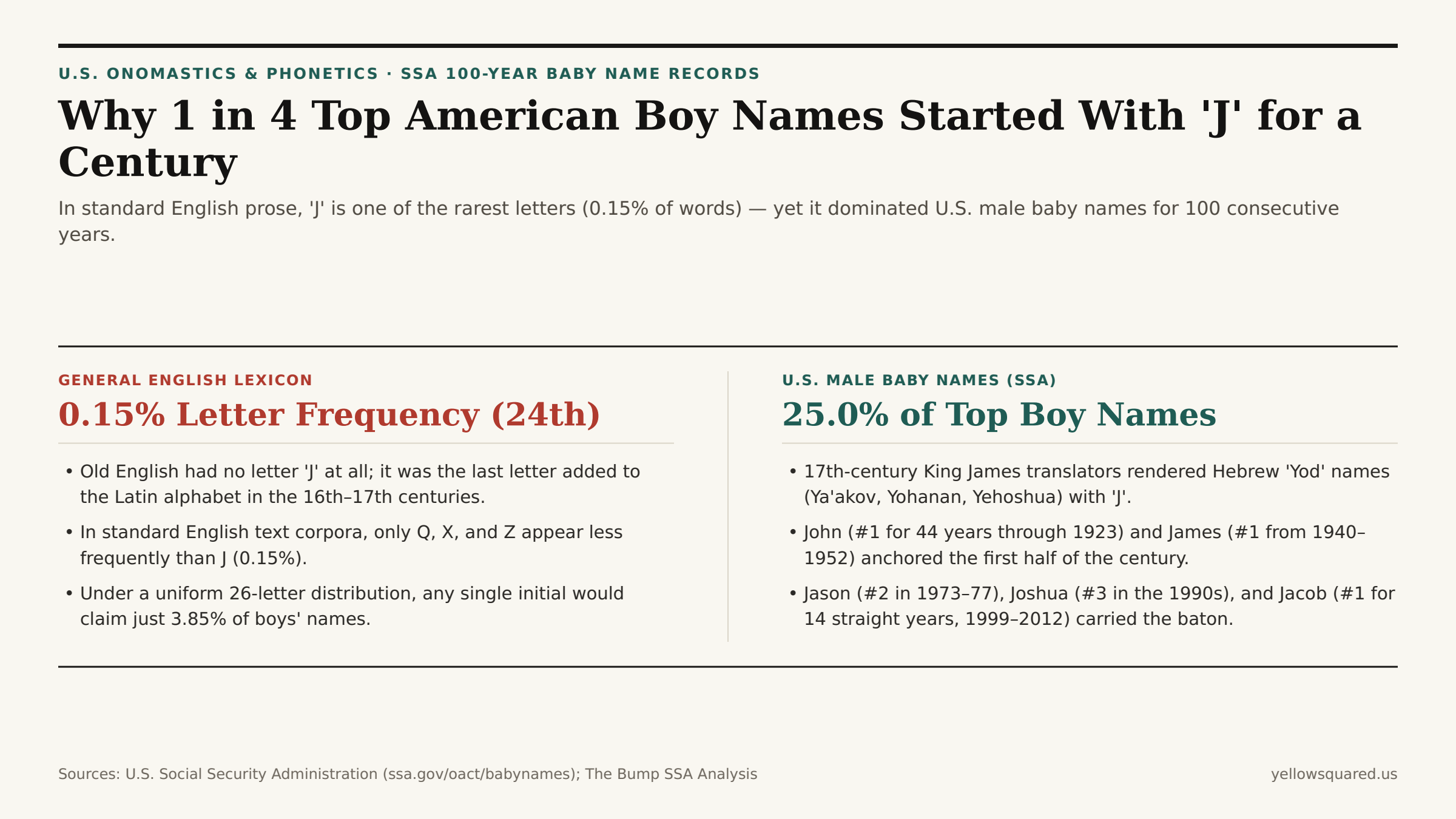
Open any English dictionary or run a letter-frequency count on a million words of English prose, and the letter J ranks 24th out of 26 letters — accounting for a microscopic 0.15% of all words in the English language (ahead of only Q, X, and Z). Yet if you examine the U.S. Social Security Administration's (SSA) 100-Year Top Baby Names Record and The Bump's Historical SSA Analysis of Boy Names Starting With J, a stunning phonetic anomaly emerges: for a full century (1925–2024), 25% of the most popular boy names in the United States started with the letter J.
From John (#1 from 1880 to 1923) and James (#1 from 1940 to 1952) to Jason, Jeremy, Justin, Joshua, Jordan, Jonathan, Jack, and Jacob (#1 for 14 consecutive years from 1999 to 2012), American parents treated J as the default phonetic anchor for boys across five consecutive generations — a 166-fold overrepresentation relative to the English vocabulary. To explore historical popularity curves and phonetic sibling matches across every decade, Explore historical baby name trends in Name Scout.
1. The Linguistic Mystery: How Hebrew Yod (Y) Became English J
Why does a letter that barely exists in native Germanic English vocabulary dominate English given names? Because almost none of the classic English J names originated in Old English. Indeed, the letter J did not even exist as a distinct consonant in the English alphabet until the early 1600s.
Nearly all of the foundational J boy names trace back to Biblical Hebrew names beginning with the tenth Hebrew letter, Yod (י, pronounced /j/ like the English Y in "yes"):
- John & Jonathan: From Hebrew Yohanan ("Yahweh is gracious") and Yonatan ("Yahweh has given").
- James & Jacob: Both descend from the exact same Hebrew patriarch name, Ya'akov (
יעקב), which passed into Late Latin as Iacobus and Iacomus before splitting into Old French James and English Jacob. - Joshua & Joseph: From Hebrew Yehoshua ("Yahweh is salvation") and Yosef ("He will add").
- Jeremy / Jeremiah & Jordan: From Hebrew Yirmeyahu and Yarden (the River Jordan).
When Greek and Latin scribes transliterated Hebrew Yod, they wrote it with an initial I (Ioannes, Iacobus, Iosue). During the Middle Ages, calligraphers added a decorative hook (J) to initial I characters, and under Old French phonetic influence after the Norman Conquest, that initial palatal glide hardened into the punchy voiced postalveolar affricate (/dʒ/) we pronounce in English today.
2. The 5-Generation Phonetic Relay (1880–2024)
Why didn't J names fade out when John and James stopped claiming the #1 spot in the 1950s? Sociolinguists point to phonetic continuity with rhythmic novelty: parents wanted a name that kept the crisp, familiar /dʒ/ initial stop of their father's or grandfather's name (John, Jim, Joe), but with a fresher vowel cadence and ending consonant:
- Wave 1 — The Monosyllabic Classics (1880–1952): John (#1 from 1880–1923) and James (#1 from 1940–1952), flanked by Joseph and Jack.
- Wave 2 — The 1960s–1970s Trochaic Shift: As Baby Boomers named Gen X sons, they pivoted to two-syllable names ending in
-son,-ry, or-my: Jason (Greek, rocketing to #2 nationally from 1973–1977), Jeffrey, Jerry, and Jeremy. - Wave 3 — The 1980s–1990s Millennial Boom: At the peak of the
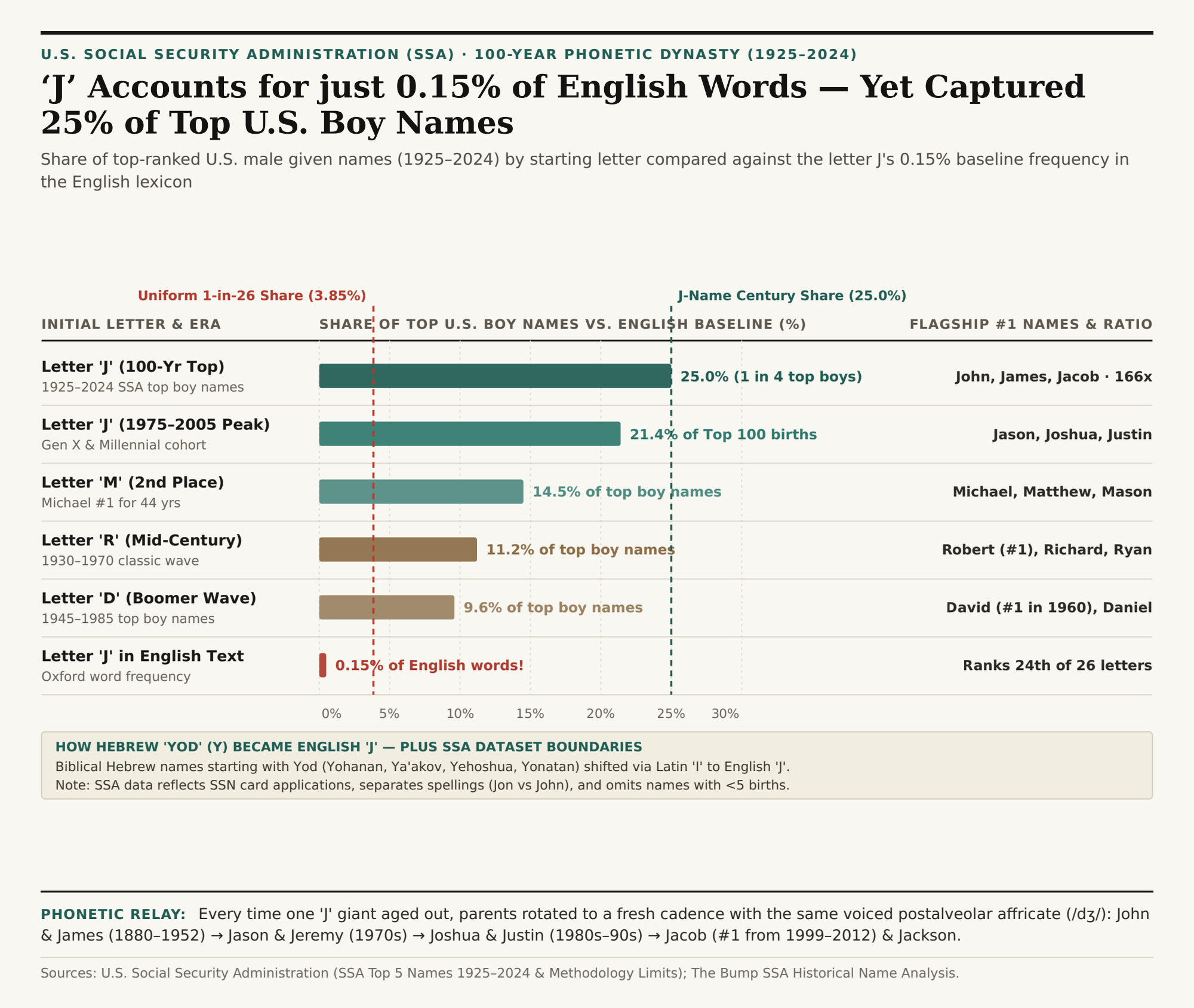
Jwave between 1975 and 2005, more than 1 in 5 boys in the U.S. Top 100 (21.4%) carried aJname, led by Joshua (Top 5 from 1989–2009), Justin, Jordan, and Jonathan. - Wave 4 — The Turn-of-the-Century
JacobDynasty (1999–2012): Jacob dethroned Michael in 1999 and held the #1 spot in the United States for 14 consecutive years, joined by Jayden and Jack. - Wave 5 — The Modern Surname & Revival Era (2013–Present): Even as soft-vowel boy names (
Liam,Noah,Oliver) rose in the 2010s and 2020s, James returned to the national Top 5 alongside Jackson, Jack, and Josiah.
"Because John, James, Jason, Joshua, and Jacob each peaked in a different 25-year window, the letter J stayed at the top of U.S. birth certificates for a century without a single generation feeling like they were picking a dated name."
| Initial / Cohort | SSA Benchmark Scope | Top Name Share | English Dictionary Share | Overrepresentation | Signature Anchor Names |
|---|---|---|---|---|---|
| Letter 'J' (Century Top) | SSA Top Boy Names (1925–2024) | 25.0% | 0.15% | 166x over baseline | John, James, Jason, Joshua, Jacob |
| Letter 'J' (1975–2005 Peak) | Top 100 Male Birth Share | 21.4% | 0.15% | 142x over baseline | Jason, Jeremy, Justin, Joshua, Jacob |
| Letter 'M' (2nd Place) | SSA Top Boy Names (1925–2024) | 14.5% | 4.10% | 3.5x over baseline | Michael (#1 for 44 yrs), Matthew, Mark |
| Letter 'R' (Mid-Century) | SSA Top Boy Names (1930–1970) | 11.2% | 6.00% | 1.9x over baseline | Robert (#1 in 1924–39), Richard, Ryan |
| Letter 'D' (Boomer Wave) | SSA Top Boy Names (1945–1985) | 9.6% | 4.30% | 2.2x over baseline | David (#1 in 1960), Daniel, Donald |
| Letter 'J' in English Prose | Oxford English Lexicon | 0.15% | 0.15% | 1.0x (24th of 26) | Only Q, X, and Z are rarer in English |
Important SSA Dataset Boundaries & Spelling Splits
When analyzing multi-decade name shares, keep in mind the official U.S. Social Security Administration Baby Names Dataset Limits: SSA totals are compiled from Social Security Number (SSN) card applications (which became nearly universal at birth after the Tax Reform Act of 1986 required SSNs for tax dependents, whereas early-1900s records reflect adults applying after the 1935 Social Security Act), every exact spelling is ranked separately (so Jackson, Jaxon, and Jaxson or John and Jon are counted as distinct entries rather than combined), and any name with fewer than 5 occurrences (<5) in a given year is omitted to protect individual privacy. Explore historical baby name trends in Name Scout to compare spelling clusters side by side, and download the 100-year J-name dominance CSV dataset.