
Why Did Kazakhstan Switch to One Single Time Zone (UTC+05:00) in 2024?
For 96 years—from the Soviet time-zone decrees of the 1920s until Leap Day 2024—the Republic of Kazakhstan divided its vast territory across two time zones: UTC+05:00 in the west and UTC+06:00 across the central and eastern regions, including the capital Astana and largest city Almaty. Then, at midnight between February 29 and March 1, 2024, twelve regions and three major cities turned their clocks back one hour from 00:00 to 23:00, placing the world's largest landlocked country onto a single nationwide time zone (UTC+05:00) with zero Daylight Saving Time. As documented in civil timekeeping records for Kazakhstan, Time and Date's March 2024 reform dispatch, and operating-system TZDB advisories, the reform solved a long-standing solar-clock skew in Astana and Almaty while igniting a fierce debate in East Kazakhstan.
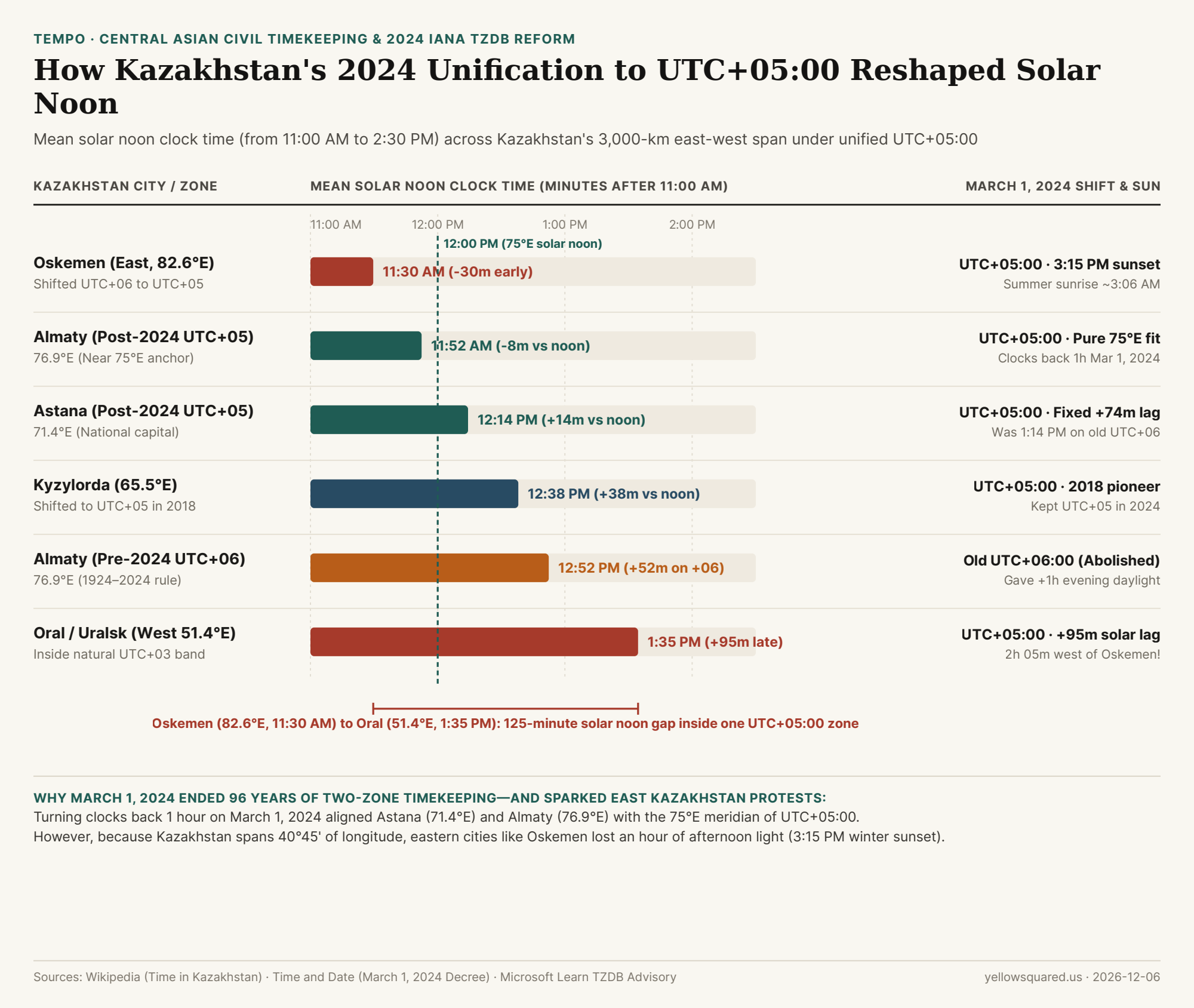
UTC+05:00. Data: Wikipedia (Time in Kazakhstan) and Time and Date (download CSV).Why Astana (71.4°E) and Almaty (76.9°E) Belonged Geometrically in UTC+05:00 All Along
In the international 24-zone meridian system, each 1-hour offset spans 15° of longitude (4 solar minutes per degree), meaning the natural UTC+05:00 time zone is centered dead on the 75°00'E meridian (covering 67.5°E to 82.5°E). When chronobiologists and astronomers appointed by Kazakhstan's Ministry of Trade and Integration and Ministry of Ecology and Natural Resources audited the country's geography in 2023, they pointed out a striking anomaly:
- Astana (
71°26'E=71.43°E): Located3.57°west of the75°Emeridian, Kazakhstan's capital sits squarely inside the geographicUTC+05:00band. Under the pre-2024UTC+06:00rule (anchored to90°E), Astana was running 74 minutes ahead of solar time (mean solar noon at1:14 PM). Shifting toUTC+05:00brought Astana's mean solar noon to12:14 PM. - Almaty (
76°54'E=76.90°E): Situated less than two degrees east of the75°Emeridian, Almaty's true solar noon sat at12:52 PMunderUTC+06:00. OnUTC+05:00, Almaty's mean solar noon arrives at11:52 AM—within 8 minutes of 12:00 PM clock noon. - Kyzylorda's 2018 Precedent (
65.50°E): On December 20–21, 2018, Kyzylorda Region successfully shifted fromUTC+06:00toUTC+05:00after residents complained of dark winter mornings when solar noon fell at1:38 PM.
"Because Kazakhstan stretches 40°45' from west to east—a 2-hour-and-43-minute solar span—fixing the clock for Astana (71.4°E) meant pushing winter sunsets to 3:15 PM in eastern Oskemen (82.6°E)."
The 40°45' Longitude Dilemma: Oral in the West vs. Oskemen in the East
While unifying onto UTC+05:00 eliminated domestic flight and rail clock jumps and placed Astana and Almaty near solar noon, Kazakhstan's 2,960-kilometer east-west breadth spans nearly three natural solar time zones (from 46°30'E near the Volga delta to 87°20'E in the Altai Mountains):
- East Kazakhstan's Early Dawn and 3:15 PM Winter Dusk (
Oskemen, 82.61°E): In Oskemen (Ust-Kamenogorsk) and Semey near the Chinese and Russian Altai border, local solar time sits 30 minutes ahead of the75°Emeridian. Dropping fromUTC+06:00toUTC+05:00pulled mean solar noon back to11:30 AM—meaning June summer sunrises break around3:06 AMwhile December winter sunsets fall around3:15 PM. Despite a 2024 public petition onE-Petition.kztitled "Turn the Time Back" from eastern residents wanting evening daylight back, the government upheld the unifiedUTC+05:00zone while encouraging flexible regional work hours. - West Kazakhstan's Late Solar Afternoon (
Oral, 51.37°E): At the opposite end of the country, Oral (Uralsk) and Atyrau (51.88°E) sit geographically inside the naturalUTC+03:00(45°E) zone, yet have remained onUTC+05:00since 2005—placing mean solar noon in Oral at1:35 PM(+94.5 minutesafter clock noon, and 2 hours and 5 minutes later than solar noon in Oskemen!).
| Kazakhstan City | Longitude | Pre-March 2024 | Post-March 2024 | Solar Noon (UTC+05) | Solar Skew vs. 12:00 PM | Daylight & Administrative Impact |
|---|---|---|---|---|---|---|
| Oskemen (East) | 82.61°E |
UTC+06:00 |
UTC+05:00 |
11:30 AM | -30.4 min (Early) |
June dawn ~3:06 AM; Dec dusk ~3:15 PM |
| Almaty (Post-2024) | 76.90°E |
UTC+06:00 |
UTC+05:00 |
11:52 AM | -7.6 min (Ideal fit) |
Sits just 1.9° east of 75°E meridian |
| Astana (Capital) | 71.43°E |
UTC+06:00 |
UTC+05:00 |
12:14 PM | +14.3 min (Ideal fit) |
Eliminated old +74 min morning lag |
| Kyzylorda | 65.50°E |
UTC+05:00 |
UTC+05:00 |
12:38 PM | +38.0 min |
Switched from UTC+06 in Dec 2018 |
| Almaty (Pre-2024) | 76.90°E |
UTC+06:00 |
Historical | 12:52 PM (on +06) | +52.4 min |
96-year standard ended Mar 1, 2024 |
| Oral / Uralsk (West) | 51.37°E |
UTC+05:00 |
UTC+05:00 |
1:35 PM | +94.5 min (Late) |
Natural UTC+03 longitude; 1:35 PM noon |
How to Check Unified Kazakhstan Time Against Europe, India, and North America
Since March 1, 2024, every city in Kazakhstan—whether wired to Asia/Almaty, Asia/Qostanay, Asia/Aqtobe, Asia/Atyrau, or Asia/Oral in the IANA Time Zone Database—shares the exact same UTC+05:00 offset as Tashkent and Karachi (sitting 30 minutes behind India's UTC+05:30 and 3 hours Behind Beijing's UTC+08:00). Open Tempo in your browser to compare live meeting windows between Astana, Almaty, London, and New York without outdated UTC+06:00 tables.