
Why Did Mexico Abolish Daylight Saving Time in 2022 (Except Along the U.S. Border)?
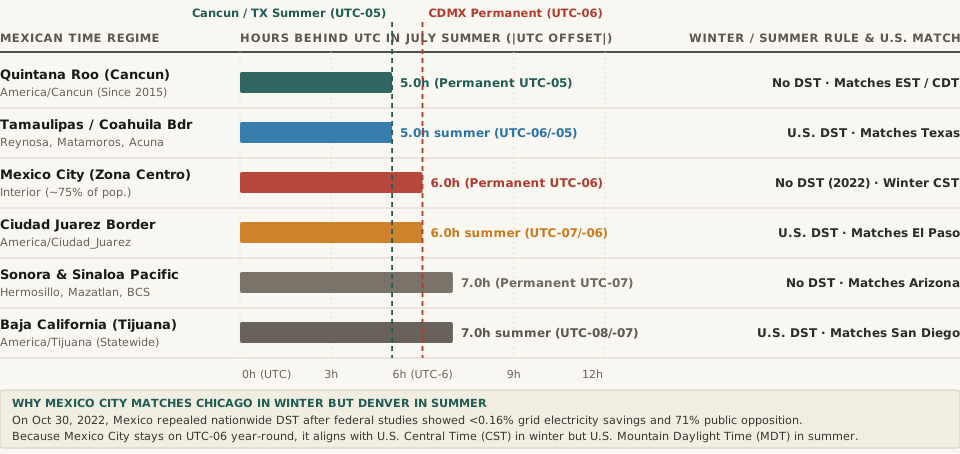
If you schedule a recurring video call between New York or Chicago and Mexico City, you have probably noticed a disorienting seasonal shift: from November to March, Mexico City sits in the exact same time zone as Chicago and Dallas (UTC−06:00, Central Standard Time). Yet on the second Sunday in March, when the United States springs forward into Daylight Saving Time, Mexico City does not move its clocks—leaving it aligned with Denver and El Paso (Mountain Daylight Time, UTC−06:00) for eight months of the year. Even more confusingly, if you travel to Tijuana, Ciudad Juárez, or Reynosa along the northern frontier, clocks do still spring forward and fall back on the exact U.S. schedule, while Cancún on the Caribbean coast remains permanently locked on UTC−05:00.
This split-screen clock architecture is the direct result of Mexico's October 30, 2022 abolition of nationwide Daylight Saving Time under the federal Ley de los Husos Horarios en los Estados Unidos Mexicanos (Law on Time Zones in the United States of Mexico). Here is the complete breakdown of why Mexico adopted nationwide DST in 1996, why it repealed the practice 26 years later after federal energy audits found less than 0.16% electricity savings, and how Mexico's four standard time zones and three special regional exceptions actually work.
1. Why Mexico Adopted Nationwide DST in 1996—and Why a 3-to-4-Week Gap Opened in 2007
Although Baja California began observing regional Daylight Saving Time in the mid-20th century to keep pace with California's economy, Mexico did not introduce nationwide Daylight Saving Time (horario de verano) until 1996 under President Ernesto Zedillo. The original rationale was twofold: reducing early-evening residential electricity demand on the national grid (CFE) and keeping Mexican financial markets and manufacturing plants synchronized with the United States following the 1994 enactment of NAFTA.
From 1996 through 2006, Mexico and the United States changed their clocks on the exact same Sundays: advancing one hour on the first Sunday in April and returning to standard time on the last Sunday in October. However, when the U.S. Congress passed the Energy Policy Act of 2005 (taking effect in March 2007), the United States extended its Daylight Saving Time by four to five weeks—starting on the second Sunday in March and ending on the first Sunday in November.
Mexico's interior refused to adopt the longer U.S. schedule because pushing clocks forward in early March left elementary school children across central and southern Mexico commuting in total darkness. Instead, according to historical records on Daylight saving time in Mexico, only Mexican municipalities within 20 kilometers (12.4 miles) of the U.S. border adopted the U.S. March-to-November dates in 2010, while Mexico City and the interior kept the April-to-October dates. For 12 years (2010–2022), businesses coordinating between the U.S. and Mexico City endured a notorious three-to-four-week spring gap (mid-March to early April) and a one-week autumn gap (late October to early November) when the time difference between U.S. cities and Mexico City temporarily shifted by an hour.
“When the U.S. extended Daylight Saving Time into March and November in 2007, interior Mexico stayed on the shorter April-to-October calendar—creating a four-week annual desynchronization window that frustrated cross-border aviation and finance for 15 years.”
2. The October 2022 Repeal: <0.16% Grid Savings and 71% Public Opposition
Why did Mexico finally abolish nationwide Daylight Saving Time on Sunday, October 30, 2022? Like Brazil (which repealed DST in April 2019), most of Mexico lies at tropical and subtropical latitudes between 14.5°N and 24°N, south of the Tropic of Cancer (23.44°N). In Mexico City (19.43°N), natural daylight length barely changes across the year: winter solstice days last roughly 10 hours and 57 minutes, while summer solstice days last 13 hours and 19 minutes. Moving the clock ahead by an hour in summer did not unlock long northern-style evenings; it simply forced workers and students to wake up at what was solar 5:00 AM.
Before introducing the 2022 bill, Mexico's Secretariat of Energy (SENER), the Federal Electricity Commission (CFE), and the Secretariat of Health presented three decisive empirical findings to the Mexican Congress:
- Negligible Grid Savings (<0.16% of National Consumption): According to federal SENER and FIDE audits cited in the legislative record for Mexico's 2022 DST repeal, nationwide Daylight Saving Time saved roughly 537 gigawatt-hours (GWh) in 2021—representing less than 0.16% of Mexico's total national electricity consumption (worth roughly 1.13 billion pesos, or ~$56 million USD across a population of 128 million). The universal adoption of high-efficiency LED lighting and inverter air conditioning had eroded the evening lighting spike that 1990s models relied upon.
- Circadian and Cardiovascular Health Costs: Mexico's Secretariat of Health documented spikes in sleep deprivation, daytime fatigue, irritability, and short-term cardiovascular and metabolic disruption during the April spring-forward transition, concluding that biological harm outweighed a 0.16% electricity reduction.
- 71% Public Support for Abolition: A June–July 2022 national public opinion survey conducted by the Secretariat of the Interior (SEGOB) showed that 71% of Mexican citizens favored abolishing seasonal clock changes permanently.
Mexico's Chamber of Deputies approved the repeal by an overwhelming 445–8 vote in September 2022, the Senate passed it 59–25 on October 26, 2022, and Mexico set its interior clocks back one final time on October 30, 2022.
3. Mexico's Three Major Regional Time Exceptions Explained
While the 2022 law eliminated clock changes for roughly three-quarters of the country, it carefully preserved three geographical exceptions that every traveler, logistics planner, and software engineer needs to understand. Here is the complete reference table across all Mexican regions:
| Mexican Time Zone or Border Regime | IANA Zone Identifier | Winter UTC Offset (Nov–Mar) | Summer UTC Offset (Mar–Nov) | Annual Clock Shifts | Gap vs. U.S. Central Time (CST/CDT) | Statutory & Geographic Scope |
|---|---|---|---|---|---|---|
| Zona Sureste (Quintana Roo / Cancún) | America/Cancun |
UTC−05:00 | UTC−05:00 | 0 shifts (Since Feb 2015) | +1h in Winter / 0h in Summer | Quintana Roo state (Cancún, Cozumel, Tulum) for evening resort daylight |
| Zona Centro (Mexico City & Interior) | America/Mexico_City |
UTC−06:00 | UTC−06:00 | 0 shifts (Repealed Oct 2022) | 0h in Winter / −1h in Summer | ~75% of Mexico's population; matches U.S. MDT in summer |
| Border Zone East (Reynosa / Nuevo Laredo) | America/Matamoros |
UTC−06:00 | UTC−05:00 (DST) | 2 shifts/yr (U.S. Mar/Nov) | 0h year-round (Matches Texas) | Municipalities within 20 km of Texas border in Tamaulipas, Nuevo León, Coahuila |
| Chihuahua Interior (Chihuahua City) | America/Chihuahua |
UTC−06:00 | UTC−06:00 | 0 shifts (Moved Oct 2022) | 0h in Winter / −1h in Summer | Moved from UTC−07/UTC−06 DST to permanent UTC−06 in Oct 2022 |
| Border Zone West (Ciudad Juárez / Ojinaga) | America/Ciudad_Juarez |
UTC−07:00 | UTC−06:00 (DST) | 2 shifts/yr (U.S. Mar/Nov) | −1h year-round (Matches El Paso) | Chihuahua border municipalities synced to El Paso, Texas (MST/MDT) |
| Zona Pacífico — Sonora (Hermosillo) | America/Hermosillo |
UTC−07:00 | UTC−07:00 | 0 shifts (No DST since 1998) | −1h in Winter / −2h in Summer | Matches Arizona (America/Phoenix) on permanent UTC−07:00 |
| Zona Noroeste — Baja California (Tijuana) | America/Tijuana |
UTC−08:00 | UTC−07:00 (DST) | 2 shifts/yr (U.S. Mar/Nov) | −2h year-round (Matches CA) | Entire state of Baja California synced to California (PST/PDT) |
Exception 1: The Northern U.S. Border Zone (Baja California, Ciudad Juárez, Reynosa & Matamoros)
To prevent chaos across deeply integrated cross-border manufacturing complexes (maquiladoras), port-of-entry customs bridges, and binational metropolitan areas like San Diego–Tijuana, El Paso–Ciudad Juárez, and McAllen–Reynosa, the 2022 law explicitly exempted the northern border zone (zona fronteriza). The entire state of Baja California (America/Tijuana) and 37 border municipalities across Chihuahua, Coahuila, Nuevo León, and Tamaulipas continue to observe Daylight Saving Time on the exact U.S. schedule—springing forward at 2:00 AM on the second Sunday in March and falling back at 2:00 AM on the first Sunday in November.
Notice the fascinating quirk in the state of Chihuahua: in October 2022, interior Chihuahua (including Chihuahua City) moved from Mountain Time to permanent Central Standard Time (UTC−06:00). Meanwhile, Ciudad Juárez on the El Paso border initially stayed at UTC−06:00 for four weeks in November 2022 before the Mexican Congress passed an emergency amendment on November 29, 2022 (creating the new IANA zone America/Ciudad_Juarez) so Juárez could drop back to UTC−07:00 in winter and UTC−06:00 in summer, restoring 100% clock alignment with El Paso, Texas.
Exception 2: Sonora (America/Hermosillo) and the Arizona Sync Since 1998
Why did the northwestern state of Sonora opt out of Daylight Saving Time back in 1998, 24 years before the rest of Mexico? Sonora shares a 560-kilometer border and an integrated agricultural and automotive supply chain with the U.S. state of Arizona. Because Arizona (outside the Navajo Nation) has stayed on permanent Mountain Standard Time (UTC−07:00, America/Phoenix) since 1968 to avoid extending blistering 110°F (43°C) desert heat later into the evening, Sonora followed suit in 1998 and has remained on permanent UTC−07:00 ever since.
Exception 3: Quintana Roo and Cancún's Permanent UTC−05:00 Zone Since February 2015
On the opposite side of the country, the Caribbean state of Quintana Roo—home to Cancún, Cozumel, Playa del Carmen, and Tulum—lobbied the federal government for years to create a fourth Mexican time zone: Zona Sureste (UTC−05:00). On February 1, 2015, Quintana Roo permanently advanced its clocks to Eastern Standard Time (UTC−05:00) year-round without DST. By staying on permanent UTC−05:00, Caribbean resorts gain an extra hour of winter afternoon sunlight before sunset (preventing 5:15 PM December sunsets on the beach) and save tourists flying in from New York, Toronto, and Miami from changing their watches during the peak winter travel season.
Verify Mexican Interior, Border, and Resort Offsets Instantly in Tempo
Whether you are scheduling a summer sprint review with engineers in Mexico City and Guadalajara (America/Mexico_City, permanent UTC−06:00), coordinating freight across the Laredo–Nuevo Laredo or El Paso–Ciudad Juárez border bridges (America/Matamoros and America/Ciudad_Juarez), or booking flights into Cancún (America/Cancun, permanent UTC−05:00), relying on pre-2022 time-zone assumptions will put your calendar an hour off between March and November. Open Tempo in your browser to compare exact IANA timezone rules across all four Mexican time zones and border exceptions side by side for any date of the year.