
Why Did Samoa Skip December 30, 2011? How Crossing the International Date Line Jumps 24 Hours
Why Did Samoa Skip December 30, 2011? How Crossing the International Date Line Jumps 24 Hours
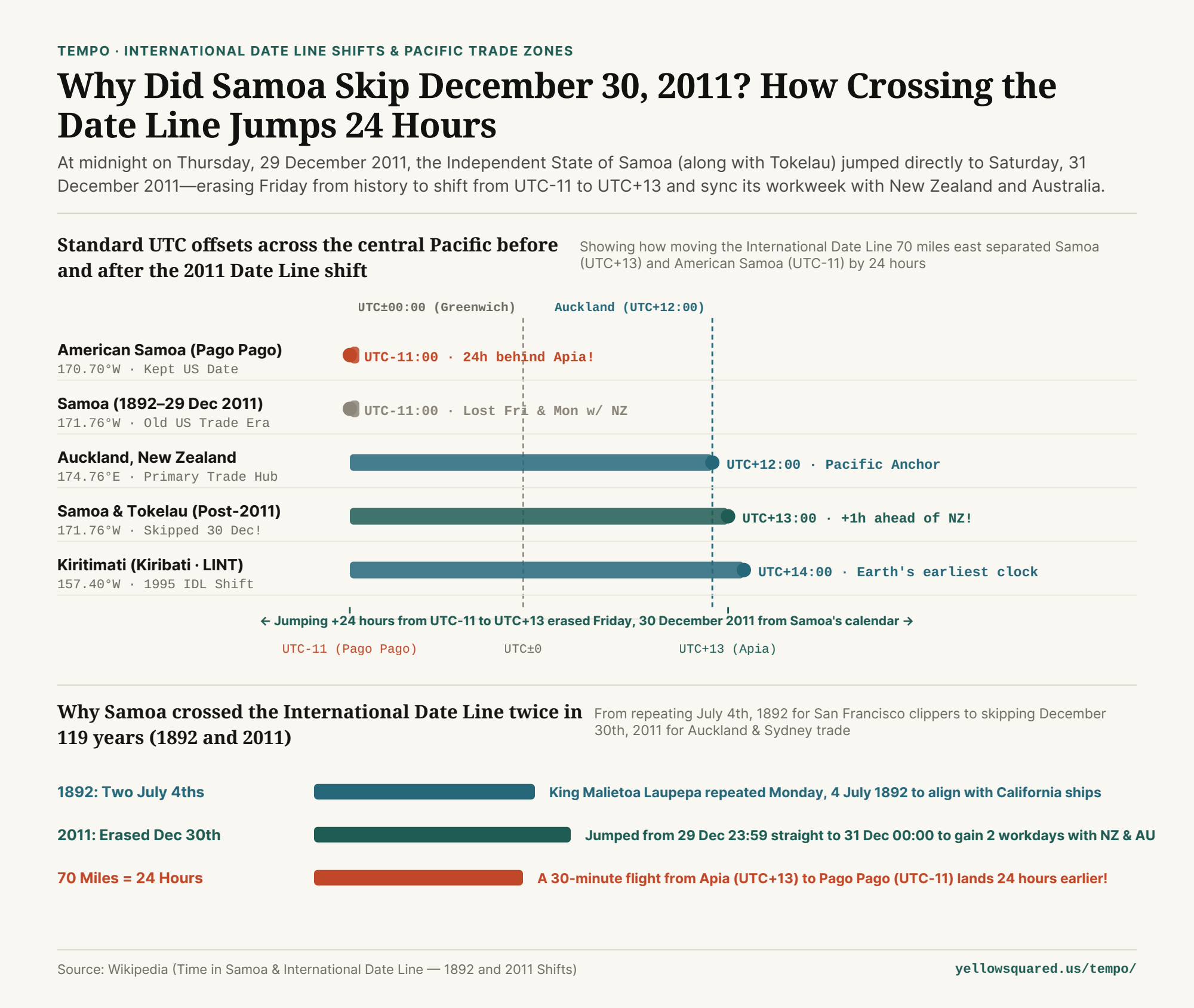
If you pull up historical hotel ledgers, bank statements, or birth certificates from Apia, Samoa in late December 2011, you will encounter a calendar riddle: Thursday, 29 December 2011 is followed immediately by Saturday, 31 December 2011. Friday, December 30th simply does not exist. Nobody forgot to wind the clock. By act of Parliament, the Independent State of Samoa—followed alongside by the New Zealand territory of Tokelau—redrew the International Date Line (IDL), leaping 24 hours forward from UTC-11:00 to UTC+13:00 (UTC+14:00 during summer DST at the time).
1. From Two July 4ths (1892) to Zero December 30ths (2011)
Wait—why was Samoa on the American side of the International Date Line in the first place? As documented in the historical records of Time in Samoa and the International Date Line, early European navigators arriving from Asia originally placed the Samoan archipelago on the western (Asian) side of the dateline. In 1892, however, American steamship and copra merchants based in San Francisco persuaded King Malietoa Laupepa to switch Samoa to the American date (`3 hours` behind California). To move backward a calendar day in 1892, Samoa celebrated Monday, 4 July 1892 twice in a row.
By the early 21st century, economic gravity had shifted completely. Samoa's dominant trading partners, supply chains, and largest expatriate communities were in New Zealand (UTC+12:00 / UTC+13:00) and Australia (UTC+10:00 / UTC+11:00). Sitting at UTC-11:00 meant Apia was 21 to 23 hours behind Auckland and Sydney: when it was Friday afternoon in Samoa, New Zealand businesses were already closed for Saturday; when Auckland opened on Monday morning, Samoa was still observing Sunday. Out of a 5-day Monday–Friday workweek, Samoa and New Zealand shared only 3 working days.
"By jumping 24 hours across the International Date Line at midnight on 29 December 2011, Samoa traded a 23-hour lag behind Auckland for a 1-hour lead—instantly gaining two full shared business days every week."
2. The 70-Mile Time-Travel Flight: Apia (UTC+13) vs. Pago Pago (UTC-11)
Because neighboring American Samoa (`Pacific/Pago_Pago`, an unincorporated U.S. territory located just 70 miles / 113 km east of Upolu) remained on the American side of the International Date Line at UTC-11:00, the 2011 shift routed the International Date Line straight through the narrow ocean channel between the two Samoas:
- Same Solar Noon, Different Calendar Day: Apia (`171.76°W`) and Pago Pago (`170.70°W`) sit just
1.06°of longitude apart—a true solar time difference of only 4 minutes and 14 seconds. Yet their wall clocks sit exactly 24 hours apart (`UTC+13:00` vs. `UTC-11:00`). - Celebrating Your Birthday Twice: You can celebrate your birthday or New Year's Eve at midnight in Apia, board a 30-minute turboprop flight east to Pago Pago, and land 23 hours and 30 minutes earlier to celebrate the exact same calendar date all over again.
- Tokelau's Simultaneous Shift: Because the New Zealand territory of Tokelau (`Pacific/Fakaofo`, `171.2°W`) relies on Apia as its primary shipping and administrative gateway, Tokelau skipped 30 December 2011 alongside Samoa, shifting from `UTC-11:00` to `UTC+13:00`.
3. Central Pacific International Date Line Comparison Table
Compare UTC offsets, Auckland time differences, and weekly shared business days across all five central Pacific jurisdictions below (available in why-did-samoa-skip-december-30-2011-international-date-line.csv):
| Pacific Jurisdiction | Reference City | Standard Offset | Gap vs Auckland (NZST) | Shared Workdays w/ NZ | Date Line History |
|---|---|---|---|---|---|
| American Samoa (US) | Pago Pago (170.70°W) | SST (UTC-11:00) | -23 hours behind | 3.0 days / week | East of IDL (US Date) |
| Samoa (1892–2011) | Apia (Pre-Shift) | UTC-11:00 | -23 hours behind | 3.0 days / week | Repeated 4 July 1892 |
| Samoa (Post-2011) | Apia (171.76°W) | WST (UTC+13:00) | +1 hour ahead! | 5.0 days / week! | Skipped 30 Dec 2011! |
| Tokelau (NZ) | Fakaofo (171.20°W) | TKT (UTC+13:00) | +1 hour ahead | 5.0 days / week | Skipped 30 Dec 2011 |
| Kiritimati (Kiribati) | London (157.40°W) | LINT (UTC+14:00) | +2 hours ahead | 5.0 days / week | Skipped 31 Dec 1994 |
4. Compare Cross-Dateline Working Windows in Tempo
Note that Samoa permanently abolished seasonal Daylight Saving Time in 2021, locking `Pacific/Apia` to `UTC+13:00` year-round—matching New Zealand Daylight Time (`NZDT, UTC+13:00`) in summer and sitting 1 hour ahead of New Zealand Standard Time (`NZST, UTC+12:00`) in winter. To coordinate calls across the International Date Line without getting tripped up by a +1 or -1 calendar-day wrap, Open Tempo in your browser.
Verified Primary Sources
- Wikipedia — Time in Samoa (1892 July 4th Duplication, 29–31 December 2011 IDL Shift & 2021 Permanent UTC+13) (Retrieved 2026-10-31).
- Wikipedia — International Date Line: Samoan Islands, Tokelau, and 1995 Kiribati Realignments (Retrieved 2026-10-31).