
Why Did Samoa Skip Friday, December 30, 2011? (And the 24-Hour Gap to American Samoa)
If you board a twin-turboprop plane in Apia, Samoa at 9:00 AM on Monday and fly 70 kilometers (43 miles) across the ocean to Pago Pago, American Samoa, your flight takes just 35 minutes. Yet when your wheels touch the runway in Pago Pago, the local time is 9:35 AM on Sunday—the day before. You can celebrate your birthday or New Year's Eve from midnight to 11:00 AM in Apia, hop a short commuter flight to Pago Pago, and celebrate the exact same calendar date all over again 24 hours later.
How did two islands of the same Samoan archipelago—sharing the same language, culture, and 171°W longitude band—end up separated by a full 24-hour calendar day (showing the exact same hour and minute on the clock, but one day apart)? The answer goes back to one of the boldest civil timekeeping resets in modern history: at the stroke of midnight on Thursday, December 29, 2011, the independent nation of Samoa (along with the New Zealand territory of Tokelau) fast-forwarded its clocks by 24 hours, completely erasing Friday, December 30, 2011 from its calendar.
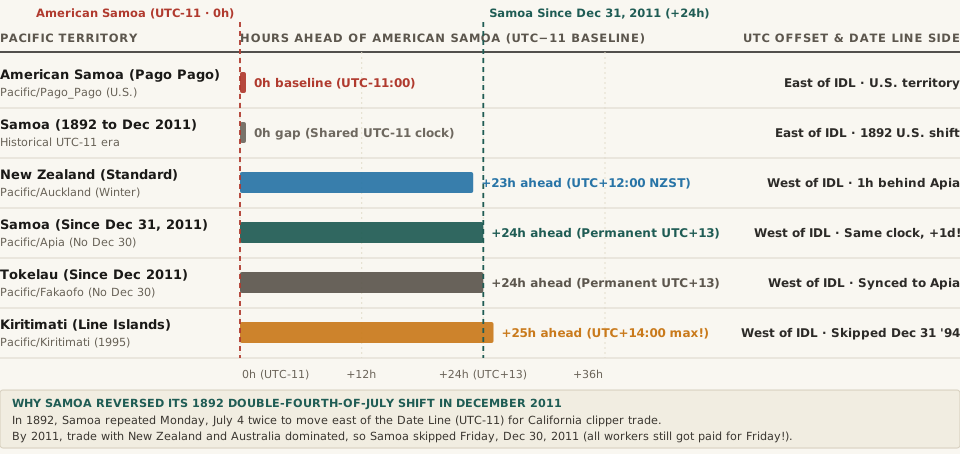
UTC−11:00 baseline) across South Pacific jurisdictions, showing how Samoa's December 2011 shift to UTC+13:00 created a 24-hour calendar gap across 70 km of ocean. Download the raw dataset: samoa-2011-dateline-jump-utc-13-vs-american-samoa-utc-11-and-kiribati-14.csv.1. Why Samoa Moved East of the Date Line in 1892: The Double Fourth of July
Geographically, the Samoan Islands sit near longitude 171°W to 172°W—about nine degrees east of the 180th meridian. Originally, early European missionaries and traders arriving from Australia and New Zealand kept Asian/Australasian dates in Samoa (west of the International Date Line).
However, in the late 19th century, San Francisco steamship lines and American merchants dominated Samoan maritime trade. To eliminate the one-day calendar mismatch with California, King Malietoa Laupepa was persuaded by U.S. traders in 1892 to move Samoa to the eastern (American) side of the International Date Line. How do you move a country backward by one calendar day? Samoa simply lived through Monday, July 4, 1892 twice in a row—giving American diplomats and traders in Apia two consecutive Fourth of July celebrations and locking Samoa onto UTC−11:00 (Samoa Standard Time) for the next 119 years.
2. The Two-Workday Penalty: Why Samoa Erased Friday, December 30, 2011
By the early 21st century, Samoa's economic gravity had shifted back across the southwest Pacific. Over 70% of Samoa's import/export trade, banking, and expatriate diaspora ties were anchored in New Zealand (UTC+12 / UTC+13 NZDT), Australia (UTC+10 / UTC+11 AEDT), and East Asia. Sitting at UTC−11:00 (23 hours behind Auckland in winter and 24 hours behind in summer) created a crippling four-workday week for Samoan businesses:
- Monday in Auckland Was Still Sunday in Apia: When New Zealand banks, shipping ports, and government ministries opened on Monday morning, Samoa was still closed for Sunday church and family rest.
- Friday in Apia Was Already Saturday in Auckland: When Samoan offices worked through Friday, businesses in New Zealand, Sydney, and Tokyo had already closed for the weekend.
To eliminate that two-day weekly dead zone, Samoan Prime Minister Tuilaepa Sailele Malielegaoi pushed through the International Date Line Act 2011. As documented in the historical record for Time in Samoa, at the end of Thursday, December 29, 2011 (23:59:59 UTC−10:00 DST), Samoa jumped straight to 00:00:00 on Saturday, December 31, 2011 (UTC+14:00 DST, UTC+13:00 standard). Friday, December 30, 2011 never happened in Samoa (or in neighboring Tokelau, which jumped on the exact same night so its administrative offices in Apia remained synchronized). Under the statute, employers were legally required to pay salaried and hourly staff a full day's wages for the non-existent Friday, while banks were barred from charging interest for December 30.
“At midnight on Thursday, December 29, 2011, clocks in Apia jumped directly to Saturday, December 31—erasing Friday, December 30 from history so Samoa could share all five weekdays with New Zealand and Australia.”
3. The 24-Hour and 25-Hour Date Line Quirks: Samoa, American Samoa & Kiribati
Because the International Date Line is set by national law rather than international treaty, two major Date Line realignments—Kiribati skipping December 31, 1994 and Samoa skipping December 30, 2011—created the world's most extreme time-zone contrasts. Here is the complete reference table:
| Pacific Territory or Time Zone Era | IANA Zone Identifier | Standard UTC Offset | Gap vs. American Samoa (UTC−11) |
Geographic Longitude | Date Line Side & Historical Milestone |
|---|---|---|---|---|---|
| American Samoa (Pago Pago) | Pacific/Pago_Pago |
UTC−11:00 | 0h (Baseline) | 170.70°W | Stayed east of IDL; last inhabited place on Earth to ring in New Year |
| Samoa Pre-2011 (1892–Dec 29, 2011) | Pacific/Apia (Historical) |
UTC−11:00 | 0h (1h in 2010–11 DST) | 171.76°W | Repeated Monday, July 4, 1892 twice to align with California trade |
| New Zealand (Auckland / Wellington) | Pacific/Auckland |
UTC+12:00 (UTC+13 DST) | +23h Winter / +24h Summer | 174.76°E | Samoa's top regional trading partner; drove the 2011 Date Line shift |
| Samoa Post-2011 (Since Dec 31, 2011) | Pacific/Apia |
UTC+13:00 (Year-round) | +24h (Same clock, +1 day!) | 171.76°W | Skipped Dec 30, 2011 to jump to UTC+13; scrapped DST in Sep 2021 |
| Tokelau (NZ Dependent Territory) | Pacific/Fakaofo |
UTC+13:00 (Year-round) | +24h Year-Round | 171.21°W | Skipped Dec 30, 2011 alongside Samoa to match Apia & Wellington |
| Kiribati Line Islands (Kiritimati) | Pacific/Kiritimati |
UTC+14:00 (Earliest Zone) | +25h (+1 day & +1 hour!) | 157.47°W | Skipped Dec 31, 1994 (UTC−10 to UTC+14) to unify Kiribati's calendar |
Why American Samoa Stayed Behind—and Why Samoa Scrapped DST in 2021
When independent Samoa leaped to UTC+13:00 in December 2011, why didn't neighboring American Samoa (just 70 km to the east) jump with it? As an unincorporated territory of the United States whose government, military, and tuna-cannery exports are tied to Honolulu (UTC−10:00) and the U.S. mainland, American Samoa stayed on UTC−11:00. Furthermore, in September 2021, independent Samoa abolished its seasonal Daylight Saving Time (UTC+14:00), locking its clocks at permanent UTC+13:00 year-round. Because +13 − (−11) = 24 hours, clocks in Apia and Pago Pago now display the exact same hour and minute 365 days a year—separated by exactly one calendar day.
And if you compare American Samoa (UTC−11:00) with Kiritimati (Christmas Island) in Kiribati's Line Islands (Pacific/Kiritimati, which sits at 157.47°W directly south of Hawaii yet uses UTC+14:00 after skipping December 31, 1994), the time difference is 25 hours—meaning two inhabited Pacific islands exist across three different calendar dates simultaneously for one hour every day (10:00 to 10:59 UTC).
Compare Date Line Jumps and Global Offsets in Tempo
Coordinating across the International Date Line—between U.S. West Coast or Hawaii teams and partners in Auckland (Pacific/Auckland), Sydney (Australia/Sydney), Apia (Pacific/Apia), or Tokyo (Asia/Tokyo)—is where off-by-one-day calendar bugs happen most often. Open Tempo in your browser to visualize exact calendar-day boundaries and multi-region meeting overlaps across both sides of the Pacific.