
Why Did the U.S. Twin Birth Rate Surge 79% and Then Fall—And How Do Parents Pair Twin Baby Names?
For thirty-four straight years between 1980 and 2014, twin strollers became a dramatically more common sight in American neighborhoods: according to U.S. Centers for Disease Control and Prevention (CDC) National Center for Health Statistics (NCHS) natality records, the U.S. twin birth rate surged by 79%—climbing from 18.9 twin babies per 1,000 live births in 1980 (68,339 infants) to an all-time national high of 33.9 per 1,000 in 2014 (135,336 infants). Then the curve reversed. Over the decade from 2014 to 2024, the national twin birth rate fell 11% to 30.1 per 1,000 (109,195 infants, a 20-year low)—driven by a remarkable 46% drop in twinning among mothers aged 40 and older.
Reader outcome: You will see the exact CDC NCHS demographic numbers behind the 1980–2014 rise and 2014–2024 decline in U.S. twin births, understand how single-embryo IVF changed multiple-birth rates, and learn the three linguistic frameworks parents use to pair 54,500 sets of twin names each year.
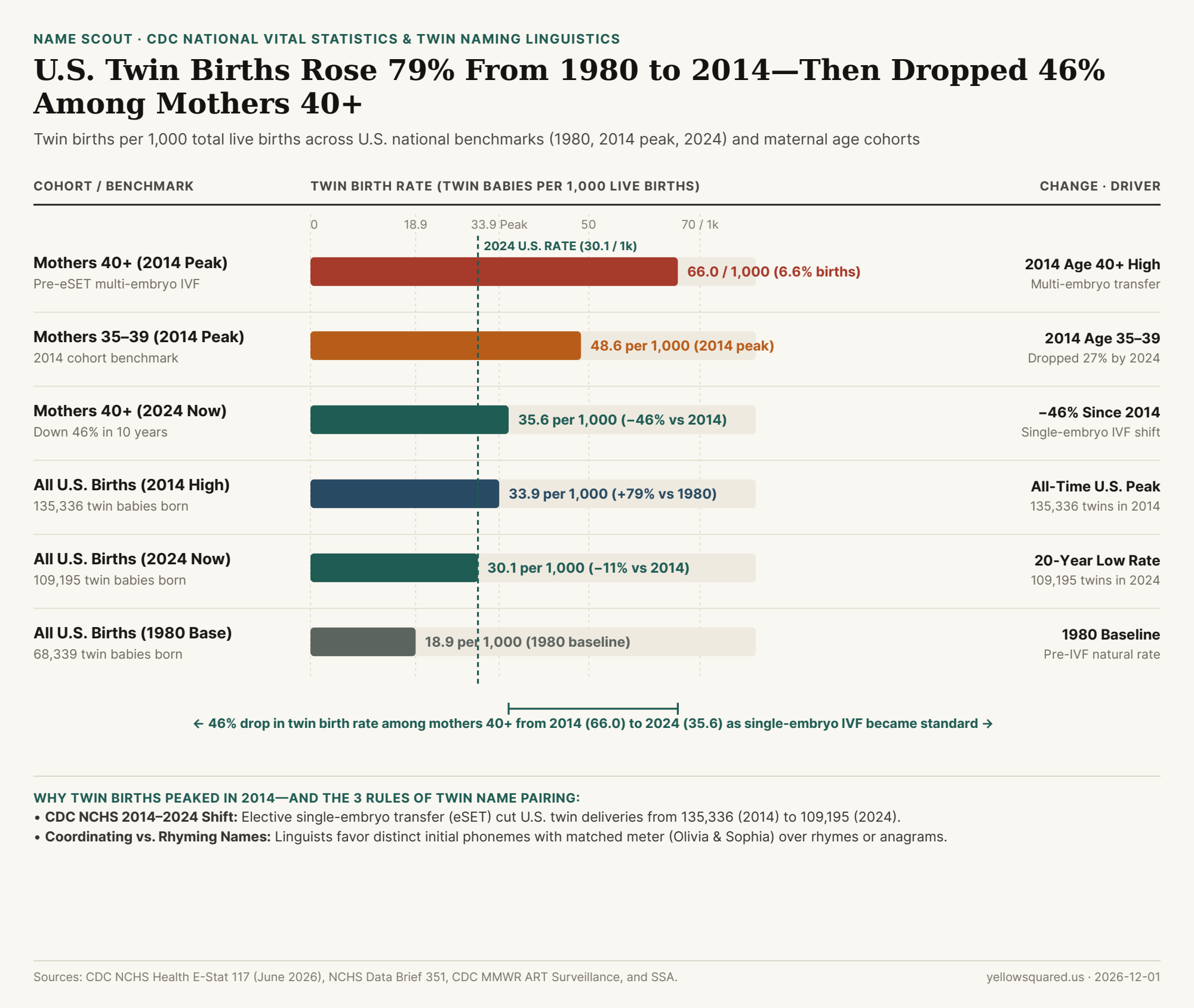
Why U.S. Twin Births Rose 79% (1980–2014) and Then Dropped 46% in Mothers 40+
Human twinning occurs through two distinct biological pathways. Monozygotic (identical) twins—when a single fertilized egg splits—occur at a nearly constant baseline rate of roughly 3.5 to 4.0 per 1,000 deliveries worldwide across all maternal ages. Dizygotic (fraternal) twins—when two separate eggs are released and fertilized in the same cycle—vary dramatically with two factors: maternal age (because follicle-stimulating hormone, or FSH, naturally rises as women enter their 30s) and assisted reproductive technology (ART / IVF).
As CDC NCHS Data Brief 351 and NCHS Health E-Stat 117 document, the 1980–2014 boom and the 2014–2024 reversal were driven by a major shift in reproductive medicine:
- The 1980–2014 Multi-Embryo Transfer Era: During the first three decades of in vitro fertilization (IVF) and ovulation-induction therapies, clinics routinely transferred 2, 3, or more embryos per cycle to maximize pregnancy odds. Combined with rising maternal age at first birth, twin deliveries more than doubled from
68,339babies in 1980 to138,961in 2007 and135,336in 2014 (`33.9 per 1,000`). In 2013, CDC MMWR ART surveillance showed that ART-conceived infants accounted for18.5%of all U.S. twins. - The 2014–2024 Elective Single-Embryo Transfer (
eSET) Revolution: As blastocyst culture and preimplantation genetic testing improved implantation rates, the American Society for Reproductive Medicine (ASRM) updated clinical guidelines to strongly recommend elective single-embryo transfer (eSET). Between 2014 and 2024, twin birth rates stayed flat for mothers under 25 (`23.0` to `22.7` per 1,000) but plummeted in every cohort where IVF is most common: down18%for ages 30–34 (`40.3` to `33.2`), down27%for ages 35–39 (`48.6` to `35.4`), and down46%for mothers aged 40 and older (`66.0` to `35.6` per 1,000).
Between 2014 and 2024, the twin birth rate for U.S. mothers aged 40 and older fell nearly in half—from 66.0 to 35.6 per 1,000 births—as single-embryo IVF replaced multi-embryo transfers.
CDC NCHS Twin Birth Rates by Cohort and the 3 Architectures of Twin Naming
Even at 30.1 per 1,000 births, roughly 109,195 twin babies (over 54,500 pairs) are named in the United States every year. Note that while CDC NCHS natality files track plurality (`twin` vs. `singleton`), the public U.S. Social Security Administration (SSA) baby name file tabulates individual SSN card applications by exact spelling (`>=5` births/year) without linking sibling pairs—so twin naming patterns are studied through state vital-statistics linkage and onomastic research:
| Cohort / Maternal Age Group | 2014 Peak Rate (per 1k) | 2024 Rate (per 1k) | 2014–2024 Change | Annual U.S. Twin Infants | Clinical & Demographic Driver |
|---|---|---|---|---|---|
| Mothers Aged 40 and Older | 66.0 / 1,000 |
35.6 / 1,000 |
−46.1% decline | Highest ART eSET shift | Transition to single-embryo IVF transfer |
| Mothers Aged 35 to 39 | 48.6 / 1,000 |
35.4 / 1,000 |
−27.2% decline | Second-largest drop | Natural FSH peak + single-embryo IVF |
| Mothers Aged 30 to 34 | 40.3 / 1,000 |
33.2 / 1,000 |
−17.6% decline | Core maternal cohort | 18% decline over 2014–2024 decade |
| Mothers Aged 20 to 24 | 23.0 / 1,000 |
22.7 / 1,000 |
−1.3% (Stable) |
Spontaneous baseline | Minimal ART usage; natural dizygotic rate |
| All U.S. Births (2014 Peak) | 33.9 / 1,000 |
— |
+79.4% vs. 1980 |
135,336 twins (2014) |
All-time U.S. national twinning record |
| All U.S. Births (2024 Current) | — |
30.1 / 1,000 |
−11.2% vs. 2014 | 109,195 twins (2024) |
Lowest U.S. twin rate in 20+ years |
How to Pair Twin Names Without Falling Into the 'Rhyming & EHR Mix-Up' Trap
When naming twins, hospital patient-safety researchers and naming specialists warn against ultra-similar rhyming, single-letter-difference, or anagram pairs (such as Taylor & Tyler, Mia & Mya, Ronald & Donald, or the reversed spelling Heaven & Nevaeh): when two children share the exact same birth date, last name, address, and first initial, electronic health records (EHRs), pharmacy labels, and school databases suffer a significantly higher rate of chart mix-ups. Instead, use three clean pairing principles:
- Give Each Twin a Distinct First Initial: Assigning different starting letters (e.g.,
CandV, orLandN) gives each child a unique monogram (`C.H.` vs. `V.H.`) and prevents automated medical and administrative record collisions. - Match Prosodic Meter or Era Instead of Rhyming Endings: Pair two names that share the same syllable weight or historical vintage without sharing identical vowel-consonant rhymes—such as two four-syllable Latinate classics (
Isabella & GabriellaorOlivia & Amelia), two two-syllable trochees (Liam & HenryorClara & Hazel), or two nature/botanical names (Willow & Sienna). - Test the 'Playground Call' Cadence: Say both names out loud in both orders (`"A and B"`, `"B and A"`): distinct stressed vowels make it effortless for each twin to recognize their own name in a noisy room. To run head-to-head partner swipes and compare 140+ years of U.S. SSA trajectories for sibling and twin pairs, Explore historical name trends in Name Scout.