
Why Did Venezuela Use a 30-Minute Time Zone (UTC−04:30)—And Why Did It Switch Back to UTC−04:00 in 2016?
Today, Venezuela observes Venezuelan Standard Time (UTC-04:00, VET) year-round, matching Bolivia, Puerto Rico, and eastern winter clocks during U.S. Daylight Saving Time. Yet if you inspect historical logs in the IANA time zone database for America/Caracas, you will find one of the most unusual back-and-forth clock experiments in modern history: for over half a century from 1912 to 1964, and again for eight and a half years from December 9, 2007 to April 30, 2016, Venezuela detached itself from every whole-hour time zone in South America to run on its own 30-minute offset at UTC-04:30.
Reader outcome: By the end of this guide, you will understand the astronomical geometry behind Venezuela's two rival meridians (67°30'W at Villa de Cura vs. 60°00'W at Punta de Playa), why President Hugo Chávez moved clocks back 30 minutes in 2007, and why a severe hydroelectric drought at the Guri Dam forced President Nicolás Maduro to advance clocks 30 minutes on May 1, 2016.
The Two Meridians of Venezuela: 67°30'W (Villa de Cura) vs. 60°00'W (Punta de Playa)
Look at a map of northern South America, and Venezuela's territory stretches almost symmetrically between 60°W longitude at its eastern Atlantic delta ( bordering Guyana) and 73°W longitude along its western border with Colombia—Sitting squarely inside the 15-degree longitudinal band between the 60°W (UTC-04:00) and 75°W (UTC-05:00) standard meridians.
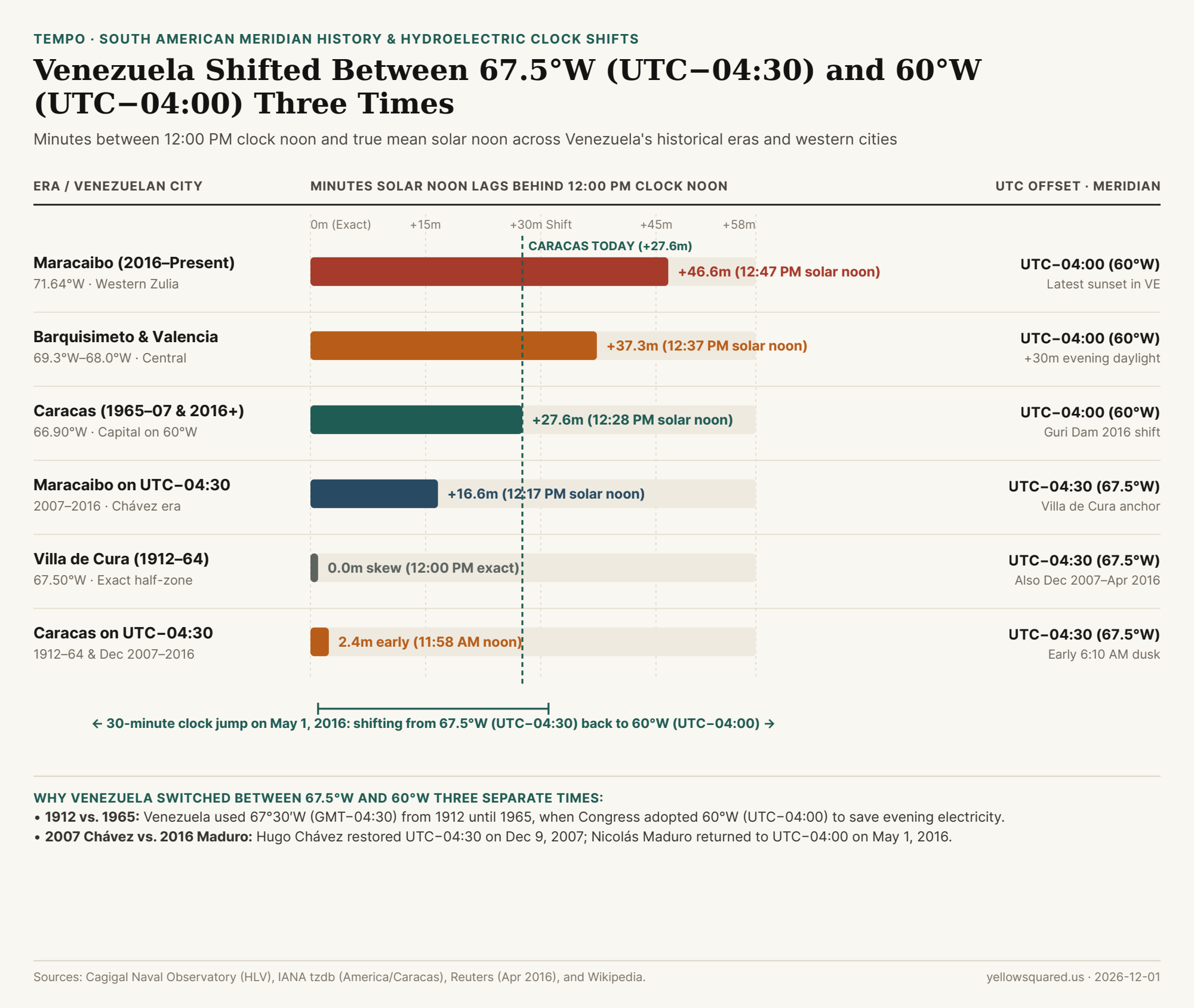
When the Venezuelan government created the Hora Legal de Venezuela (HLV, administered by the Cagigal Naval Observatory in Caracas) in 1912, astronomers chose the exact geometric midpoint between 60°W and 75°W: the 67°30'W (67.5°W) meridian passing through the central town of Villa de Cura in Aragua state. Multiplying 67.5° × 4 solar minutes per degree equals exactly 270 minutes = 4 hours and 30 minutes behind Greenwich (GMT-04:30). Because Caracas sits at 66°54'W (66.90°W), just 36 arcminutes east of Villa de Cura, GMT-04:30 placed true mean solar noon in Caracas at 11:57:36 AM—within 144 seconds of 12:00 PM!
Why did Venezuela abandon that astronomical fit in January 1965? As historical records from the Cagigal Naval Observatory document, two forces converged in the mid-1960s:
- International Integer-Hour Standardization: International aviation, maritime, and telecommunications bodies urged nations to align with whole-hour multiples of
15°longitude—specifically the60°Wmeridian passing through Punta de Playa in Venezuela's eastern Delta Amacuro state (UTC-04:00). - The La Electricidad de Caracas Grid Study: Engineers at La Electricidad de Caracas (the capital's electric utility) calculated that advancing the national clock by
+30 minutesfromGMT-04:30toUTC-04:00would still leave plenty of morning daylight near the Equator (`10.5°N` latitude) while adding 30 extra minutes of natural afternoon sunlight, cutting residential and commercial lighting demand at the 6:00 PM–7:00 PM evening peak.
Sitting at 10.5°N latitude, Caracas gets roughly 11.5 to 12.5 hours of daylight all year—so shifting between 67.5°W (UTC−04:30) and 60°W (UTC−04:00) acts like a permanent 30-minute Daylight Saving switch.
2007 vs. 2016: Why Chávez Subtracted 30 Minutes and Maduro Added It Back
After 42 years on UTC-04:00, President Hugo Chávez announced in late 2007 that Venezuela would return to the 67°30'W Villa de Cura meridian. Chávez argued that under UTC-04:00, elementary schoolchildren—especially in western states like Zulia (Maracaibo, 71.64°W, where solar noon on UTC-04:00 occurred at 12:47 PM)—were waking up and commuting to 7:00 AM classes before dawn. At 3:00 AM on December 9, 2007, Venezuela turned its clocks back 30 minutes to UTC-04:30, requiring emergency patches across operating systems, airlines, and financial terminals worldwide.
Eight and a half years later, the exact electricity physics predicted by La Electricidad de Caracas in 1965 returned with a vengeance. In early 2016, a severe El Niño drought dropped water levels at the Simón Bolívar Hydroelectric Plant (Guri Dam)—which supplied roughly two-thirds of Venezuela's electrical power—near its critical minimum turbine intake elevation. Because UTC-04:30 caused sunset in Caracas to occur around 6:10 PM in winter and 6:50 PM in summer, millions of households switched on lights, televisions, and air conditioners simultaneously while offices were still running:
| Venezuelan Era / City | Active Offset | Reference Meridian | City Longitude | Mean Solar Noon | Solar Lag vs. 12:00 PM |
|---|---|---|---|---|---|
| 1912–1964 (Villa de Cura) | GMT-04:30 |
67°30'W |
66.90°W (Caracas) |
11:58 AM HLV | -2.4 min ahead of noon |
| 1965–2007 (Punta de Playa) | UTC-04:00 |
60°00'W |
66.90°W (Caracas) |
12:28 PM VET | +27.6 min behind noon |
| Dec 2007–Apr 2016 (Chávez) | UTC-04:30 |
67°30'W |
66.90°W (Caracas) |
11:58 AM VET | -2.4 min ahead of noon |
| May 2016–Present (Caracas) | UTC-04:00 |
60°00'W |
66.90°W (Caracas) |
12:28 PM VET | +27.6 min behind noon |
| Maracaibo (Western Zulia) | UTC-04:00 |
60°00'W |
71.64°W (Maracaibo) |
12:47 PM VET | +46.6 min behind noon |
| Bogotá, Colombia (Neighbor) | UTC-05:00 |
75°00'W |
74.07°W (Bogotá) |
11:56 AM COT | -3.7 min (1 hr behind VE) |
On April 15, 2016, President Nicolás Maduro announced that Venezuela would reverse the 2007 time zone change to curb evening electricity demand. On May 1, 2016 at 02:30:00 local time, clocks across Venezuela sprang forward 30 minutes to 03:00:00 (UTC-04:00), leaving Newfoundland (America/St_Johns, UTC-03:30) as the only remaining half-hour time zone in the Americas. To compare Caracas against New York, Bogotá, Santiago, and São Paulo across seasonal DST shifts, Open Tempo in your browser.