
Why Did Classic Boys' Names Like Leslie, Ashley, and Dana Become Girls' Names—And Rarely Switch Back?
Open a 1910 U.S. census ledger or early Social Security Administration (SSA) birth register, and names like Leslie, Ashley, Dana, Beverly, Evelyn, and Lynn belong overwhelmingly to boys and men. Fast-forward to the late 20th century, and every one of those names had flipped to more than 80%–98% female—while virtually zero historically female names made the reverse journey to become boys' names. For years, popular articles treated this as an ironclad "tipping-point clock": the moment girls reach a fixed percentage of a boy's name, boys supposedly abandon it forever. Yet when sociologists tested the full century of U.S. birth data, they uncovered a much richer, more nuanced story. Comparing the foundational 2000 American Journal of Sociology paper by Harvard sociologist Stanley Lieberson, Susan Dumais, and Shyon Baumann ("The Instability of Androgynous Names: The Symbolic Maintenance of Gender Boundaries") against the 2020 computational audit of 1880–2016 SSA records by Charles Seguin and colleagues ("The Stability of Androgynous Names: Dynamics of Gendered Naming Practices in the United States 1880–2016"; ResearchGate archive) reveals both why gender shifts are strictly one-way and why most modern unisex names do not actually tip at all.
1. Why the Direction Is Strictly One-Way: Asymmetric Gender Boundaries (Lieberson et al., 2000)
In their March 2000 American Journal of Sociology study (Lieberson, Dumais & Baumann 2000), researchers analyzed every white birth recorded in the state of Illinois from 1916 through 1989 alongside national U.S. naming series to understand why the rise of gender equality had not produced a genderless pool of first names. They identified a striking sociological asymmetry:
- Asymmetric Symbolic Contamination: First names are the primary linguistic marker of gender in English. Because traditional social hierarchies penalized boys for carrying feminine-coded markers far more harshly than they penalized girls for carrying masculine-coded or surname markers, parents of daughters felt free to borrow prestige male names or surnames (such as Ashley, Leslie, Dana, or Taylor), whereas parents of sons almost never selected established girls' names.
- The Schelling Segregation Analogy & Proposed Thresholds: Borrowing economist Thomas Schelling's famous neighborhood tipping model, Lieberson et al. (2000) argued that androgynous names are inherently unstable. As summarized in Seguin et al.'s review of the model, Instability suggested that once an androgynous name crosses either
0.2%of the population in a given year (illustrated with Casey, Dana, Angel, and Sean) or a numerical threshold of over100children born for one sex (illustrated with Corey, Kelly, Robin, and Taylor), a bandwagon feedback loop takes over and locks the name into a single gender.
"At some point, one gender reaches a certain level of usage that then becomes a barrier to expansion by the other group, the latter then declines, and an androgynous name (in terms of its early usage) progressively becomes a name that is favored for only one sex."
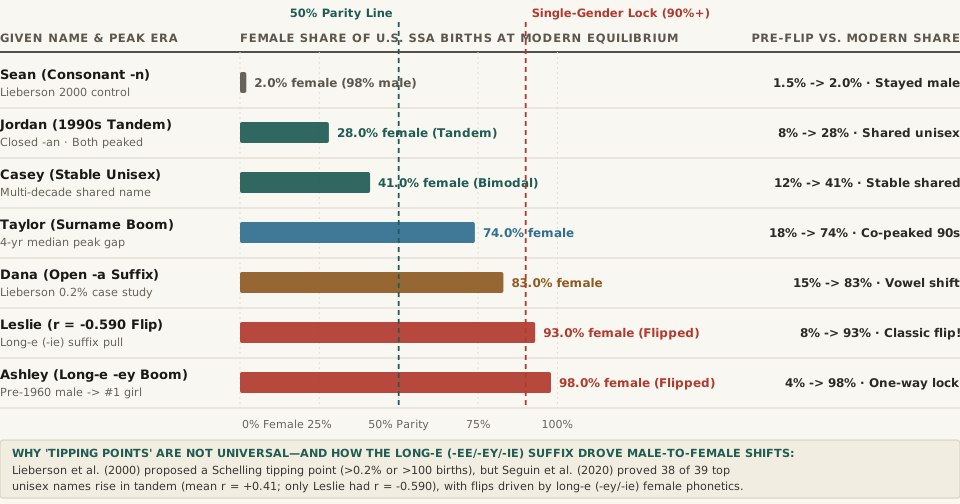
2. Testing the Tipping-Point Myth Against 136 Years of SSA Data (Seguin et al., 2020)
Does crossing 0.2% or 100 female births really function as an automatic clock that drives boys away? In 2020, sociologist Charles Seguin and colleagues tested Lieberson's contagion threshold systematically across the complete U.S. Social Security Administration dataset from 1880 through 2016 (Seguin et al., 2020). Their empirical findings overturned the idea that every unisex name is doomed to tip:
- Boys' and Girls' Usage Usually Rises and Falls in Tandem (
r = +0.41): If rising popularity among girls drove boys away, the year-to-year correlation between male and female births for androgynous names should be strongly negative. Instead, across the 39 most popular androgynous names in U.S. history, Seguin et al. found a positive mean correlation ofr = +0.41. Only one single name out of the top 39—Leslie (r = -0.590)—exhibited the negative correlation predicted by pure contagion flight! - Simultaneous Popularity Peaks (4-Year Median Gap,
r = 0.89): Rather than girls peaking decades after driving boys out, the year of peak popularity for boys and the year of peak popularity for girls carrying the same androgynous name are separated by a median of just 4 years, with a cross-gender peak-year correlation ofr = 0.89(seen in names like Jordan, Casey, Riley, and Taylor). - The Real Culprit Behind Leslie and Ashley: The Long-E (
-ee/-ey/-ie) Phonological Shift: Why, then, did Leslie, Ashley, Kelly, and Beverly flip so completely from male to female in the mid-20th century? As Seguin et al. (2020) demonstrate, the shift was driven by phonological taste rather than sheer headcount contagion: during the mid-1900s, a wave of newly coined and popularized girls' names ending in a long-e vowel sound (-y,-ie,-ey,-ee) caused American English speakers to subconsciously reclassify the entire long-e suffix class as feminine. Older male names that happened to end in a long-e sound (like Leslie and Ashley) were pulled into the female phonological category, whereas consonant-ending names like Sean or Jordan were not.
3. Complete Data Table: Classic Gender-Shift Names vs. Stable Androgynous Names
The reproducible table below—matching the companion CSV (androgynous-baby-name-gender-shifts-lieberson-2000-seguin-2020-ssa-benchmarks.csv)—contrasts the phonetic structure, historical trajectory, and empirical correlation metrics across seven benchmark names from Lieberson et al. (2000) and Seguin et al. (2020):
| Given Name | Phonetic Ending | Early 1900s Female Share | Modern Female Share | Cross-Sex Correlation (Seguin 2020) | Primary Demographic & Phonological Mechanism |
|---|---|---|---|---|---|
| Sean | Closed consonant (-n) |
~1.5% |
~2.0% |
Stable male control | Lieberson 0.2% test case; closed consonant suffix resisted female shift |
| Jordan | Closed consonant (-an) |
~8.0% |
~28.0% |
Tandem peak (r = 0.89 group) |
Rose and peaked simultaneously for boys and girls in the 1990s |
| Casey | Two-syllable long-e (-ey) |
~12.0% |
~41.0% |
Positive tandem (mean r = +0.41) |
Multi-decade bimodal stability (~59% male / ~41% female) |
| Taylor | Rhotic surname (-or) |
~18.0% |
~74.0% |
4-year median male/female peak gap | 1990s occupational surname surge shared across both sexes |
| Dana | Open vowel (-a) |
~15.0% |
~83.0% |
Lieberson 0.2% tipping example |
Terminal -a vowel matched dominant English female suffix class |
| Leslie | Two-syllable long-e (-ie) |
~8.0% |
~93.0% |
r = -0.590 (Only negative in top 39!) |
Archetypal male-to-female replacement driven by long-e suffix shift |
| Ashley | Two-syllable long-e (-ey) |
~4.0% |
~98.0% |
Complete post-1970 gender lock | Flipped from >95% male pre-1960 to #1 U.S. girls' name in the 1980s |
4. Three Critical U.S. Social Security Administration (SSA) Data Caveats
When interpreting historical gender ratios in U.S. baby name charts, always account for three structural artifacts in the underlying SSA dataset:
- Exact Spelling Separation (Phonetic vs. Orthographic Splits): The SSA tabulates every spelling as a completely separate name. As noted in demographic analyses of U.S. androgynous names, parents frequently gender-differentiate an androgynous sound through spelling:
Leslievs.Lesley,Charlievs.Charlee, orNoah(overwhelmingly male) vs.Noa(predominantly female, rising in tandem since ~1995). - Pre-1937 Card Applications vs. Post-1986 Birth Registration: The Social Security Act was signed in 1935, and parents were not required to obtain SSNs for young children for tax-deduction purposes until the Tax Reform Act of 1986. Early 1880–1935 gender ratios reflect adults applying for SSNs decades after birth, which over-sampled women in certain cohorts and under-sampled rural male cohorts.
- Privacy Suppression Under 5 Births (
<5): The SSA omits any name-year-sex combination with fewer than 5 occurrences (<5) nationally or per state. Rare early female usages of male names—or rare modern male usages of flipped names—are truncated at zero until they cross 5 births in a single calendar year.
To inspect male-to-female percentage curves, phonetic suffix groupings, and decade-by-decade SSA birth counts across thousands of given names, Compare name popularity curves in Name Scout.