
Why Do Cameras Shoot in 3:2 While Phones Shoot in 4:3—And Why Do 8×10 Prints Cut Off the Edges of Your Photos?
Take a family portrait or landscape on a full-frame or APS-C mirrorless camera, upload the raw JPEG to a print lab to order a classic 8×10-inch framed print—or drop it into a vertical 4:5 (1080×1350) social post—and the crop preview immediately chops off 16.7% of your composition along the long edges. Take the exact same shot on an iPhone, Android phone, or medium-format GFX camera, however, and it drops into an 8×10 or 4:5 frame with barely a sliver (6.2%) trimmed away. Why do dedicated interchangeable-lens cameras shoot in a wider 3:2 (1.50:1) rectangle while smartphones, Micro Four Thirds, and digital medium-format backs shoot in a boxier 4:3 (1.33:1) rectangle—and why doesn't either one match an 8×10 frame? Surprisingly, both sensor shapes trace back to the exact same strip of 1890s 35mm motion-picture film.
Reader outcome: You will learn how Oskar Barnack rotated Thomas Edison's 18×24mm (4:3) movie frame by 90 degrees and doubled it into the 24×36mm (3:2) Leica frame in 1913, see the exact percentage of pixels lost across every print and social ratio, and learn how aspect-ratio border padding preserves 100% of your composition.
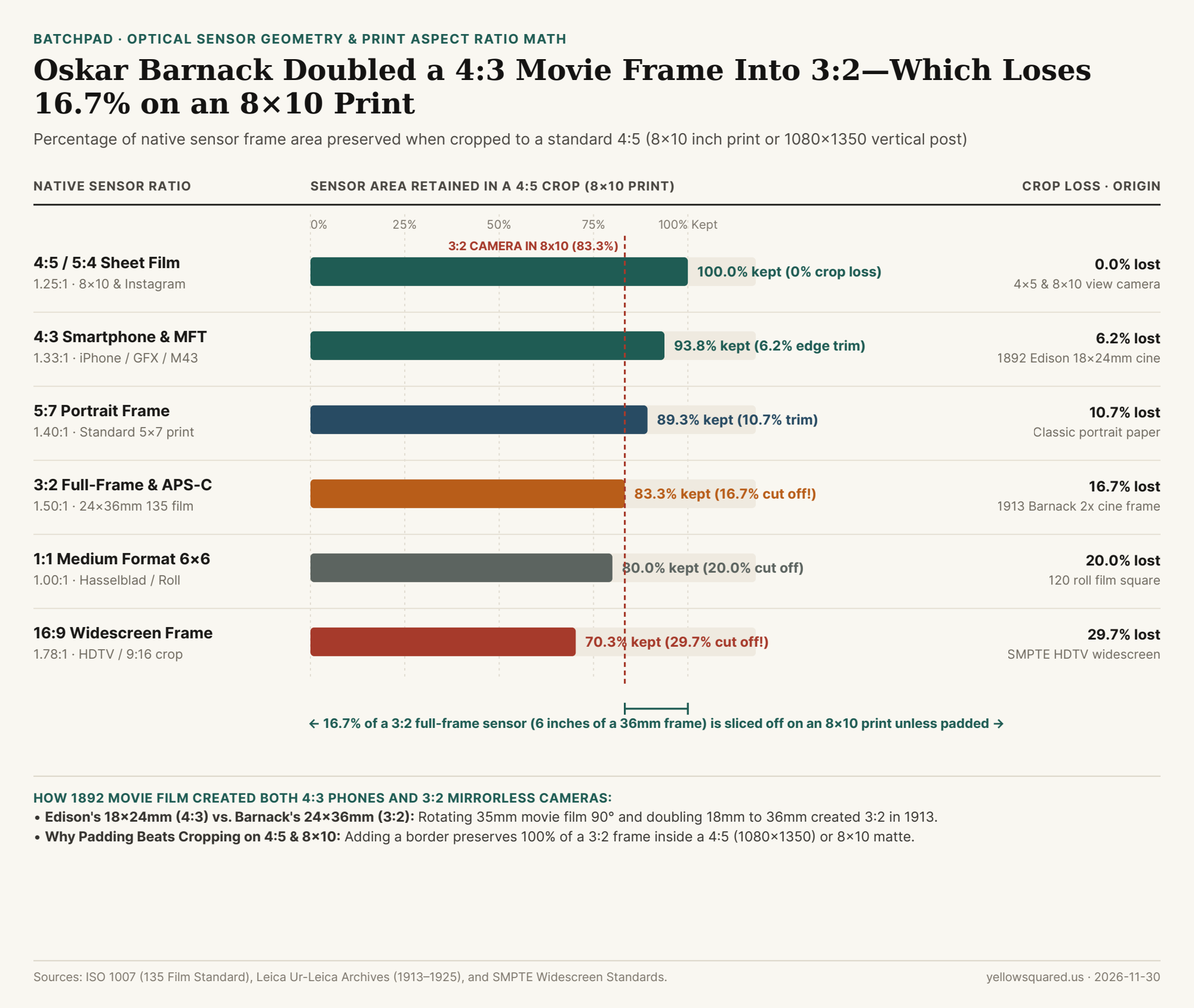
How One Strip of 35mm Cinema Film Created Both 4:3 and 3:2
In 1889–1892, William Kennedy Laurie Dickson working in Thomas Edison's laboratory slit Eastman Kodak's 70mm roll film in half to create 35mm perforated motion-picture film. Between the two rows of sprocket holes sat a usable image strip 24 mm wide. Running the film vertically through a movie camera at 4 perforations per frame yielded an image 18 mm tall by 24 mm wide:
24 mm ÷ 18 mm = 4 : 3 (1.33 : 1)
That 4:3 Edison silent-cinema ratio became the universal geometry of 20th-century visual displays: first Hollywood's Academy ratio, then analog cathode-ray tube (CRT) televisions, and then 1980s–1990s VGA/SVGA computer monitors (640×480, 1024×768). When early digital point-and-shoot cameras, the Olympus/Kodak Four Thirds standard, and camera-phone CMOS sensors were engineered in the 1990s and 2000s, chipmakers adopted 4:3 because it matched computer screens and maximized silicon area inside circular lens image circles.
Where, then, did 3:2 come from? Around 1913–1914, optical engineer Oskar Barnack at Ernst Leitz in Wetzlar, Germany built a compact still camera (the prototype Ur-Leica) to test batches of 35mm cinema stock. A single 18×24 mm movie frame was too small and grainy for high-quality still enlargements. So Barnack turned the 35mm film strip sideways (horizontally)—making the 24 mm inter-sprocket width the height of the still frame—and doubled the 18 mm cinema height to 36 mm (advancing 8 perforations per shot instead of 4):
36 mm ÷ 24 mm = 3 : 2 (1.50 : 1)
Kodak standardized Barnack's 24×36 mm "double-frame" cinema format in 1934 as 135 film (ISO 1007), and Canon, Nikon, Sony, Leica, and Fujifilm carried that exact 3:2 geometry into modern full-frame (36×24 mm) and APS-C (~23.5×15.6 mm) digital sensors.
A 4:3 smartphone photo is the shape of a single 18×24mm Edison movie frame; a 3:2 full-frame photo is two of those 4:3 frames stitched side by side into Oskar Barnack's 24×36mm Leica rectangle.
The Print & Social Crop Mismatch: 3:2 vs. 4:3 vs. 4:5 (8×10)
Why do standard picture frames at retail stores come in 4×6, 5×7, and 8×10 (or 16×20)—three completely different aspect ratios? Because 8×10 and 4×5 (both 4:5 / 1.25:1) come from 19th-century large-format glass plates and sheet film, whereas 4×6 (2:3 / 1.50:1) was created in the late 20th century specifically to print 35mm 135 film without cropping. Here is how much of your sensor you lose when converting between formats without padding:
| Format / Aspect Ratio | Decimal Ratio | Historical Hardware Origin | Area Kept in 8×10 (4:5) | Area Kept in 4×6 (3:2) | Primary Modern Ecosystems |
|---|---|---|---|---|---|
| 1:1 Square Format | 1.00 : 1 |
6×6 cm 120 roll film (Rolleiflex / Hasselblad) | 80.0% (-20.0% crop) |
66.7% (-33.3% crop) |
Medium format 6×6 & square grids |
| 4:5 / 5:4 Large Format | 1.25 : 1 |
4×5 in and 8×10 in sheet film cameras | 100.0% (0% crop) | 83.3% (-16.7% crop) |
8×10 / 16×20 prints & 1080×1350 social |
| 4:3 Smartphone & MFT | 1.33 : 1 |
1892 Edison 18×24mm 4-perf 35mm cine | 93.8% (-6.2% crop) | 88.9% (-11.1% crop) |
iPhone/Android, Micro 4/3, Fujifilm GFX |
| 5:7 Portrait Standard | 1.40 : 1 |
Half-plate sheet film & portrait frames | 89.3% (-10.7% crop) |
93.3% (-6.7% crop) |
5×7 in desk frames & A-series paper |
| 3:2 Full-Frame & APS-C | 1.50 : 1 |
1913 Oskar Barnack 24×36mm Leica (8-perf) | 83.3% (-16.7% crop) | 100.0% (0% crop) | 35mm film, Full-Frame & APS-C cameras |
| 16:9 Widescreen Video | 1.78 : 1 |
1980s SMPTE HDTV geometric compromise | 70.3% (-29.7% crop) |
84.4% (-15.6% crop) |
4K/1080p video, YouTube, 9:16 Reels |
How to Print 3:2 Photos on 8×10 Paper or Post to 4:5 Feeds Without Cropping
When you shoot tightly framed architecture, group portraits, or wide landscapes on a 3:2 full-frame camera, losing 16.7% of the frame (2 full inches of width on an 8×12 image squeezed into an 8×10 frame) amputates hands, feet, or horizon lines. You have two clean solutions:
- Leave a 10% "4:5 Safe Zone" in the Viewfinder: Many mirrorless bodies let you display
4:5or1:1frame lines over the3:2raw viewfinder so you keep key subjects inside the inner83.3%box while still recording the full raw sensor. - Use Aspect-Ratio Matte Padding Instead of Destructive Cropping: Instead of slicing 16.7% off a
3:2image to force-fill a4:5(1080×1350) social canvas or an8×10print frame, place the uncropped3:2(or4:3) photo inside a4:5padded matte border. Adding a clean gallery border preserves 100% of your original lens geometry while giving mixed horizontal (3:2) and vertical (2:3/3:4) series a uniform outer frame. To batch-pad, frame, and export mixed-ratio photo sets into consistent4:5,1:1, or9:16layouts offline, Format and export multi-photo grids in BatchPad.