
Why Do Carrots Get Rubbery in the Fridge? How to Keep Them Crisp
Why Do Carrots Get Rubbery in the Fridge? How to Keep Them Crisp
Carrots lack a waxy cuticle skin and lose moisture 10 times faster than apples or potatoes; removing leafy green tops immediately and storing roots in a sealed container or water bath at 33°F–38°F prevents turgor loss for 4 weeks.
Bring home a fresh bunch of farmers-market carrots with lush green tops, toss them into your refrigerator crisper drawer, and within four days the roots can bend into a U-shape without snapping. Yet an apple or a bell pepper sitting in the exact same drawer stays firm for weeks. Many home cooks assume rubbery carrots have spoiled, when in fact the roots are biologically sound—they have simply suffered acute transpiration dehydration.
Understanding the anatomy of a carrot root's outer skin and how attached foliage acts as a moisture pump explains why carrots wilt so quickly—and how a 10-second prep step keeps them snapping crisp for over a month.
Cuticle Permeability and the Leafy-Top Moisture Pump
Above-ground fruits like apples, tomatoes, and bell peppers evolved in dry open air and are coated in a thick, hydrophobic waxy cuticle that locks water inside. Carrots (Daucus carota) are underground storage taproots designed to absorb water directly from damp soil. Instead of a waxy cuticle, a carrot is covered only by a thin, highly permeable periderm skin.
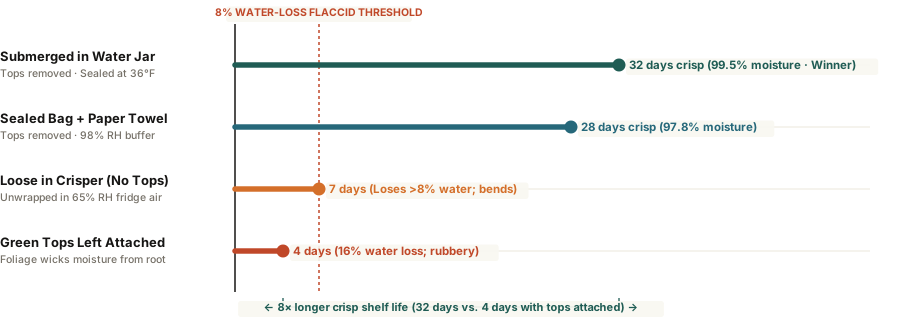
According to postharvest physiology benchmarks from the University of California, Davis, carrots require 98% to 100% relative humidity at 32°F–38°F (0°C–3°C) to prevent water vapor loss. Because a standard home refrigerator operates at just 60% to 70% relative humidity, an unwrapped carrot loses water continuously into the cold dry air. Once a carrot loses more than 8% of its fresh weight in water, internal hydrostatic pressure (turgor pressure) against the cell walls collapses, turning the crisp root flexible and rubbery.
Leaving leafy green tops attached to carrots is like leaving a lit wick in an oil lamp: the leaves continuously pump water out of the root and evaporate it into the fridge.
When carrots are sold with their feathery green tops still attached, dehydration accelerates dramatically. Leaf blades are packed with microscopic pores (stomata) designed for high-surface-area transpiration. Even after harvest, those leaves continue drawing water out of the taproot to replace moisture evaporating from the foliage, shriveling the carrot in just 4 days.
The 30-Day Crisp Protocol (and How to Revive Limp Carrots)
- Twist Off Green Tops Immediately: The moment you unpack bunched carrots, twist or trim the green stems down to a 0.5-inch nub. Save the greens separately for pesto or chimeric chimichurri.
- Lock in 98% Micro-Humidity: Place unwashed, unpeeled carrots inside a sealed zip-top bag or airtight container lined with a single dry paper towel (which buffers excess condensation that could trigger surface mold) to keep them crisp for 28 days—or submerge peeled carrots completely in a sealed jar of cold water (changing the water every 5–7 days) for 32+ days of peak crunch.
- Osmotic Rehydration for Rubbery Carrots: Because a rubbery carrot has only lost water—not cellular integrity—you can reverse the wilt. Trim 0.25 inches off the stem end and stand the carrots in a bowl of ice water for 60 to 90 minutes; osmosis refills the vacuoles and restores a crisp snap.
To check optimal humidity and ethylene-separation rules across your entire produce drawer, you can Explore storage benchmarks in Redberi to eliminate food waste before it starts.