
Why Does Frost Form on Your Car Windshield When the Air Is 36°F or 38°F?
Why Does Frost Form on Your Car Windshield When the Air Is 36°F or 38°F?
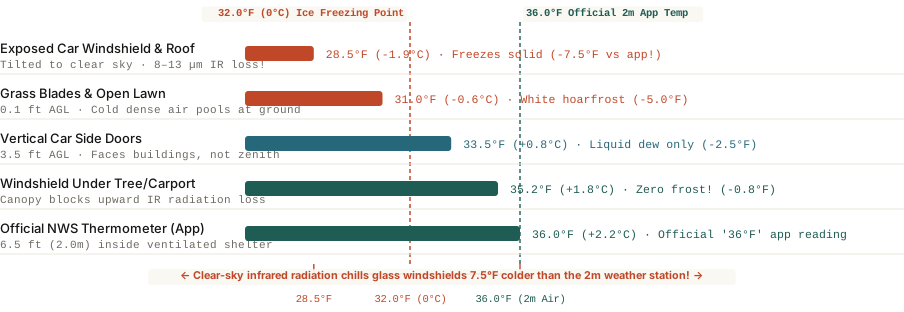
Official weather stations measure air temperature inside a sheltered box 6.5 feet (2 meters) above the ground—while your upward-tilted glass windshield radiates infrared heat (emissivity 0.94) straight into outer space on clear, calm nights and drops to 28.5°F.
Walk out to your driveway at 6:30 AM on a crisp autumn morning, glance at your phone's weather app or your car's dashboard thermometer, and it reads a safe `36°F` (`+2.2°C`)—four full degrees above the `32°F (0°C)` freezing point of water. Yet when you look at your car's windshield and roof, both are coated in a crunchy layer of white crystalline frost that requires five minutes of scraping.
How can water freeze solid onto glass when the air temperature never dropped to `32°F`? According to meteorologists at the National Weather Service (NOAA)—who routinely issue official **Frost Advisories** whenever overnight lows are forecast between **`33°F and 36°F`**—two distinct microclimate physics mechanisms cause your windshield to drop **`5°F to 8°F` colder than the weather station**.
Mechanism 1: Blackbody Infrared Radiation Through the 8–13 µm Sky Window
The primary reason your windshield freezes first has nothing to do with the air touching it—it is about **what your windshield is pointing at**. Every object above absolute zero emits thermal infrared radiation (`Stefan-Boltzmann Law`). Silica automotive glass has an exceptionally high thermal infrared emissivity of `~0.94` (behaving almost like an ideal thermal blackbody at longwave wavelengths):
- The `8–13 µm` Atmospheric Window: On a crystal-clear, cloud-free night with low humidity aloft, Earth's atmosphere is nearly transparent to infrared wavelengths between `8 and 13 micrometers`. An upward-tilted car windshield and flat metal car roof beam their heat straight out into the `-450°F` vacuum of outer space at roughly `70 to 110 Watts per square meter`.
- Why Air Cannot Warm the Glass Fast Enough: When the wind is calm (`<5 mph`), still air acts as a thermal insulator. Your glass windshield loses heat to the night sky far faster than the surrounding `36°F` air can conduct heat back into it—chilling the glass surface down to `28°F to 30°F`. Once the glass drops below both the dew point and `32°F`, water vapor in the air deposits directly onto the glass as solid ice crystals (`deposition`).
- Why Vertical Side Windows Frost Less: Notice how your tilted front and rear windshields are frozen solid while the vertical side windows are often clear? The tilted windshield faces the cold zenith of outer space, whereas vertical side doors face warm neighboring houses, fences, and trees that radiate infrared heat back at them!
Your car's thermometer measures the air; frost responds to the temperature of the glass—which is radiating heat straight into outer space.
Mechanism 2: The 6.5-Foot (2-Meter) Weather Station Inversion
The second reason your weather app reads `36°F` during a frost event is **sensor height**. By World Meteorological Organization (WMO) and NOAA standards, official weather station thermometers (`ASOS`) are mounted `2 meters` (`6.5 feet`) above the ground inside a white, louvered wooden or plastic box (`Stevenson screen`) that shields the sensor from radiating heat to the night sky.
- Shallow Nocturnal Inversion (`-4°F to -6°F` at the Ground): Because cold air is denser than warm air, on a calm night cold air sinks and pools in the lowest `4 to 12 inches` above the grass and pavement. When it is `36°F` inside a sheltered box at head height (`6.5 feet`), the open grass at ankle height is already **`30°F to 31°F`**.
- How to Prevent Windshield Frost Without a Garage: Because windshield frost is driven by upward infrared radiation to the clear zenith sky, simply **parking under the branches of a tree, beside a tall building wall, or placing a thin cloth cover over the glass** blocks the "sky-view factor" and keeps the glass within `1°F` of the `36°F` ambient air—completely frost-free.
To track overnight radiational cooling inversions, 2-meter vs. skin-temperature spreads, and local frost probabilities, you can Analyze atmospheric soundings on Eranorms for your exact station coordinates.