
Why Do Chili Peppers Burn Your Mouth, Why Does Water Make It Worse, and Why Does Milk Stop the Burn?
Bite into a fresh habanero or serrano pepper and your brain immediately registers an unmistakable emergency: your tongue feels as though it has been doused in boiling water, your face flushes, and sweat beads on your forehead. Yet if you place a thermometer on your tongue, the tissue temperature has not risen a single degree, and zero chemical blistering is taking place. In 1997, University of California, San Francisco physiologist David Julius solved this century-old sensory puzzle—work that earned him the 2021 Nobel Prize in Physiology or Medicine. As detailed in the Nobel Committee's scientific background on TRPV1 and the British Pharmacological Society's receptor review, chili peppers hijack a specific thermal ion channel on your pain nerves—and the molecular shape of capsaicin explains why gulping ice water backfires while dairy milk extinguishes the fire.
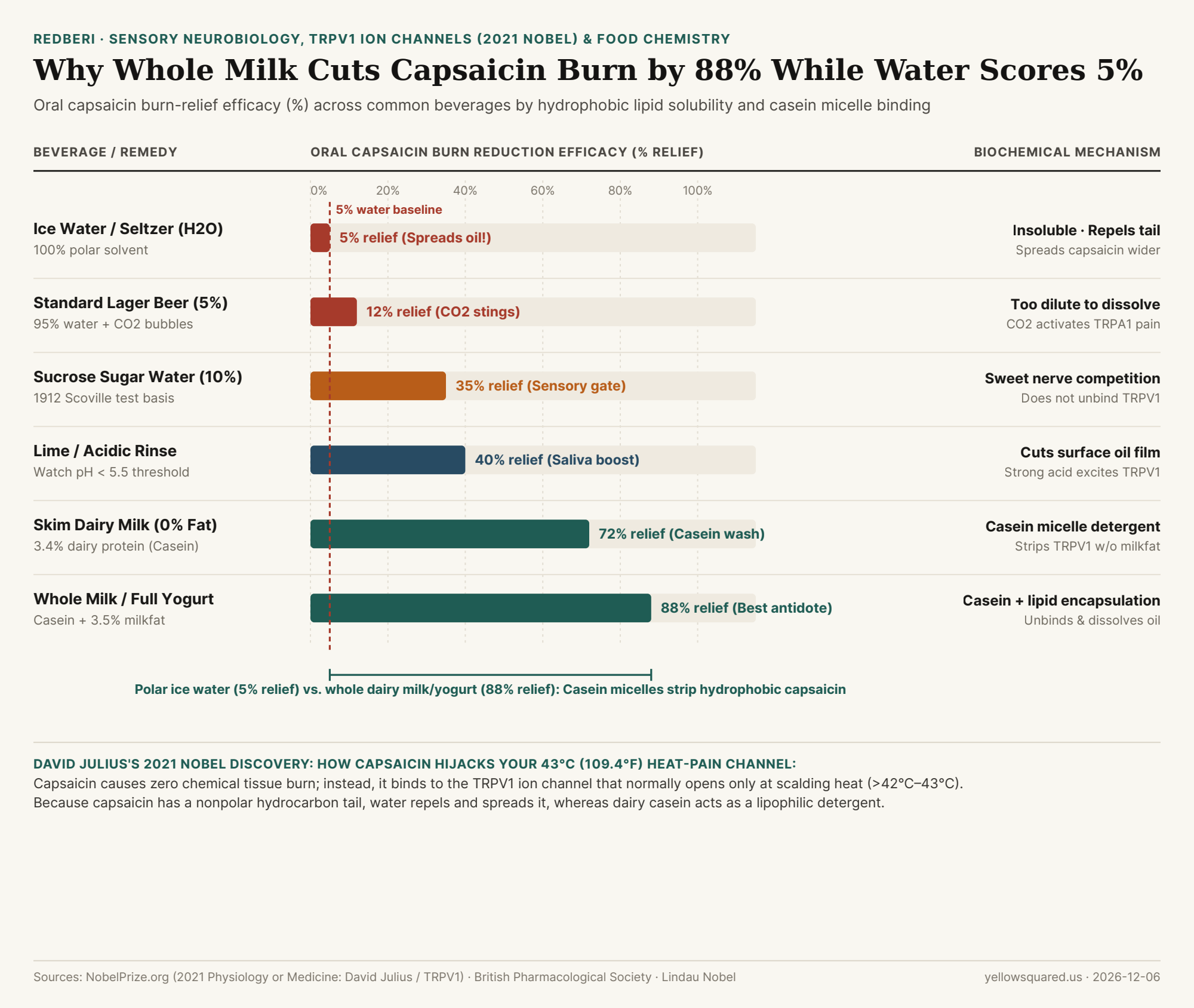
TRPV1 receptor. Data: NobelPrize.org (2021 Physiology or Medicine) and British Pharmacological Society (download CSV).How Capsaicin Hijacks Your 43°C (109.4°F) Heat-Pain Ion Channel (TRPV1)
By screening millions of DNA fragments expressed in sensory pain neurons (nociceptive C-fibers and Aδ-fibers of the trigeminal and dorsal root ganglia), David Julius and his colleagues identified the exact protein receptor that binds capsaicin (8-methyl-N-vanillyl-6-nonenamide, C18H27NO3): a transmembrane ion channel named TRPV1 (Transient Receptor Potential Vanilloid 1). When Julius tested what TRPV1 does in the absence of chili peppers, he made a breakthrough discovery (Lindau Nobel Laureate review):
- The Normal
42°C–43°C (109.4°F)Thermal Gate: In everyday life,TRPV1is your body's physical scalding-heat alarm. Below42°C, the channel stays closed; the instant a sip of hot coffee or a stove burner heats tissue above42°C to 43°C (107.6°F–109.4°F)—the exact threshold where heat begins denaturing human proteins—TRPV1pops open, flooding the nerve cell with positively charged calcium (Ca²⁺) and sodium (Na⁺) ions and firing a "burning pain" signal to the brain. - How Capsaicin Lowers the Thermostat Below Body Temperature: When capsaicin slips through the cell membrane and locks into the vanilloid binding pocket of
TRPV1, it allosterically lowers the channel's thermal activation threshold from43°Cdown below30°C (86°F). Suddenly, the normal warmth of your own mouth (37.0°C / 98.6°F) is more than hot enough to holdTRPV1wide open—causing your trigeminal nerve to scream "boiling heat!" at normal body temperature. - Why Sour Acids Can Make Spicy Food Feel Even Hotter: As documented in pharmacological studies of TRPV1, the channel is also gated by high proton concentrations (acidity at
pH 5.5 and below), which potentiates capsaicin's opening of the pore.
"Capsaicin does not burn your mouth; it lowers the activation threshold of your TRPV1 heat-pain channels from 43°C down below 30°C, so your own 37°C body warmth triggers the brain's scalding-water alarm."
Why Ice Water Scores 5% (Spreading the Oil) While Dairy Casein Scores 72%–88%
Look at the chemical structure of capsaicin (C18H27NO3) and you immediately see why reaching for a glass of water fails:
- Why Polar Water (
H2O) and Beer Fail (5%–12%Relief): Capsaicin possesses a long, nonpolar hydrophobic hydrocarbon tail—making it an oil-like lipid that is virtually insoluble in polar water. While ice water briefly activates cold-sensingTRPM8channels for 5 to 10 seconds while in your mouth, the water molecules cannot dissolve or dislodge capsaicin; instead, swishing water acts like pouring water on a grease fire, washing un-dissolved capsaicin droplets across previously untouched receptors at the back of your throat. Standard lager beer (~95% water,5% ethanol) is far too dilute in alcohol to dissolve capsaicin, and its carbonation (CO2converted to carbonic acid) stimulatesTRPA1pain channels. - How Dairy Casein Protein Acts as a Molecular Detergent (
72%–88%Relief): Cow's milk, yogurt, and kefir contain two weapons against capsaicin. First, in whole milk and full-fat yogurt (~88%burn reduction), nonpolar milkfat globules dissolve capsaicin's hydrophobic tail. Even more importantly, sensory trials show that fat-free skim milk still delivers~72%burn relief because dairy contains casein—an amphiphilic (both water- and fat-loving) phosphoprotein organized into micelles. Casein micelles act like a microscopic dish soap for your tongue, surrounding nonpolar capsaicin molecules, prying them out of theTRPV1binding pocket, and emulsifying them so they wash away cleanly.
| Beverage / Kitchen Remedy | Chemical Interaction with Capsaicin | Burn Relief (%) | Solubility Class | Effect on TRPV1 Receptor |
|---|---|---|---|---|
| Ice Water / Seltzer | Polar H2O repels nonpolar C18H27NO3 tail |
5% | Insoluble in water | Brief TRPM8 chill, then spreads oil wider |
| Standard Beer (5% ABV) | 95% water + trace ethanol + CO2 |
12% | Negligible solubility | CO2 excites TRPA1 pain channels |
| 10% Sucrose Sugar Water | Sweet taste-bud sensory competition | 35% | No dissolution | Dampens central pain signal (1912 Scoville basis) |
| Lime / Acidic Rinse | Cuts surface oil film + boosts saliva | 40% | Low solubility | Cleans skin/lips, but pH <5.5 excites TRPV1 |
| Skim Dairy Milk (0% Fat) | Amphiphilic casein protein micelles | 72% | Micellar encapsulation | Casein detergent strips capsaicin from TRPV1 |
| Whole Milk / Full Yogurt | Casein micelles + 3.5% nonpolar milkfat | 88% | Lipid + micelle soluble | Unbinds receptor, dissolves oil & cools below 37°C |
Where Capsaicin Hides Inside a Pepper (Hint: It's Not the Seeds!)
When prepping jalapeños, serranos, or habaneros in the kitchen, chefs often tell you to "scrape out the seeds to remove the heat." In plant anatomy, chili seeds produce zero capsaicin (aside from a thin surface dusting where they touch the core); nearly 90% to 95% of a chili pepper's capsaicinoids are synthesized inside the pale white pith (the placental ribs/septum) that holds the seeds. Slicing out the white pith ribs with a paring knife—and washing your hands with dish soap or rubbing oil before soap rather than plain water—keeps the fruity pepper aroma while taming the burn. Check pepper heat profiles and produce guides in Redberi when selecting fresh chilies at the market.