
Why Do Close-Up Phone Selfies Make Your Nose Look 30% Bigger, and Does Lens Focal Length or Distance Cause Distortion?
Hold your phone at arm's length (12 inches / 30 cm) to snap a front-camera selfie, and your face looks subtly wrong: your nose appears bulbous and wide, your forehead bulges forward, and your ears recede behind your cheeks. For decades, photographers casually blamed this look on "wide-angle lens distortion," claiming that a 24mm lens warps faces while an 85mm lens flatters them. In March 2018, researchers Brittany Ward, Max Ward, Stanford computer scientist Ohad Fried, and Rutgers facial plastic surgeon Boris Paskhover published a landmark mathematical proof in JAMA Facial Plastic Surgery (PubMed Central PMC5876805; full JAMA paper PDF) quantifying the exact geometry of the "Selfie Effect": a 12-inch photograph inflates perceived nasal width by 30% in males and 29% in females compared to true three-dimensional proportions—and the culprit is 100% camera-to-subject distance, not the glass inside the lens.
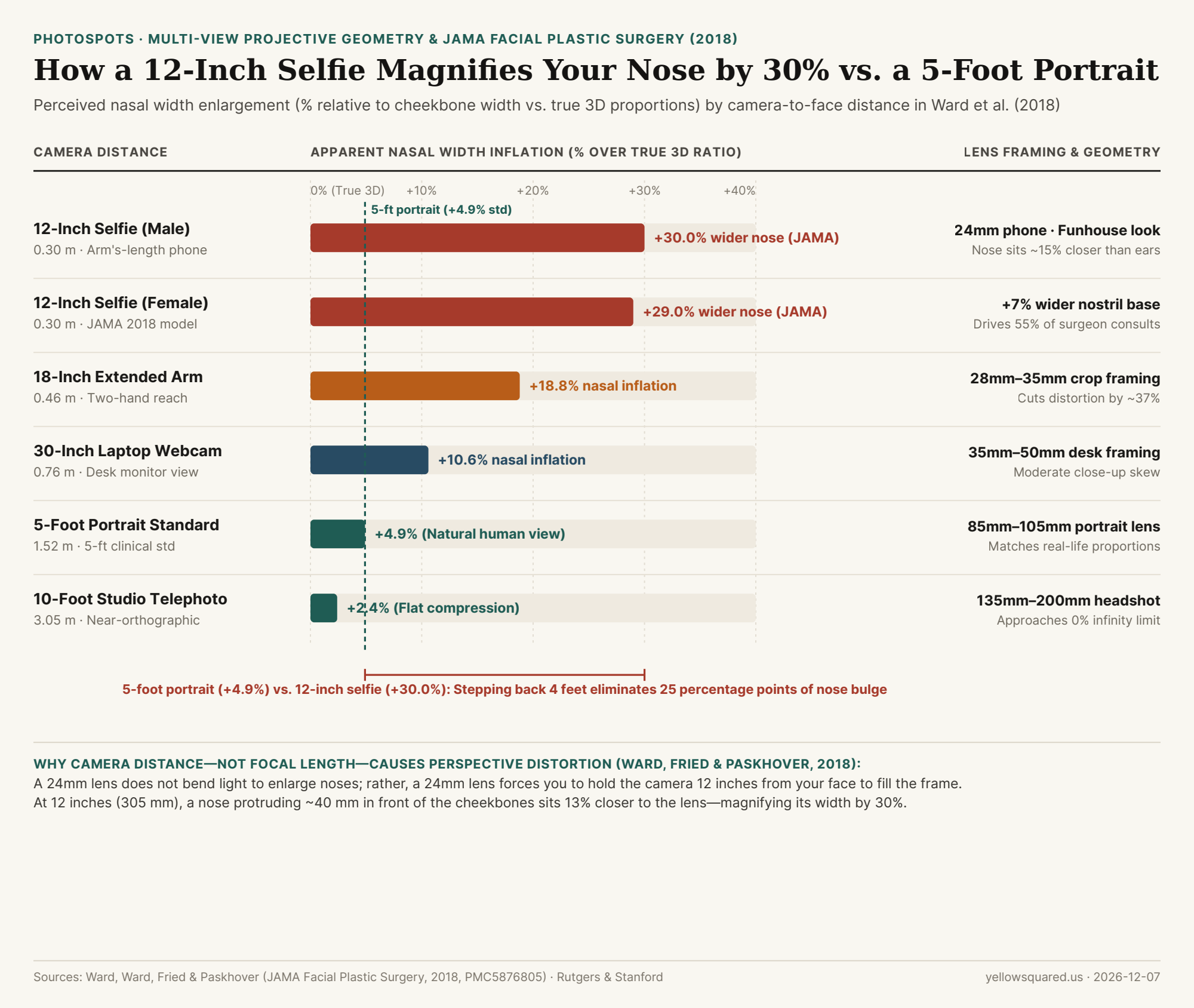
The Multiview Geometry Proof: Why 12 Inches Magnifies the Nose by 30%
Prompted by an American Academy of Facial Plastic and Reconstructive Surgeons survey showing that 42% to 55% of surgeons were seeing patients requesting rhinoplasty specifically to look better in social-media selfies (ZME Science), Paskhover and Fried modeled the human head as a set of parallel vertical planes perpendicular to the camera axis using U.S. anthropometric averages (PMC5876805):
- The Depth Gap Between Nose Tip and Cheekbones: On an average adult face, the bizygomatic plane (the widest point of the cheekbones, averaging
143.5 mmin males and135.1 mmin females) sits roughly70 to 90 mmbehind the tip and alar base of the nose (where nasal protrusion alone averages21.1 mmin males and19.8 mmin females in front of the glabella). - The Ratio of Distances (
D1 / D2) Controls Perspective Magnification: In pinhole projective geometry, the apparent size of any feature is inversely proportional to its distance from the camera's entrance pupil. When a camera is placed5 feet (60 inches / 1,524 mm)away—standard clinical and studio portrait distance—the nose is only about4.7% to 4.9%closer to the lens than the cheekbone plane, yielding a natural portrait that matches how people see you across a room. - What Happens at
12 Inches (304.8 mm): When you hold a smartphone just12 inchesfrom your face, your nose sits roughly23%closer to the camera lens than the plane of your cheekbones and ears! Keeping cheekbone width constant in the frame, the multi-view projection equationN'/B = (N · D1) / (B · D2)proves that a 12-inch selfie stretches perceived nasal width by30.0%in males and29.0%in females (and widens the intercrural nostril base by7%) compared to true orthographic proportions!
"Young adults are constantly taking selfies to post to social media and think those images are representative of how they really look... when they take a selfie they are in essence looking into a portable funhouse mirror." — Dr. Boris Paskhover, Rutgers New Jersey Medical School (ZME Science)
Debunking the Lens Myth: Why Focal Length Only Changes Framing, Not Perspective
If perspective distortion depends strictly on the distance ratio D1 / D2 between the camera and the subject's facial planes, why do photographers call 85mm and 105mm lenses "flattering portrait lenses" while warning against 24mm lenses?
- Same Distance = Identical Perspective Geometry: If you stand
5 feet (1.52 m)away from a subject, take one photo with a24mmwide-angle lens and a second photo with an85mmportrait lens from the exact same tripod spot, and then crop the center of the24mmframe to match the85mmfield of view, the nose-to-cheekbone ratio is 100% identical (+4.9%) in both photos! - Why Wide Lenses Trick You Into Stepping Too Close: The only reason a
24mmsmartphone camera distorts faces is behavioral: to fill the frame with a head-and-shoulders portrait using a wide24mmlens, you have to move the camera to within 12 to 18 inches of the face. Switching to your phone's2x (50mm)or3x–5x (77mm–120mm)telephoto camera forces you (or a friend/tripod) to step back to 4 to 6 feet—where perspective distortion vanishes!
| Camera-to-Face Distance | Metric / Imperial | Typical Framing Lens | Male Nose Inflation | Female Nose Inflation | Projective Geometry & Visual Outcome |
|---|---|---|---|---|---|
| Arm's-Length Selfie | 0.30 m (12 in) |
24mm–26mm front cam |
+30.0% | +29.0% | Severe "selfie nose" bulge; ears recede |
| Extended Arm / Grip | 0.46 m (18 in) |
26mm–28mm main cam |
+18.8% | +18.1% | 6 extra inches cuts nose distortion by ~37% |
| Laptop / Desk Webcam | 0.76 m (30 in) |
35mm–50mm equiv |
+10.6% | +10.2% | Mild close-up emphasis ("Zoom dysmorphia") |
| Standard Portrait | 1.52 m (5 ft) |
85mm–105mm portrait |
+4.9% | +4.7% | Clinical & studio standard; true-to-life face |
| Studio Telephoto | 3.05 m (10 ft) |
135mm–200mm tele |
+2.4% | +2.3% | Near-orthographic compression; flatters ears |
| Orthographic Limit | ∞ (Infinity) |
Theoretical parallel | 0.0% | 0.0% | Exact 3D anthropometric caliper ratio |
Two Instant Fixes for Flattering Phone Portraits
When taking a portrait with a smartphone, never fill the frame from 12 inches away. Either switch to the 2x or 3x telephoto lens and step back 5 feet, or—if you must use the front camera at arm's length—hold the phone at full 18-to-24-inch extension with your face occupying the center third of the frame, then crop in afterward. Cropping a wider shot taken from 3 feet away gives you the exact same flattering perspective as a telephoto lens. Save portrait and landscape camera vantage points in PhotoSpots to record the best shooting distances and focal lengths at every location.