
Why Do Cucumbers Turn Slimy and Pitted in the Fridge? (The 50°F Chilling Threshold)
Why Do Cucumbers Turn Slimy and Pitted in the Fridge? (The 50°F Chilling Threshold)
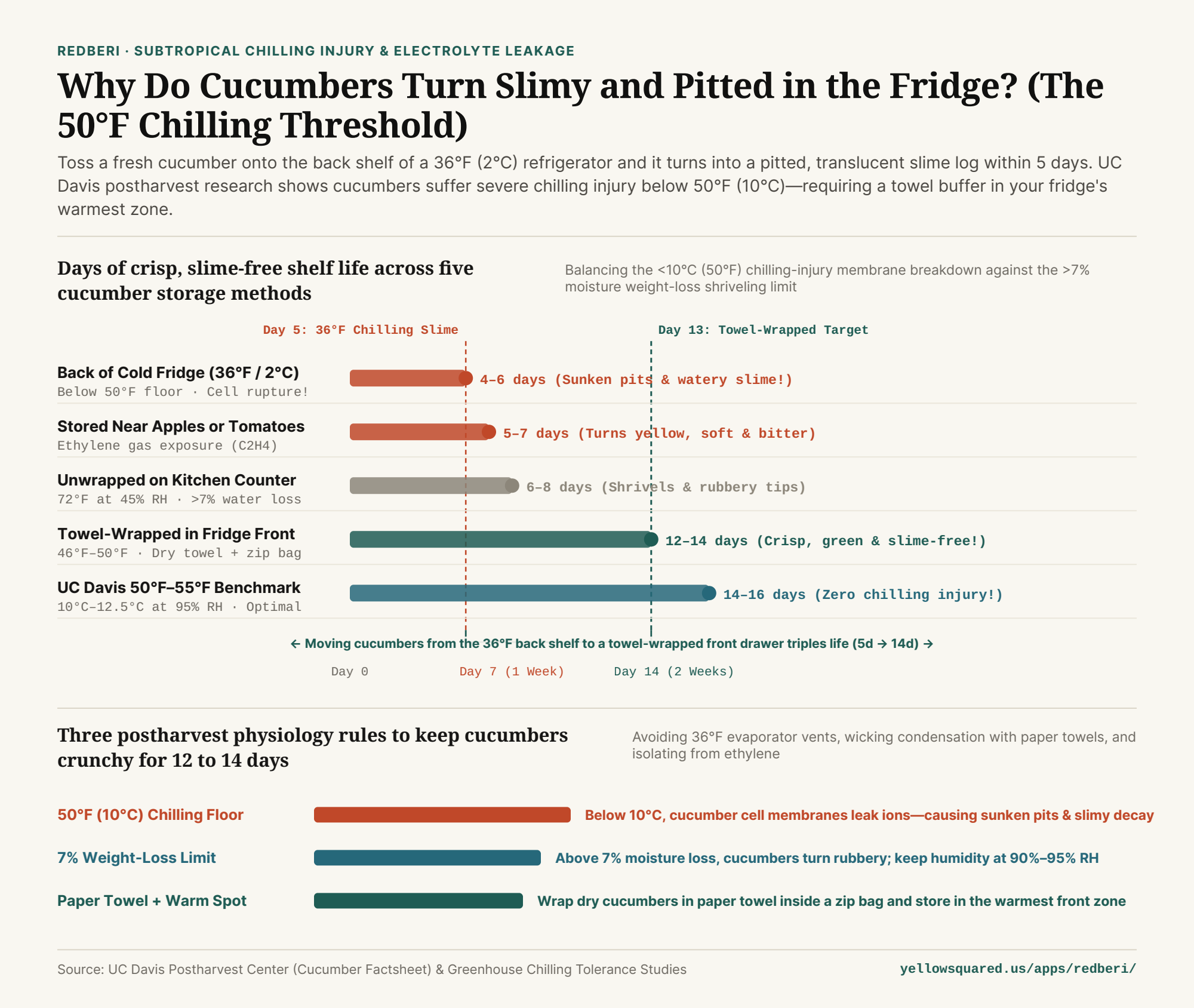
You buy three firm, glossy green cucumbers on Sunday, slide them onto the middle shelf of your refrigerator, and reach for one on Friday—only to find its skin pockmarked with sunken craters and its ends soft, translucent, and coated in slippery slime. How did a fresh vegetable rot in five days inside a cold 37°F (3°C) refrigerator? According to the UC Davis Postharvest Research and Extension Center, your refrigerator didn't fail to keep the cucumber cold enough—it kept it too cold. Cucumbers are subtropical fruits that suffer destructive chilling injury whenever temperatures drop below 50°F (10°C).
1. The Cellular Physics of Chilling Injury and Ion Leakage Below 50°F
Botanically, the cucumber (Cucumis sativus) is native to the warm foothills of the Himalayas and South Asia. Unlike cold-hardy root crops such as carrots or celery (which thrive at 32°F / 0°C), cucumber cell membranes are rich in saturated lipids that undergo a physical phase transition—stiffening from a flexible fluid into a rigid, leaky gel—whenever tissue temperatures fall below 10°C (50°F).
As demonstrated in controlled postharvest cucumber physiology trials, holding cucumbers at 2°C–5°C (36°F–41°F) triggers rapid electrolyte (ion) leakage across the mesocarp cell walls. Within 3 to 5 days, collapsed cells form microscopic sunken pits on the skin and translucent, water-soaked patches inside the flesh. Once cellular fluid leaks onto the surface, opportunistic cold-tolerant bacteria colonize the wet skin, turning the cucumber slimy.
"Cucumbers are caught in a temperature catch-22: below 50°F (10°C) their cell membranes rupture from chilling injury; at 70°F room temperature they lose 7% of their water weight and shrivel within a week."
2. How to Keep Cucumbers Crunchy for 12 to 14 Days at Home
If your kitchen counter is too warm and dry (`70°F` at `45% RH`, where cucumbers cross the 7% marketable weight-loss limit and turn rubbery in 6 to 8 days) and the back of your refrigerator is too cold (`36°F`), how do you bridge the gap? Replicate the UC Davis 50°F / 95% RH storage benchmark using thermal buffering:
- Wrap each dry cucumber in a paper towel inside a zip-top bag: Wrapping unwashed, bone-dry cucumbers in a dry paper towel and sliding them into a loosely closed zip-top bag accomplishes two things: the trapped air and towel insulate the skin against icy evaporator-fan blasts, and the paper towel wicks away any condensation droplets so surface bacteria cannot form slime.
- Store in the warmest zone of your fridge (Front Crisper or Upper Door): Never push cucumbers to the back wall of the refrigerator (where vents blow `33°F–35°F` air). Place them at the very front of the crisper drawer or on an upper refrigerator door shelf, where temperatures sit closer to `45°F–50°F (7°C–10°C)`.
- Isolate from ethylene emitters: Cucumbers are extremely sensitive to ethylene gas (
C2H4). Storing them in the same drawer as apples, bananas, melons, or ripening tomatoes triggers rapid chlorophyll breakdown—turning cucumbers yellow, limp, and bitter in days.
3. Cucumber Storage Methods & Chilling Injury Comparison Table
Compare temperature, humidity, shelf life, and primary spoilage mechanisms across all five cucumber storage methods below (available in why-do-cucumbers-get-slimy-in-the-fridge-how-to-store.csv):
| Storage Method | Temp & Humidity | Crisp Shelf Life | Primary Spoilage Disorder | Moisture / Ethylene Note | Recommended Location |
|---|---|---|---|---|---|
| Back of Cold Fridge | 36°F (2°C) Unwrapped | 4 to 6 days (Slimy!) | Severe chilling injury (<50°F) | Cell membrane ion leakage | Avoid completely |
| Near Apples / Tomatoes | Any Temp + Ethylene | 5 to 7 days (Yellow) | Chlorophyll degradation | High C2H4 sensitivity | Isolate in separate bin |
| Unwrapped on Counter | 72°F (22°C) · 45% RH | 6 to 8 days (Shrivels) | >7% moisture weight loss | Blossom end turns rubbery | Short-term (3–5 days) only |
| Towel + Bag (Warm Zone) | 45°F–50°F · ~90% RH | 12 to 14 days (Crisp!) | Towel buffers cold & moisture | Wicks surface condensation | Front crisper or door shelf |
| 50°F–55°F Wine/Cellar | 10°C–12.5°C · 95% RH | 14 to 16 days | Zero chilling injury | <3.5% weight loss in 14d | Commercial / wine-fridge ideal |
4. Check Chilling and Ethylene Compatibility in Redberi
Buying thin-skinned English (hothouse) cucumbers? Leave their tight factory polyethylene shrink-wrap on until you slice them—that film is engineered specifically to keep weight loss under 3.5% without trapping liquid water. To check which fruits and vegetables belong in the cold crisper versus the warm front zone or pantry, Explore storage benchmarks in Redberi.
Verified Primary Sources
- UC Davis Postharvest Research and Extension Center — Cucumber Produce Factsheet: 10°C–12.5°C (50°F–55°F) Optimum Storage, Chilling Injury & Ethylene Sensitivity (Retrieved 2026-11-01).
- ResearchGate / Postharvest Horticulture — Postharvest Chilling Tolerance of Cucumber (Cucumis sativus) Fruit: 7% Weight-Loss Limit & Mesocarp Ion Leakage (Retrieved 2026-11-01).