
Why Do Cucumbers Get Slimy in the Fridge? How to Store Whole and Cut Cucumbers
Why Do Cucumbers Get Slimy in the Fridge? How to Store Whole and Cut Cucumbers
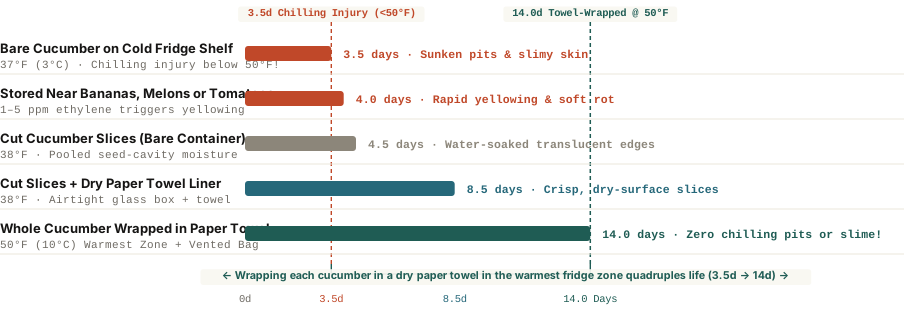
Because cucumbers are subtropical fruits whose cell membranes fracture below 50°F (10°C), storing them bare in a 37°F refrigerator causes microscopic stomata cracks, sunken pits, and bacterial slime in 3 to 4 days—unless insulated in a dry paper towel.
Toss two fresh green cucumbers into the back of your refrigerator crisper drawer on Sunday, reach for one on Thursday to make a salad, and your fingers meet a familiar kitchen disappointment: the skin is covered in tiny sunken dimples, the tip feels squishy and waterlogged, and a slick, slimy film coats the surface.
Most home cooks assume the cucumber simply "got old." According to postharvest plant physiologists at the University of California, Davis, however, your cucumber did not die of old age—it froze. Even though your refrigerator sits safely above the `32°F (0°C)` freezing point of water, standard `36°F–38°F (2.2°C–3.3°C)` refrigerator air is far below the biological temperature floor of a subtropical cucumber (`Cucumis sativus`). Understanding how sub-50°F chilling injury fractures cucumber skin—and how a simple paper-towel sleeve prevents it—lets you keep whole cucumbers snapping crisp for 14 full days.
The 50°F (10°C) Chilling Threshold: Why Stomata Crack and Leak
According to the UC Davis Postharvest Research and Extension Center, the optimum storage temperature for fresh cucumbers is `50°F to 55°F (10°C to 12.5°C)` at `95%` relative humidity. When cucumbers are held below `50°F` (such as `37°F–40°F` in a domestic fridge) for more than 2 to 3 days, their cell membranes undergo a lipid phase transition from flexible liquid-crystalline gel into rigid, leaky patches:
- Microscopic Stomata Fractures (`45–250 µm`): Scanning electron microscopy studies of cucumbers stored at `39°F (4°C)` show that within 3 to 4 days, the guard cells around the skin's microscopic breathing pores (`stomata`) collapse inward, opening `45 to 250 micrometer` micro-cracks across the epidermis.
- Pitting and Slimy Exudate: As underlying parenchyma cells collapse, sunken pits form on the skin and cellular water weeps onto the surface—creating an ideal nutrient broth for Alternaria, Pythium, and bacterial soft rot (the slippery slime you feel on day 4 or 5).
- Extreme Sensitivity to `1–5 ppm` Ethylene: UC Davis researchers also warn that cucumbers are acutely sensitive to exogenous ethylene gas: storing cucumbers in the same drawer as tomatoes, bananas, cantaloupes, or apples (`1–5 ppm` ethylene) rapidly breaks down green chlorophyll, turning cucumbers yellow and accelerating decay.
A standard 37°F refrigerator is 13 degrees colder than a cucumber's biological comfort zone; bare cold air fractures its skin in 72 hours.
The 14-Day Protocol for Whole and Sliced Cucumbers
Because leaving cucumbers on a warm `72°F` kitchen counter causes them to shrivel and yellow within 4 to 5 days, the best household strategy is to **buffer the refrigerator's cold drafts and wick away surface moisture**:
- Wrap Each Whole Cucumber in a Dry Paper Towel: Wipe any grocery-store condensation off the cucumber, roll it snugly in a dry paper towel (or clean cotton dish towel), and slide it into a loosely zipped plastic or silicone bag. The paper towel acts as both a thermal buffer against cold air blasts and a moisture wick that keeps the epidermis dry.
- Store in the Warmest Zone of Your Fridge (`42°F–48°F`): Never put cucumbers on the freezing back shelf near the cooling vent. Place them at the very front of the crisper drawer or in an upper refrigerator door bin (the warmest zone in the fridge), completely separated from tomatoes, avocados, and melons.
- Line Cut Cucumber Slices With Paper Towels (8–9 Days): For pre-sliced cucumber rounds or sticks, line the bottom and top of an airtight glass container with dry paper towels to absorb weeping seed-cavity fluid (`mesocarp exudate`), keeping slices crisp for over a week.
To check exact chilling thresholds, ethylene pairings, and crisper settings for every item in your kitchen, you can Explore storage benchmarks in Redberi when putting away your groceries.