
Why Do Cut Avocados Turn Brown So Fast?
Why Do Cut Avocados Turn Brown So Fast?
Exposed avocado flesh browns within 4 hours as polyphenol oxidase reacts with atmospheric oxygen; acidic lemon juice and airtight surface wraps delay discoloration by lowering enzymatic pH below 4.0.
Slice a ripe Hass avocado in half for lunch, set the second half in the refrigerator, and by dinner time the vibrant pale-green flesh has degraded into a muddy, dull brown skin. Few kitchen frustrations occur as rapidly or predictably as avocado discoloration. Supermarket lore abounds with home remedies—leaving the seed in the bowl, submerging slices in water, or storing onions nearby—yet avocados frequently brown regardless.
The speed at which avocados discolor is not a sign of bacterial spoilage or rotting; it is a high-speed enzymatic defense mechanism. Understanding the biochemistry of polyphenol oxidase (PPO) explains why traditional kitchen folklore fails and reveals the exact acid-and-barrier routine that keeps cut avocados bright green for up to 72 hours.
The Polyphenol Oxidase Reaction Mechanism
Within plant cells, polyphenols are sequestered inside storage vacuoles, while the enzyme polyphenol oxidase (PPO) resides separately in the cytoplasm and chloroplasts. When a knife slices through an avocado, the blade ruptures cellular membranes, bringing PPO enzymes, phenolic substrates (primarily caffeoylquinic acids and catechins), and atmospheric oxygen (>20% O2) into direct contact.
In the presence of oxygen, PPO rapidly oxidizes colorless phenols into reactive ortho-quinones. These quinones spontaneously polymerize with surrounding amino acids and proteins to form melanin—the same dark biological pigment responsible for tanning and enzymatic browning across apples and bananas.
Enzymatic browning requires three components: phenolic fuel, an active PPO enzyme, and free oxygen. Eliminating any one stops the reaction.
Debunking the Avocado Pit Myth
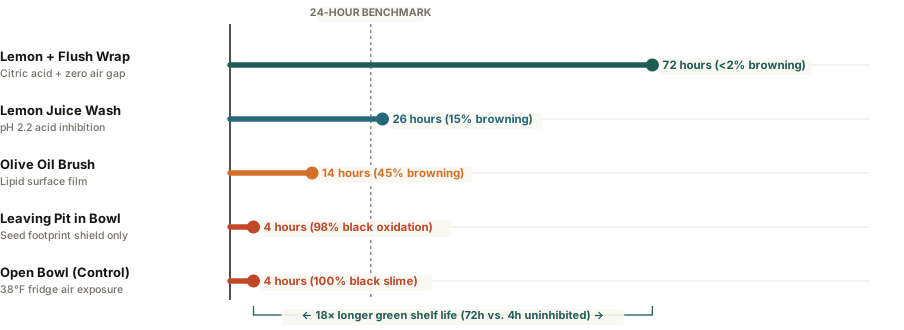
The most persistent avocado myth claims that leaving the pit (seed) in a bowl of guacamole or resting inside an unused avocado half prevents browning. In controlled culinary trials, the flesh directly underneath the pit remains green, while every square millimeter of exposed flesh surrounding it turns brown in under four hours.
The seed possesses no magical chemical shielding or antioxidant halo. It is simply an impermeable physical barrier. A golf ball, a plastic bottle cap, or a glass marble placed firmly on the guacamole achieves the exact same local preservation: it blocks atmospheric oxygen from touching the surface directly below it while leaving surrounding tissue completely exposed.
The 72-Hour Double-Barrier Solution
To preserve cut avocados or guacamole for multiple days without surface discoloration, apply a dual-action strategy targeting both enzyme kinetics and oxygen diffusion:
- Lower Surface pH Below 4.0: Avocado PPO has an optimal operating pH between 6.5 and 7.0. Brushing freshly cut flesh with fresh lemon or lime juice (citric acid, pH ~2.2) drops the surface pH below 3.5. At this acidity level, the copper-binding active sites of the PPO enzyme become reversibly denatured, cutting reaction velocity by over 85%.
- Eliminate the Oxygen Boundary Layer: Because refrigeration only slows enzyme kinetics slightly without blocking oxygen, wrap the cut fruit in plastic wrap pressed completely flush against the green flesh, smoothing out all air bubbles. For guacamole, press wrap directly onto the surface of the dip.
Combining citric acid with an airtight surface barrier extends fresh green color from 4 hours to over 72 hours in a standard 38°F refrigerator. You can Explore storage benchmarks in Redberi to compare postharvest preservation protocols across produce varieties.