
Why Do Deserts Get So Cold at Night After Reaching 100°F During the Day?
First-time campers in the Mojave, Sahara, or Atacama deserts are often shocked by how rapidly a blistering 38°C (100.4°F) afternoon collapses into shivering 10°C to 16°C (50°F–61°F)—or even sub-freezing -4°C (25°F) winter nights—within hours of sunset. While humid tropical islands and coastal cities barely cool by 2.5°C to 7.0°C (4.5°F–12.6°F) overnight, arid deserts routinely experience a Diurnal Temperature Range (DTR = T_max − T_min) of 21.5°C to 25.5°C (38.7°F to 45.9°F). As explained in atmospheric heat-transfer analyses of planetary radiative cooling, Harvard LabXchange's desert thermodynamics brief, and arid climate meteorology, this extreme swing is driven by the intersection of ground specific heat capacity and the water-vapor infrared greenhouse window.
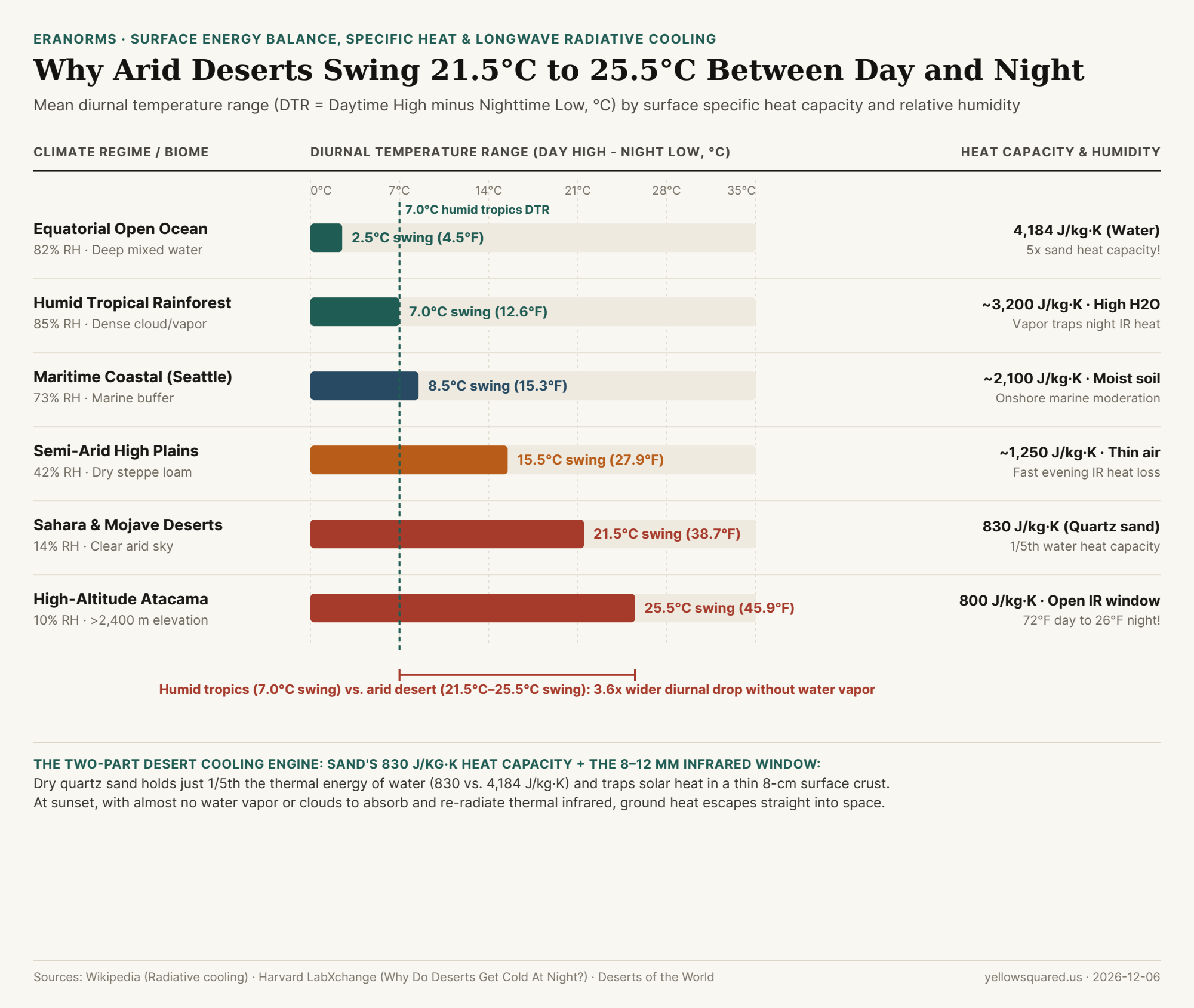
DTR, daytime high minus nighttime low in °C) alongside surface specific heat capacity (J/kg·K) and relative humidity across six global climate regimes. Data: Wikipedia (Radiative cooling), Harvard LabXchange, and Deserts of the World (download CSV).Mechanism 1: Dry Quartz Sand Holds Only One-Fifth the Thermal Energy of Water (830 vs. 4,184 J/kg·K)
People often assume that because desert sand feels scorching to bare feet at 2:00 PM, the desert floor has stockpiled a huge reservoir of heat for the night. In reality, the exact opposite is true:
- The 5-to-1 Specific Heat Ratio: Liquid water has one of the highest specific heat capacities of any common substance on Earth:
4,184 Joules per kilogram per Kelvin (J/kg·K). Dry quartz sand (SiO2) and desert rock have a specific heat capacity of roughly800 to 830 J/kg·K—meaning it takes 5 times less energy to raise 1 kilogram of dry sand by1°Cthan 1 kilogram of water, and when cooling begins at sunset, that same kilogram of sand has 80% less stored thermal energy to release before its temperature plummets. - Shallow 8-Centimeter Thermal Penetration: In an ocean or lake, solar radiation penetrates tens of meters downward and wind-driven turbulence mixes heat through a deep water column. In dry desert sand, air pockets trapped between loose quartz grains act as a thermal insulator below the surface. Solar energy cannot conduct deeply into the earth; instead, all incoming solar radiation is concentrated in a razor-thin
5 to 10 cm (2 to 4 inch)surface skin. Dig your hand six inches beneath scorching desert sand at noon and the subsurface grains feel cool; once the sun sets, that thin 8-centimeter crust exhausts its heat rapidly.
"Dry sand gets scorching hot during the day for the exact same reason it freezes at night: with a specific heat capacity of just 830 J/kg·K and zero downward mixing, all solar heating is trapped in the top few centimeters of dust and rock."
Mechanism 2: Unblocked Radiative Cooling Through the 8–12 µm Atmospheric Window
As Harvard LabXchange and radiative transfer physics emphasize, sand's low heat capacity is only half the equation—the decisive factor is what happens to the heat radiated upward after sunset:
- Water Vapor Is Earth's Primary Nighttime Blanket: By Planck's law and the Stefan-Boltzmann law (
E = εσT⁴), the warm ground continuously emits thermal longwave infrared radiation peaking at wavelengths around8 to 12 micrometers (µm). In a humid tropical forest (85% RH) or maritime city, abundant atmospheric water vapor (H2Ogas) and low clouds absorb outgoing longwave infrared and re-radiate counter-radiation (downwelling longwave flux) back toward the ground, locking nighttime temperatures within2.5°C to 8.5°Cof the daytime high. - The Clear-Sky Desert Escape Hatch: In subtropical and rain-shadow deserts where relative humidity drops to
10% to 15%and clouds are absent, the atmospheric infrared window (8–12 µm) stands wide open. Thermal infrared emitted by the hot sand shoots unimpeded into the3 Kelvin (-270°C)heat sink of outer space, dropping air temperatures by21.5°C (38.7°F)in the Sahara and Mojave, and by25.5°C (45.9°F)in high-altitude deserts like the Atacama (>2,400 m).
| Climate Regime / Biome | Mean RH (%) | Surface Specific Heat | Daytime High | Nighttime Low | Diurnal Swing (DTR) | Dominant Nighttime Heat-Transfer Process |
|---|---|---|---|---|---|---|
| Equatorial Open Ocean | 82% |
4,184 J/kg·K |
29.0°C (84.2°F) |
26.5°C (79.7°F) |
2.5°C (4.5°F) | 5x heat capacity + deep mixing + humid IR blanket |
| Humid Tropical Forest | 85% |
~3,200 J/kg·K |
31.5°C (88.7°F) |
24.5°C (76.1°F) |
7.0°C (12.6°F) | Dense column water vapor & clouds trap longwave IR |
| Maritime Coast (Seattle) | 73% |
~2,100 J/kg·K |
18.5°C (65.3°F) |
10.0°C (50.0°F) |
8.5°C (15.3°F) | Onshore marine layer moderates day/night extremes |
| Semi-Arid High Plains | 42% |
~1,250 J/kg·K |
24.0°C (75.2°F) |
8.5°C (47.3°F) |
15.5°C (27.9°F) | Lower humidity & elevation widen radiative loss |
| Sahara & Mojave Deserts | 14% |
830 J/kg·K |
38.0°C (100.4°F) |
16.5°C (61.7°F) |
21.5°C (38.7°F) | Shallow 8-cm sand crust radiates IR straight to space |
| High-Altitude Atacama | 10% |
800 J/kg·K |
22.0°C (71.6°F) |
-3.5°C (25.7°F) |
25.5°C (45.9°F) | Thin air + bone-dry sky drives daily freeze-thaw |
How to Check Daily Temperature Swings Before Packing for a Trip
Looking only at a destination's average daily high temperature hides whether you'll need a heavy down jacket after sunset: a 25°C (77°F) afternoon in Honolulu cools to a balmy 21°C (70°F) night, whereas a 25°C (77°F) spring afternoon in Joshua Tree or Calama can drop to 2°C (35°F) before sunrise. Compare daily high-low temperature swings and climate normals in Eranorms across global weather stations before you pack.