
Why Do Double Rainbows Have a Dark Sky Band Between Them and Reverse Their Colors at 51 Degrees?
Look closely at any vivid double rainbow and you will notice three striking optical features: the sky inside the inner primary bow glows noticeably brighter than the rest of the storm clouds, the outer secondary bow has its color order completely upside down (red on the inside, violet on the outside), and the 8.1-degree strip of sky sandwiched between the two bows looks dramatically darker than the sky on either side (Rainbow - Wikipedia; Chromatic dispersion, rainbows and Alexander's dark band - UNSW Physics). That dark gap is Alexander's dark band, named after the Greek philosopher Alexander of Aphrodisias who first documented it in 200 AD (Rainbow - Wikipedia).
Knowing the exact angular geometry of the 42° primary bow and 51° secondary bow around the antisolar point lets you predict exactly when a storm clearing at golden hour will produce a towering double arc—and choose the right lens focal length when you Scout golden hour and blue hour angles in PhotoSpots.
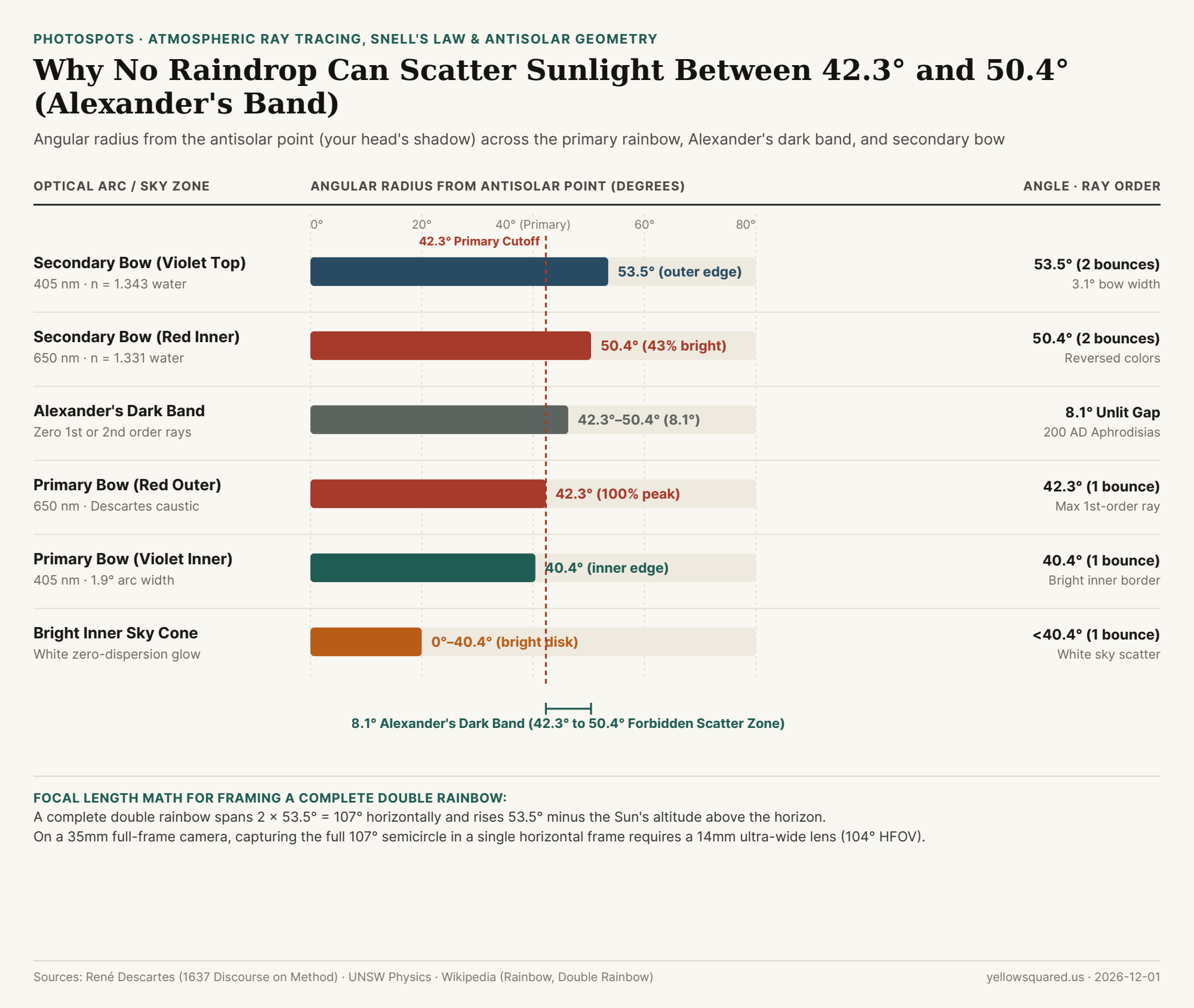
Descartes' Minimum Deviation Caustic: Why the Primary Bow Stops at 42.3°
In 1637, René Descartes traced parallel rays of sunlight entering spherical raindrops at varying impact parameters and solved the geometry of the rainbow using Snell's law of refraction (Rainbow - Wikipedia). When a ray of sunlight enters a raindrop, reflects once off the back inner wall, and refracts back out toward the observer, its total angular deviation reaches a sharp mathematical minimum—the Descartes ray (caustic):
- Red Light (650 nm, refractive index n = 1.331): Bends slightly less in water, reaching its maximum viewing angle from the antisolar point at 42.3° (a total ray deviation of
137.7°) (Rainbow - Wikipedia). - Violet Light (405 nm, refractive index n = 1.343): Bends more strongly in water, reaching its maximum viewing angle at 40.4° (a total ray deviation of
139.6°) (UNSW Physics). - Why the Sky Inside 40.4° Is Bright White: Raindrops do not scatter light only at
40.4°–42.3°; they scatter single-reflection rays at all angles from 0° up to 42.3°. Because every wavelength overlaps below40.4°, the entire inner cone of sky inside the primary rainbow is flooded with bright, unseparated white light—while zero first-order rays can exit at any angle greater than 42.3° (UNSW Physics).
Why the Secondary Rainbow Reverses Its Colors at 50.4°–53.5°
A secondary rainbow forms when sunlight enters the bottom half of a spherical raindrop and undergoes two internal reflections before exiting toward your eye (Double Rainbow - Wikipedia). That second internal bounce changes the geometry in three measurable ways:
- Minimum Deviation Exceeds 180° (Color Inversion): Two internal reflections bend the ray by more than a straight line—
230.4°for red light and233.5°for violet light. Subtracting180°gives a viewing angle of 50.4° for red (inner edge) and 53.5° for violet (outer edge), flipping the color sequence upside down (Rainbow - Wikipedia). - 3.1° Width vs. 1.9° Primary Width: The additional reflection increases angular dispersion, stretching the secondary bow to 3.1° wide—roughly
1.6×wider than the1.9°primary bow. - 43% Relative Surface Brightness: Because part of the beam escapes out the back of the raindrop on the second bounce and the remaining light spreads across a wider
3.1°band, the secondary rainbow shines at roughly 43% of the surface brightness of the primary bow.
"Alexander's dark band (42.3° to 50.4°) is an 8.1-degree optical shadow in the sky: single-reflection rays can only scatter below 42.3°, and double-reflection rays can only scatter above 50.4°."
| Optical Sky Zone / Arc | Angle from Antisolar Point | Internal Reflections | Water Index (n) | Color Order / Appearance | Relative Sky Brightness |
|---|---|---|---|---|---|
| 1. Inner Sky Cone | 0.0° to 40.4° |
1 reflection | 1.331–1.343 |
Mixed white zero-order scatter | 100% (Brightest sky cone) |
| 2. Primary Bow (Violet Inner) | 40.4° (139.6° dev) |
1 reflection | n = 1.343 (405 nm) |
Innermost violet band | High caustic concentration |
| 3. Primary Bow (Red Outer) | 42.3° (137.7° dev) |
1 reflection | n = 1.331 (650 nm) |
Outermost red band (1.9° wide) | 100% primary bow peak |
| 4. Alexander's Dark Band | 42.3° to 50.4° (8.1°) |
Zero 1st/2nd rays | Forbidden zone | Dark unlit sky gap between bows | ~35% (Darkest sky band) |
| 5. Secondary Bow (Red Inner) | 50.4° (230.4° dev) |
2 reflections | n = 1.331 (650 nm) |
Innermost red band (reversed) | 43% of primary bow |
| 6. Secondary Bow (Violet Outer) | 53.5° (233.5° dev) |
2 reflections | n = 1.343 (405 nm) |
Outermost violet band (3.1° wide) | 43% of primary bow |
Sun Altitude Rules & Lens Focal Length Math for Photographers
Because the center of every rainbow is the antisolar point—located at an angle −α below the horizon directly opposite the Sun's altitude +α—a primary rainbow disappears below flat ground whenever the Sun climbs higher than 42.3° above the horizon, while a secondary rainbow remains visible until the Sun exceeds 53.5° (Rainbow - Wikipedia). When the Sun sits right on the horizon at sunrise or sunset (α = 0°), a full double rainbow forms a towering 107-degree semicircle (2 × 53.5°). On a 35mm full-frame camera, a 24mm lens (73.7° horizontal field of view) can only capture one leg of the arch; framing the entire 84.6° primary semicircle requires at least a 16mm–18mm lens, and framing the full 107° double rainbow in a single horizontal shot requires a 14mm ultra-wide lens (104° horizontal / 114° diagonal FOV) or a multi-shot vertical panorama. To check exact solar altitude and antisolar azimuth vectors before a post-storm clearing, Scout golden hour and blue hour angles in PhotoSpots.