
Why Do If-Then Plans (Implementation Intentions) Double Your Chances of Finishing a Goal?
Every Sunday evening, millions of people form sincere, high-motivation goal intentions: "I'm going to work out three times this week," "I'll finish my tax prep this weekend," or "I'll study Spanish every night." By Friday, roughly two-thirds of those intentions have evaporated—not because the person stopped caring about the outcome, but because a vague goal intention never specifies what environmental cue will trigger the action. In 1999, New York University and University of Konstanz psychologist Peter M. Gollwitzer formalized the antidote: the implementation intention, better known as an "If-Then" plan. Across a landmark 2006 meta-analysis of 94 independent studies (N = 8,461) by Gollwitzer and Paschal Sheeran and empirical habit trials synthesized by Habi's behavioral research review and Goals & Progress, translating a goal into a single "If [Situation X], then I will [Behavior Y]" sentence doubles—and in controlled trials nearly triples—real-world follow-through.
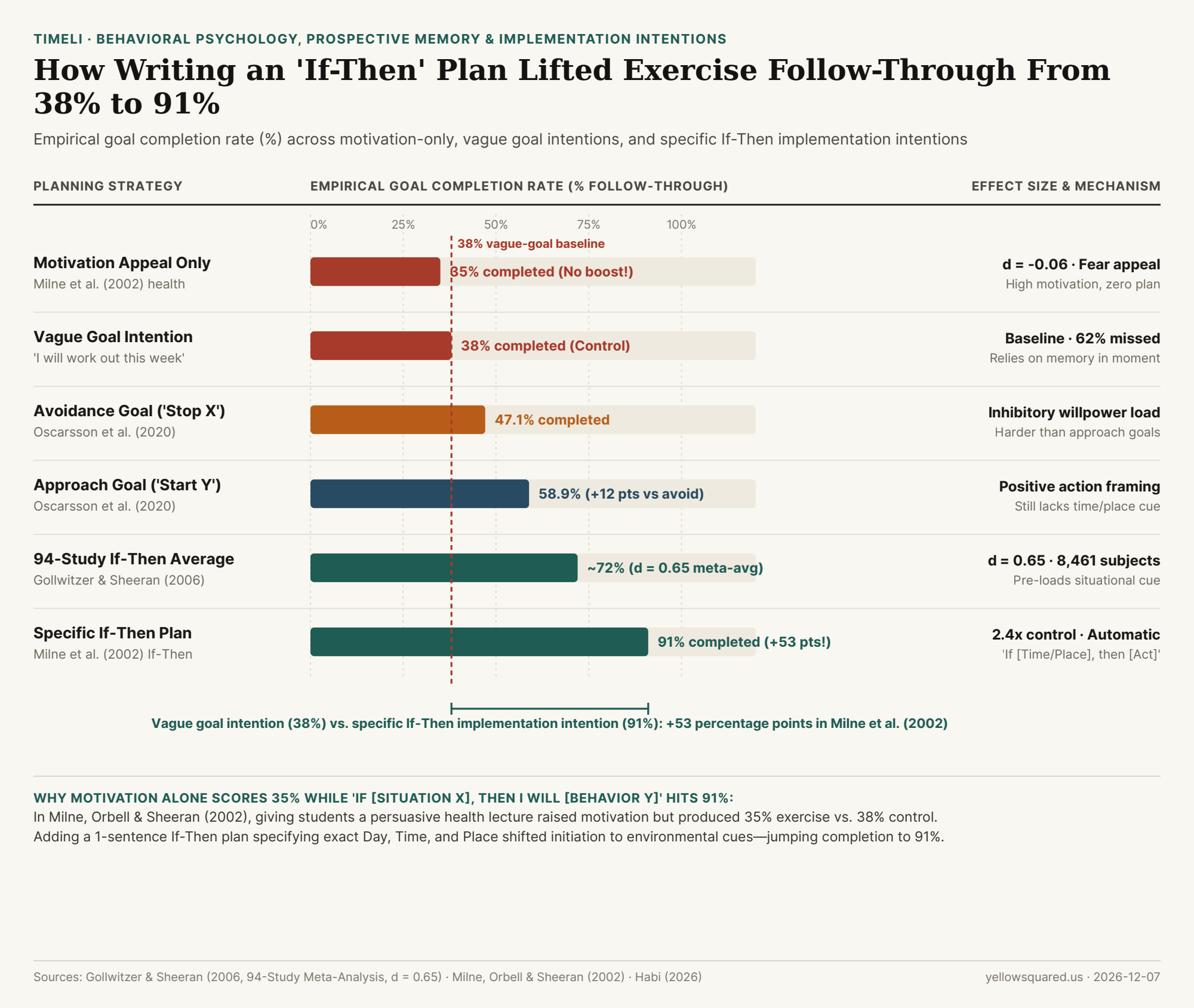
The 2002 Milne, Orbell & Sheeran Experiment: 38% vs. 35% vs. 91%
To test whether people fail at habits because they lack motivation or because they lack a trigger mechanism, psychologists Sarah Milne, Sheina Orbell, and Paschal Sheeran (2002, British Journal of Health Psychology, summarized in Habi's habit statistics benchmark) divided 248 university students into three groups and tracked who actually completed at least one 20-minute vigorous exercise session over the following week:
- Group 1 — Control Group (
38%Exercised): Participants simply tracked their baseline exercise behavior without receiving persuasive materials or writing a specific trigger plan. Only38%followed through;62%did not. - Group 2 — High-Motivation / Threat-Appeal Group (
35%Exercised): Participants read an evidence-backed medical briefing detailing how regular aerobic exercise reduces coronary heart disease risk. Post-test questionnaires confirmed that their conscious motivation and intention to exercise surged significantly—yet when the week ended, only35%actually exercised! Firing up willpower and fear of disease accomplished zero behavioral change. - Group 3 — Motivation + One-Sentence "If-Then" Implementation Intention (
91%Exercised!): Participants received the exact same health briefing, plus one extra instruction: complete the sentence, "During the next week, I will partake in at least 20 minutes of vigorous exercise on [Day or Days] at [Time of Day] at/in [Place]." Follow-through skyrocketed from35%–38%to91%—a 53-percentage-point jump from a single sentence of spatial-temporal specificity!
"In Milne, Orbell, and Sheeran's trial, raising motivation alone produced 35% follow-through (worse than the 38% control group). Adding a specific When-and-Where 'If-Then' plan drove completion to 91%."
How "If-Then" Plans Rewire Prospective Memory Across 94 Studies (d = 0.65)
Why does writing "If it is 7:30 AM on Monday after I pour my coffee, then I will open my code editor and work on Module A for 45 minutes" work so much better than "I'll work on Module A on Monday"? In their 2006 meta-analysis of 94 independent tests (Cohen's d = 0.65) and subsequent cognitive neuroscience studies, Gollwitzer and Sheeran identified two distinct neural mechanisms:
- 1. Heightened Accessibility of the Situational Cue ("If X"): When you specify a concrete external trigger—a clock time, a physical room, or the completion of an existing routine (e.g., "After I close my laptop at 5:30 PM...")—your brain holds a mental representation of that cue in a state of heightened perceptual readiness. You spot the opportunity immediately even when busy or tired, solving the #1 cause of failed goals: prospective memory failure ("forgetting to act at the right moment").
- 2. Automatized Action Initiation ("Then Y" — Zero Deliberation Gap): A vague goal forces your prefrontal cortex to negotiate with itself in the moment ("Should I work out now, or after dinner? What workout should I do?")—and during that 5-second deliberation window, fatigue and distraction win. An implementation intention pre-loads the decision ahead of time, creating an automatic associative link (
Cue X → Action Y) that initiates behavior rapidly without conscious willpower. - 3. Combining Approach Framing (
58.9%) With Coping Intentions: As Oscarsson et al. (2020) demonstrated across 1,066 participants (Habi), framing a goal as an approach behavior (58.9%success) beats an avoidance behavior (47.1%success) by nearly 12 points—and pairing your primary If-Then plan with a backup coping intention ("If my 7:00 AM slot gets interrupted by a meeting, then I will do a 20-minute session at 12:15 PM") keeps a single disruption from breaking your streak.
| Goal-Setting Strategy | Empirical Study & Sample | Completion Rate | Effect Size (d) |
Cognitive Initiation Mechanism |
|---|---|---|---|---|
| Motivation Appeal Only | Milne et al. (2002, N=248) |
35.0% | d = -0.06 (Null) |
High desire, but zero situational cue |
| Vague Goal Intention | Milne et al. (2002, N=248) |
38.0% | Baseline (0.00) |
Relies on effortful prospective memory |
| Avoidance Goal ("Stop X") | Oscarsson et al. (2020, N=1,066) |
47.1% | d = 0.24 (Small) |
Continuous inhibitory self-control load |
| Approach Goal ("Start Y") | Oscarsson et al. (2020, N=1,066) |
58.9% | d = 0.48 (Medium) |
Positive target, but lacks when/where link |
| 94-Study If-Then Meta-Avg | Gollwitzer & Sheeran (2006, N=8,461) |
~72.0% | d = 0.65 |
Pre-loaded cue detection + automatic start |
| Specific If-Then Plan | Milne et al. (2002, N=248) |
91.0% | d = 1.25 (Large) |
Exact Day + Time + Place stimulus control |
How to Turn Your Daily To-Do List Into Concrete "If-Then" Time Blocks
Instead of writing a floating checklist item like "Write quarterly review" or "Go for a run," anchor every priority to a specific When, Where, and Preceding Cue: "If it is 9:00 AM at my desk after I silence my phone, then I will draft the first section for 30 minutes." Plan daily focus blocks and specific action cues in Timeli to turn intentions into finished sessions.