
Why Do Landscape Photos Look Blurry at f/16 and f/22? How Lens Diffraction Limits Sharpness
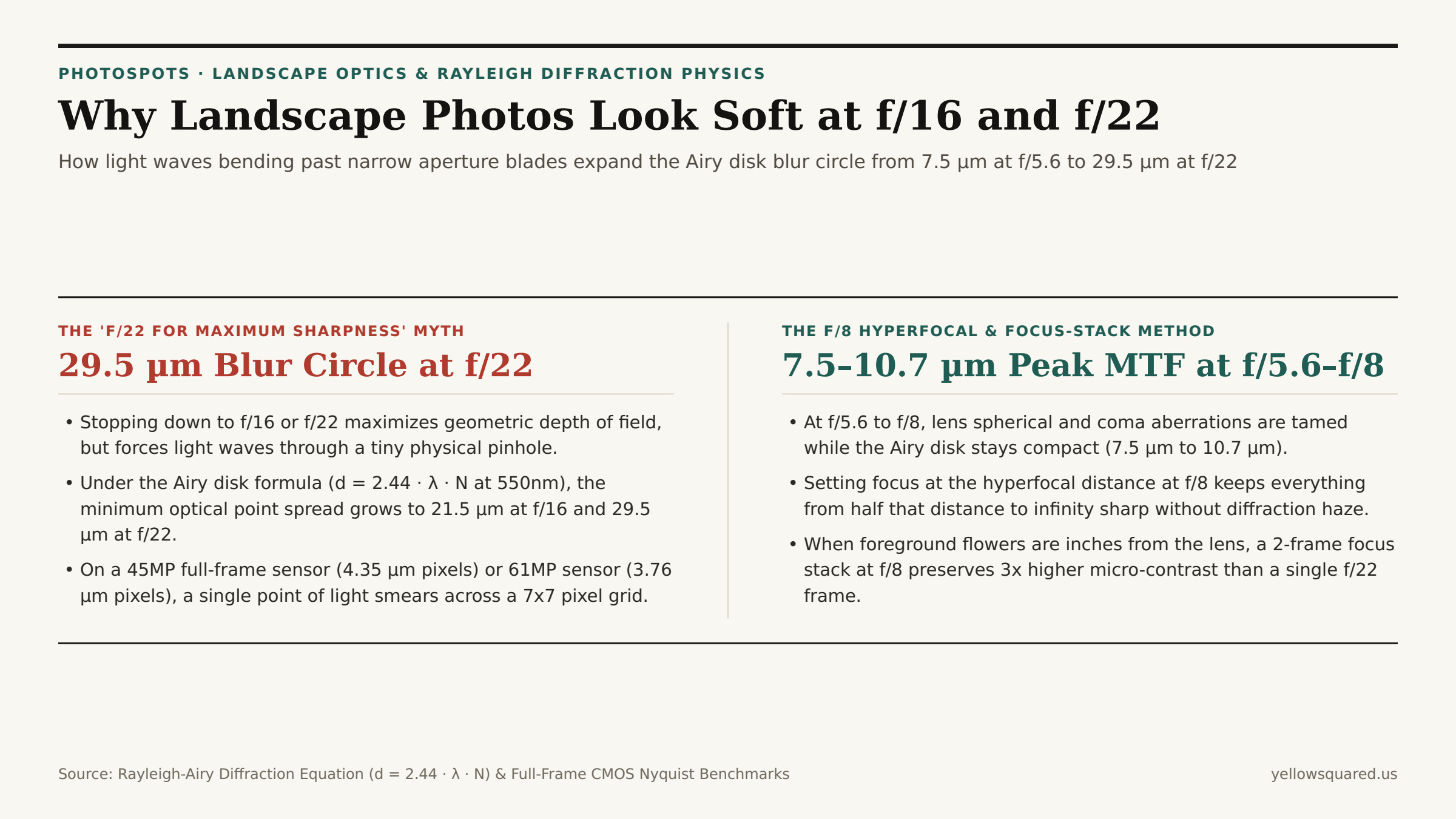
Every beginner photography guide teaches that stopping a lens down to f/16 or f/22 gives you the deepest depth of field from foreground rocks to distant mountain peaks. Yet when you inspect an f/22 landscape file at 100% on a modern 45-megapixel or 61-megapixel full-frame camera, fine pine needles, granite textures, and distant ridgelines look noticeably softer and hazier than a frame shot at f/8. The culprit is not lens glass quality or camera shake — it is an inescapable law of wave physics called optical diffraction.
When light waves pass through the circular opening of a lens aperture, the waves grazing the metal diaphragm blades bend outward and interfere with one another, projecting every pinpoint of light in your scene onto the camera sensor not as an infinitely tiny dot, but as a microscopic bullseye pattern called an Airy disk. As derived in Commonlands' Optical Physics & Spatial Resolution Analysis and Martin Bailey's Circle of Confusion and Airy Disk Reference, the physical diameter of that blur circle grows in direct linear proportion to your f-stop number (d = 2.44 * lambda * N). Before heading out for your next sunrise shoot, Plan golden-hour landscape shoots in PhotoSpots to pair optimal aperture settings with exact solar azimuth and elevation angles.
The Rayleigh-Airy Diffraction Equation vs. Modern Sensor Pixel Pitch
In wave optics, the diameter d of the central bright core of the Airy pattern (out to its first dark ring) is governed solely by the wavelength of light lambda and the lens f-number N:
d = 2.44 × λ × N
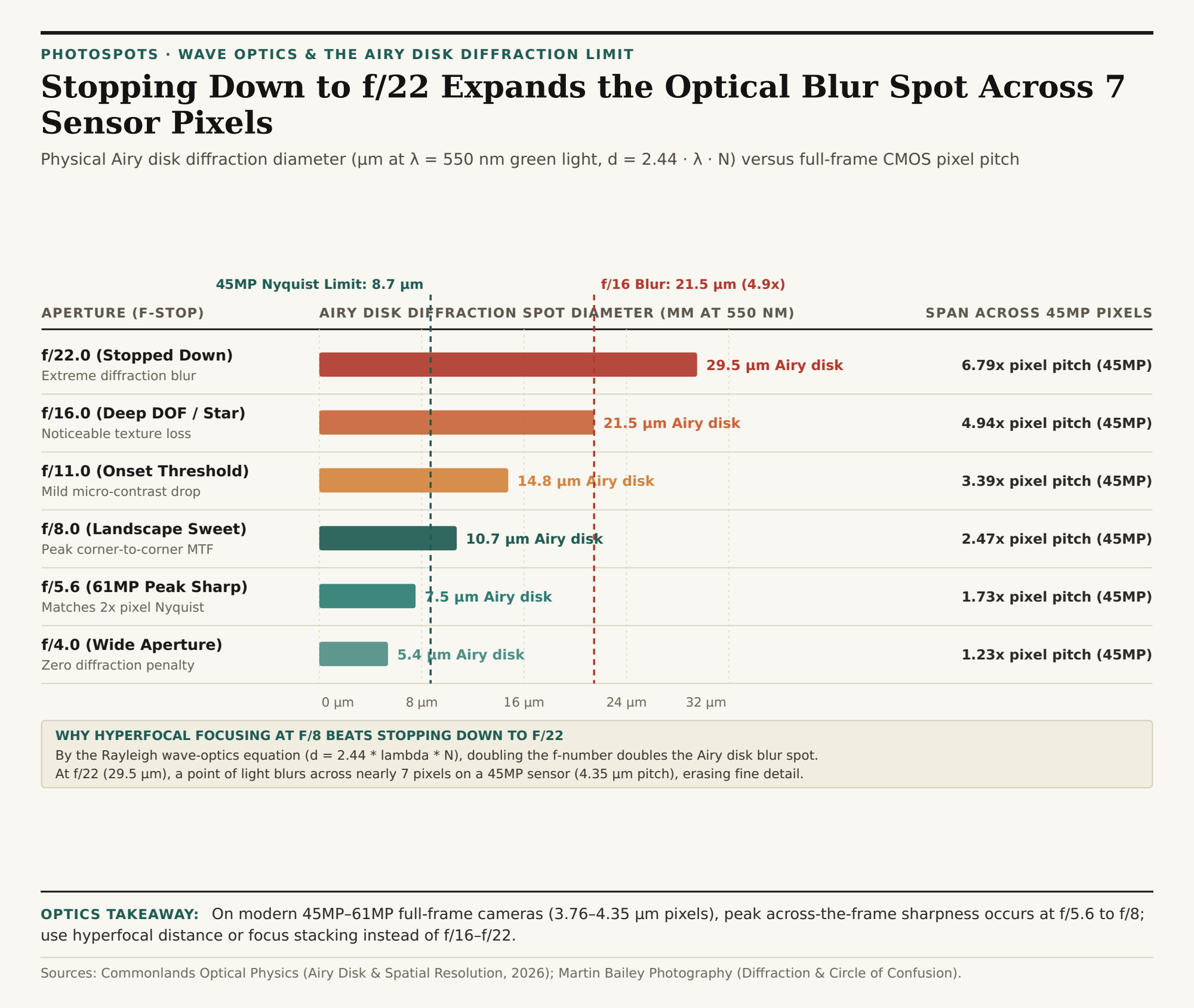
Using green light at the center of the human visible spectrum (lambda = 550 nm = 0.55 µm), every one-stop narrowing of the aperture expands the physical diffraction spot across the silicon sensor, regardless of how expensive the lens is:
- At f/4.0: The Airy disk diameter is 5.37 µm — barely wider than a single pixel on a 45MP full-frame camera (4.35 µm pixel pitch, such as the Nikon Z8/Z9 or Canon EOS R5).
- At f/5.6: The Airy disk measures 7.52 µm, matching the two-pixel Nyquist sampling limit of ultra-high-resolution 61MP sensors (3.76 µm pixel pitch, such as the Sony a7R V).
- At f/8.0: The Airy disk reaches 10.74 µm (2.47× a 45MP pixel). Because stopping down to f/8 eliminates wide-open optical aberrations (spherical aberration, coma, and field curvature) in the corners while keeping diffraction near the 2-pixel Bayer demosaicing threshold, f/5.6 to f/8 represents the true across-the-frame sharpness peak.
- At f/11.0: The Airy disk expands to 14.76 µm (3.39× pixel pitch), crossing the diffraction-limited threshold where pixel-level micro-contrast begins to soften.
- At f/16.0 and f/22.0: The Airy disk balloons to 21.47 µm (4.94× pixel pitch) at f/16 and 29.52 µm (6.79× pixel pitch) at f/22 — smearing every sharp point of light across nearly seven pixels in every direction.
When to Use Hyperfocal f/8 vs. When f/16 Still Makes Sense
Does diffraction mean you should never shoot at f/16? Not at all — it simply turns aperture selection into a deliberate trade-off between global wave-optics resolution and geometric depth-of-field / shutter-speed effects:
"When your nearest foreground subject is more than 6 to 10 feet away on a wide-angle lens (16mm to 24mm), focusing at the hyperfocal distance at f/8 keeps the entire scene from foreground to infinity within the circle of confusion while preserving peak sensor resolution."
If you are shooting wildflower petals 12 inches in front of a 24mm lens and want distant mountain peaks razor-sharp, a two- or three-frame focus stack at f/8 will deliver dramatically higher fine detail than a single frame stopped down to f/22. Reserve f/16 for two specific creative scenarios: when you want crisp 14-point or 18-point aperture sunstars as the Sun crests the horizon, or when you need to slow your shutter speed to 1/2 second in bright twilight to blur rushing water without a neutral-density filter.
| Lens Aperture | Airy Disk (550nm) | Ratio to 45MP Pixel (4.35 µm) | Ratio to 61MP Pixel (3.76 µm) | Optical Sharpness Regime |
|---|---|---|---|---|
| f/4.0 | 5.37 µm | 1.23x pixel pitch | 1.43x pixel pitch | Zero diffraction blur; corner softness from lens aberrations |
| f/5.6 | 7.52 µm | 1.73x pixel pitch | 2.00x pixel pitch | Peak center resolution on 50MP–61MP full-frame sensors |
| f/8.0 | 10.74 µm | 2.47x pixel pitch | 2.86x pixel pitch | Sweet spot for corner-to-corner sharpness on 24MP–45MP |
| f/11.0 | 14.76 µm | 3.39x pixel pitch | 3.93x pixel pitch | Diffraction threshold; mild loss of fine micro-contrast |
| f/16.0 | 21.47 µm | 4.94x pixel pitch | 5.71x pixel pitch | Visible texture softening; ideal for sunstars or slow water |
| f/22.0 | 29.52 µm | 6.79x pixel pitch | 7.85x pixel pitch | Severe wave-optics blur across ~7×7 pixel block |
Scouting Golden-Hour Angles and Sunstar Positions
Whether you are setting up an f/8 hyperfocal landscape frame during blue hour or timing an f/16 sunstar right as the solar disk touches a canyon rim, knowing the exact sun azimuth and golden-hour window eliminates guesswork in the field. Plan golden-hour landscape shoots in PhotoSpots and download the full-frame optical diffraction CSV table for your field notes.