
Why Do Leaves Change Color at Different Times Each Fall?
Autumn leaves change color on a two-stage biological system: shrinking daylight hours (photoperiod) set the strict calendar start date for green chlorophyll breakdown, while October weather — specifically sunny 65°F afternoons paired with crisp 38°F to 45°F nights — controls how much scarlet red pigment a tree manufactures before leaf drop. Contrary to popular folklore, an early hard frost (<32°F) does not create bright fall colors; freezing ruptures living leaf cells and turns foliage dull brown overnight.
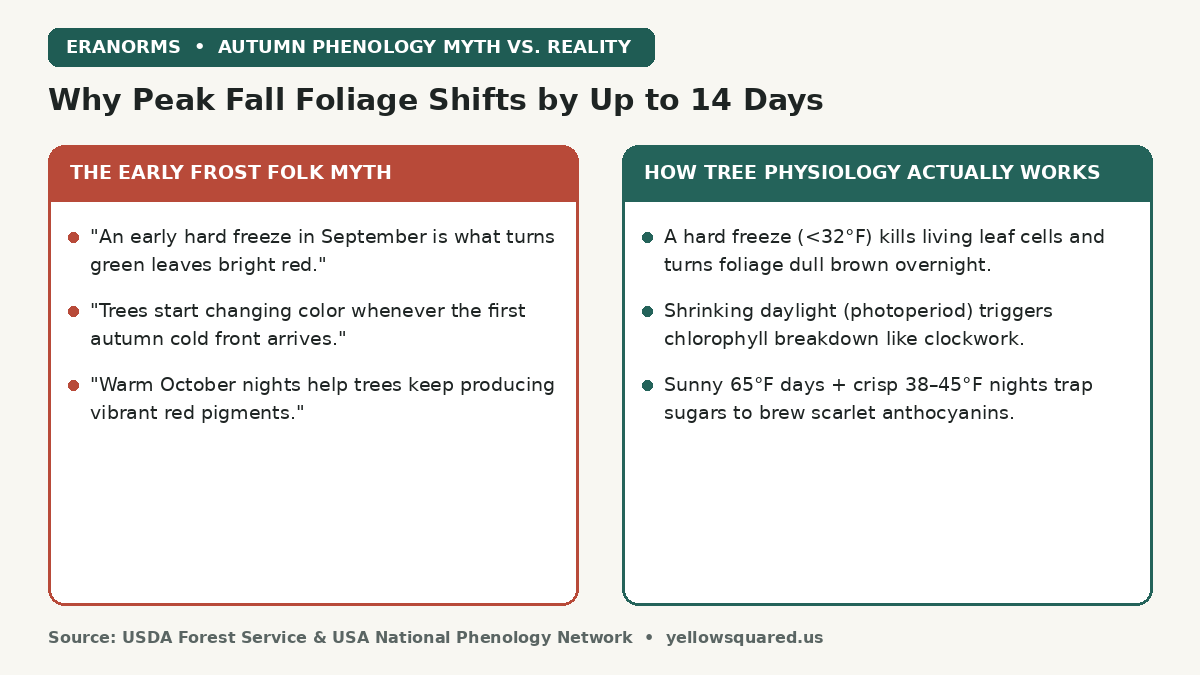
Every September and October, travelers planning autumn foliage trips notice a puzzling pattern: the exact same sugar maple or red oak ridge can blaze neon scarlet on October 12 one year, peak ten days later the next year, or fade straight from muted yellow to brown the year after. Understanding the three chemical pigment classes inside a deciduous leaf explains why astronomy governs the schedule while local weather governs the spectacle.
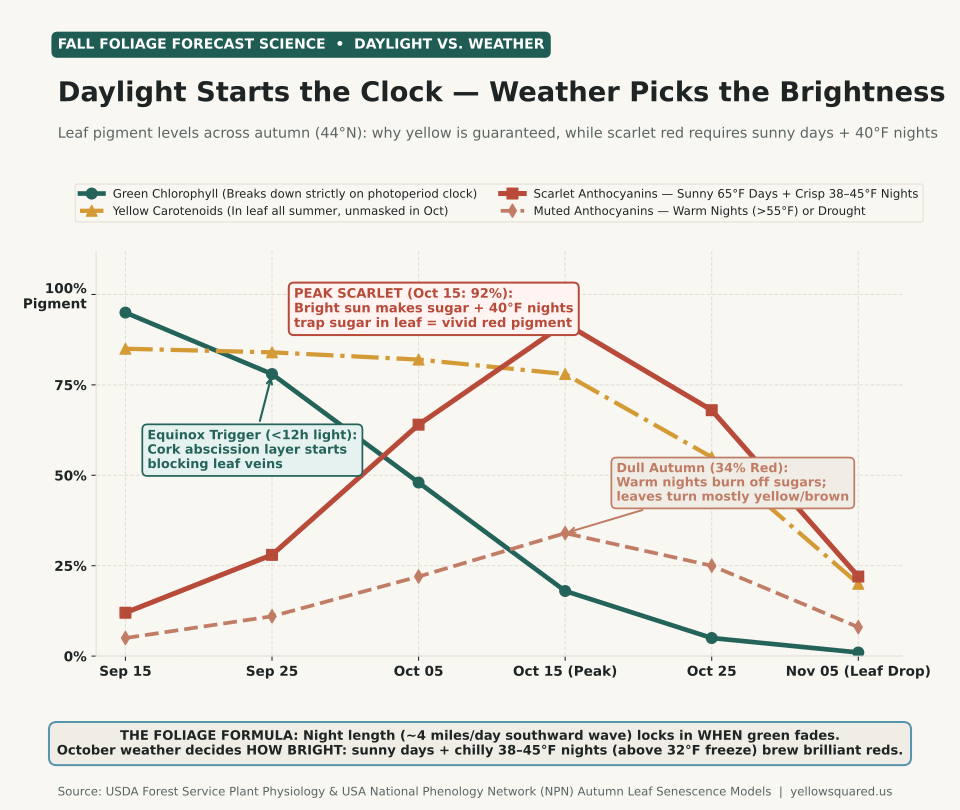
Yellow and gold pigments wait inside the leaf all summer long; scarlet and crimson pigments must be freshly brewed in October from trapped afternoon sugars.
The Three Pigment Classes Inside Deciduous Leaves
According to plant physiologists at the U.S. Forest Service, autumn foliage color comes from the interplay of three distinct chemical families:
- Chlorophyll (Green): The photosynthetic powerhouse that absorbs red and blue wavelengths of sunlight to convert carbon dioxide and water into glucose. Because chlorophyll is unstable in bright light, trees must continuously synthesize it all summer.
- Carotenoids — Lutein, Beta-Carotene, and Xanthophylls (Yellow & Orange): These stable accessory pigments sit inside the leaf plastids all summer alongside chlorophyll (the exact same compounds that color corn, carrots, and Birch or Aspen leaves). Because carotenoids degrade much more slowly than chlorophyll, they are unmasked every autumn regardless of October weather — which is why yellow birch, hickory, ginkgo, and quaking aspen reliably turn gold every single year.
- Anthocyanins (Scarlet, Crimson & Purple): Unlike yellow carotenoids, water-soluble anthocyanins are not present in summer leaves. Trees such as red maple, sugar maple, scarlet oak, sourwood, and dogwood synthesize anthocyanins inside cell vacuoles during autumn only when high concentrations of simple sugars become trapped inside the leaf blade under bright sunlight.
Why Sunny Days + 40°F Nights Brew the Brightest Reds
Once night length passes the critical threshold around the September equinox, phytochrome photoreceptors instruct the tree to grow a corky abscission layer across the base of each leaf stem (petiole). Crucially, the incoming water pipes (xylem) stay open slightly longer than the outgoing sugar pipes (phloem).
During a bright, sunny October afternoon (~60°F to 68°F), the remaining chlorophyll still manufactures a surge of glucose. When the sun sets and temperatures drop swiftly into the crisp 38°F to 45°F range (chilly, but safely above the 32°F freezing point), metabolic respiration slows down and phloem transport out of the leaf stalls. Trapped inside the leaf cells, those sugars react with sap proteins in the presence of sunlight to produce brilliant red anthocyanin pigments — which act as a natural botanical sunscreen, shielding the leaf's nutrient-recovery machinery while the tree resorbs up to 50 percent of its leaf nitrogen and phosphorus back into its branches before winter.
How Weather Anomalies Shift Peak Timing and Color Intensity
While the southward wave of lengthening nights marches from northern latitudes (~48°N) toward southern mountains (~35°N) at roughly 4 miles per day, multi-decade observations tracked by the USA National Phenology Network show how temperature and rainfall anomalies shift peak foliage by 7 to 14 days relative to 30-year climate normals:
| Autumn Weather Pattern | Effect on Peak Timing | Effect on Red / Orange Intensity | Biological Mechanism |
|---|---|---|---|
| Sunny 65°F Days + Crisp 38–45°F Nights | On-schedule peak | 90–100% Peak Scarlet | High daytime sugar production + cold-slowed nighttime phloem export maximizes anthocyanin synthesis. |
| Warm Autumn Nights (>55°F in Oct) | Delayed 5 to 12 days | Muted (30–40% Red) | Trees respire away daytime sugars overnight; leaves stay green longer, then turn mostly yellow/bronze. |
| Early Hard Freeze (<28–32°F in Sep/Early Oct) | Abrupt early termination | Ruined (Brown / Brittle) | Ice crystals rupture living parenchyma cells before chlorophyll breakdown or sugar trapping can finish. |
| Late-Summer Severe Drought | 1 to 2 weeks early | Dull / Premature Drop | Water stress triggers early abscisic acid (ABA) hormone release; trees seal petioles and shed leaves early. |
| Gale-Force Autumn Rainstorm | Shortens peak window | Moderate (pre-storm) | Heavy rain saturates blades while wind shears weakened cork abscission layers, stripping crowns in 24h. |
How to Check Local Temperature Normals Before Booking a Foliage Trip
Because elevation acts just like latitude — cooling roughly 3.5°F per 1,000 feet of altitude — a 3,500-foot ridge in the Blue Ridge or Cascades hits the 40°F nighttime sweet spot two to three weeks before the adjacent valley floor. You can compare historical autumn high/low temperature curves and monthly rainfall normals across U.S. stations by exploring the Eranorms climate explorer.