
Why Do Nearly One-Third of U.S. Boys' Names End in the Letter N?
In 1950, the ten most popular boys' names in the United States were James, Robert, John, Michael, David, William, Richard, Thomas, Charles, and Gary. Only one name in that entire top ten—John—ended in the letter N. Fast-forward to the early 2010s and read a preschool roster aloud: Aiden, Mason, Ethan, Jayden, Jackson, Logan, Benjamin, Owen, Ryan, Nathan, Dylan, Caleb, Landon, Gavin, Evan. Even as American parents abandoned the postwar habit of giving 30%+ of boys the same ten classic names, they unconsciously converged on a single terminal consonant sound.
As analyzed by name researcher Laura Wattenberg and documented in Quartz's study of U.S. Social Security Administration (SSA) terminal-letter distributions, the share of American newborn boys given a name ending in the letter N climbed from 11.5% in 1900 and 14.2% in 1950 to an extraordinary all-time peak of 33.6% in 2011—meaning more than one out of every three baby boys born in the United States received an -n name. To inspect how terminal sounds, syllable counts, and state-by-state rankings have shifted across the last century, you can Explore historical U.S. baby name trends in Name Scout.
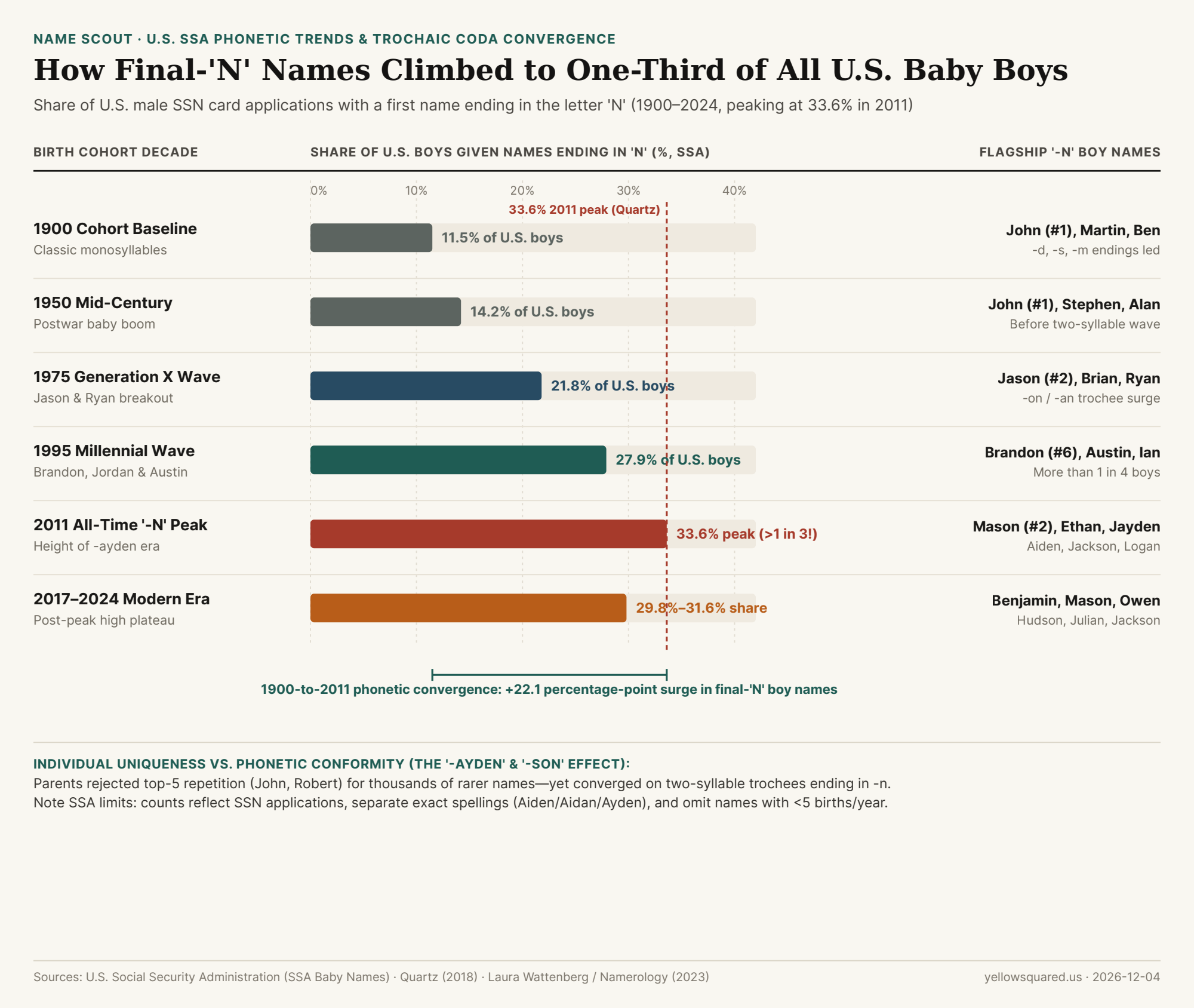
The Four Waves That Built the 33.6% 'N' Monopoly
Why did a single consonant capture a third of all male births when there are 26 letters in the English alphabet? Phonetic historians point to a two-syllable trochaic template—a stressed first syllable followed by an unstressed nasal coda (DA-da-n, such as MA-son, E-than, LO-gan, AI-den)—that rolled across four successive generational waves:
- The 1970s Jason / Brian / Ryan / Kevin Breakout (
21.8%by 1975): Until the late 1960s, male names were dominated by hard plosive and sibilant endings (-din David/Richard,-tin Robert,-sin James/Charles/Thomas). In 1972, Jason surged to#2nationally (behind Michael), joined by Celtic imports Brian, Ryan, and Kevin. That quartet conditioned a generation of American ears to hear a two-syllable-onor-ancadence as the default sound of a modern boy's name. - The 1990s Surname & Geographic Wave (
27.9%by 1995): When Generation X parents sought fresher alternatives to Jason and Brian, they kept the exact same two-syllable-nacoustic envelope and swapped in English surnames and place names: Brandon, Jordan, Austin, Dylan, Cameron, Christian, Evan, and Ian. - The 2000s–2011 -ayden & Occupational Peak (
33.6%in 2011): In the 2000s, biblical revivals (Ethan, Nathan, Benjamin), occupational surnames (Mason, Jackson, Carson, Hudson), and the rhyming -ayden quartet (Aiden, Jayden, Brayden, Caden) converged simultaneously. By 2011, 6 of the Top 10 and 11 of the Top 20 U.S. boys' names ended inN. - The Double-'N' Spinoff & Post-2017 Cooling (
~29.8%–31.6%): As noted in Quartz's phonetic breakdown and Laura Wattenberg's Namerology tracking, names ending in a double-nn(such as Finn, Quinn, Flynn, Brooklynn, and Adalynn) rose to roughly2%of all U.S. births, while overall male-nshare eased from33.6%in 2011 to31.6%in 2017 and roughly29%–30%in the early 2020s as-rendings (Oliver, Asher, Carter, Colter) and-oendings (Mateo, Theo, Leo) gained ground.
"American parents rejected the conformity of naming every boy John or Robert, yet inadvertently recreated phonetic conformity: by carving out hundreds of spelling variations on the same two-syllable '-n' template (Aiden, Aidan, Ayden, Jaidyn), a record 33.6% of boys in 2011 shared the exact same final sound."
Historical Trajectory & Mandatory SSA Dataset Limitations
When analyzing phonetic trends in U.S. Social Security Administration baby-name datasets, three structural data rules must be kept in view:
- SSN Card Applications, Not Universal Birth Certificates: The public SSA baby-name file tabulates first names from Social Security Number (SSN) card applications rather than NCHS birth certificates directly (prior to the late-1980s Enumeration at Birth program, many applications occurred years after birth).
- Exact-Spelling Separation: Every distinct orthographic string is ranked separately. During the peak
-aydenwave, Aiden, Aidan, Ayden, Aidyn, and Aden—or Jackson, Jaxon, and Jaxson—were tabulated as separate entries; pooling phonetic equivalents pushes the true share of-ncoda sounds even higher. - Small-Count Privacy Suppression (
<5Births): Any name given to fewer than5applicants of the same sex in a single birth year is omitted from the national SSA file to protect individual privacy.
| Birth Cohort Year | Boys Ending in 'N' (%) | Girls Ending in 'N' (%) | Dominant Phonetic Template | Representative Top-Ranked '-N' Boy Names |
|---|---|---|---|---|
1900 Baseline |
11.5% |
4.8% |
1-syllable traditional | John (#1), Martin, Dan, Ben, Warren |
1950 Postwar Boom |
14.2% |
6.5% |
1- & 2-syllable classic | John (#3), Stephen, Alan, Dean, Wayne |
1975 Gen-X Surge |
21.8% |
9.2% |
2-syllable -on / -an trochee |
Jason (#2), Brian, Ryan, Kevin, Aaron |
1995 Millennial Wave |
27.9% |
11.4% |
Surname & Celtic -on / -in |
Brandon (#6), Austin, Jordan, Christian, Ian |
2011 All-Time Peak |
33.6% |
12.8% |
Peak -ayden / -son / -an |
Mason (#2), Jayden (#4), Ethan (#6), Aiden (#9) |
2017–2024 Plateau |
29.8% – 31.6% |
11.1% |
Classic -n + -nn coda |
Benjamin, Mason, Ethan, Logan, Jackson, Owen, Hudson |
How to Avoid Unintended Rhyming Sibling Sets
Because terminal -n sounds are so deeply embedded in modern American naming tastes, parents frequently shortlist three or four favorites—say, Rowan, Julian, Owen, and Declan—without realizing that every single candidate shares the exact same unstressed nasal ending. Before locking in a first-and-middle-name combination or sibling pair, Explore historical U.S. baby name trends in Name Scout to compare ending sounds, decade curves, and regional state rankings side by side.