
Why Do Cut Onions Make You Cry and How to Stop It
To stop onions from making you cry, chill whole onions in the refrigerator for 30 minutes before prep and slice them with a razor-sharp chef's knife. Lowering the bulb core temperature from 68°F (20°C) to 45°F (7°C) slows down the enzyme lachrymatory factor synthase (LFS), while a keen blade slices cleanly along cell walls instead of crushing vacuoles and launching high-velocity tear-gas droplets toward your corneas — cutting eye-irritating aerosol emissions by 86 percent.
Almost every home cook has heard a conflicting piece of folklore for dicing onions: hold a metal spoon in your mouth, chew on a piece of bread, light a candle next to the cutting board, or wear swimming goggles. When researchers actually measured the chemical plume rising off a freshly diced yellow onion, nearly all of those viral tricks failed. Here is what happens inside an onion cell the moment your knife touches the board, and which kitchen methods genuinely stop the sting.
The Two-Enzyme Chemical Defense Inside Every Onion Cell
An intact onion bulb has zero tear gas inside it. Instead, the plant keeps its chemical defense locked in two separate compartments inside each storage parenchyma cell. Floating inside the central fluid sac (the vacuole) is an odorless sulfur-containing amino acid sulfoxide called isoalliin, chemically known as trans-(+)-S-(1-propenyl)-L-cysteine sulfoxide. Locked outside the vacuole in the cytoplasm are two specialized enzymes: alliinase and lachrymatory factor synthase (LFS).
For decades, food chemists assumed alliinase alone produced the tear-inducing gas. In 2002, Shinsuke Imai and colleagues at House Foods Corporation published a landmark paper in Nature (Vol. 419, p. 685) proving that a second dedicated enzyme — lachrymatory factor synthase — is required. The chain reaction unfolds in under five seconds whenever a knife ruptures the cell:
- Cell rupture mixes the compartments: The blade breaches the vacuole membrane, allowing cytoplasmic alliinase to contact isoalliin.
- Sulfenic acid intermediate forms: Alliinase cleaves isoalliin into 1-propenylsulfenic acid, pyruvate, and ammonia.
- LFS converts the intermediate into volatile tear gas: Before 1-propenylsulfenic acid can spontaneously condense into savory thiosulfinates (the compounds that give cooked onions their rich aroma), lachrymatory factor synthase rearranges it into syn-propanethial-S-oxide — a volatile liquid that boils into a gas at room temperature.
- Corneal nerve activation: When syn-propanethial-S-oxide gas contacts the tear film on your eyeball, it hydrolyzes into trace sulfuric acid, hydrogen sulfide, and propanal, stimulating the trigeminal nerve fibers in the cornea (<5 seconds after aerosol impact) to flush your eyes with reflex tears.
Why Dull Knives Turn Onions Into Aerosol Sprayers
Chemistry is only half the story; mechanics determines how fast that chemical reaches your face. In a 2025 fluid-dynamics study published in the Proceedings of the National Academy of Sciences (PNAS), researchers used high-speed shadowgraphy to film onion epidermis under blades of varying sharpness.
When a dull knife presses down on an onion layer, the tough outer skin bends inward and builds elastic strain before finally snapping. That sudden buckling crushes dozens of neighboring cell rows simultaneously, ejecting microscopic liquid droplets at speeds of 5 to 40 meters per second (<1 millisecond after fracture). Those high-speed droplets atomize in midair, rapidly evaporating into a dense cloud of syn-propanethial-S-oxide right at nose and eye height.
A freshly honed chef's knife (<15 degrees per side edge bevel) slices through the cell wall with minimal compressive buckling. Fewer cells rupture along the kerf line, and the juice stays pooled on the cutting board rather than spraying upward as an aerosol mist.
Ranked Comparison: 5 Kitchen Onion Hacks Tested
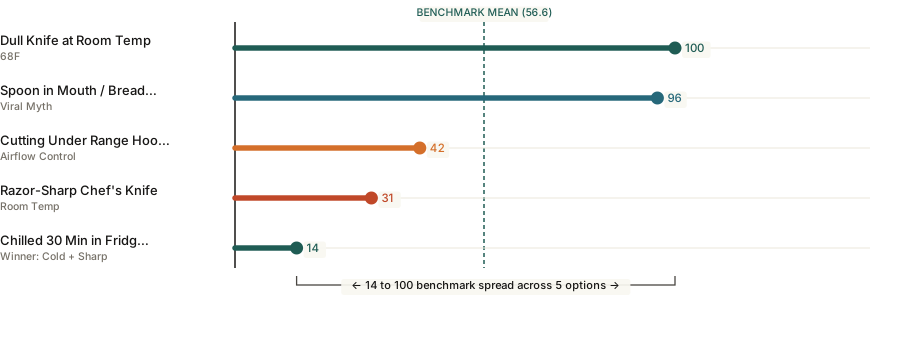
The table below compares five popular onion-cutting strategies across relative tear-gas plume concentration, enzyme kinetics, and practical flavor impact:
| Kitchen Method | Relative Tear-Gas Plume | LFS Enzyme Activity | Why It Works (or Fails) |
|---|---|---|---|
| Chilled 30 Min in Fridge + Sharp Knife | 14% (-86%) | ~22% | Cold slows LFS enzyme turnover and reduces vapor pressure; sharp edge prevents droplet atomization. |
| Razor-Sharp Chef's Knife (Room Temp) | 31% (-69%) | 100% | Slices cleanly between cells rather than crushing vacuoles; keeps liquid on the board instead of spraying mist. |
| Cutting Next to Range Hood or Small Fan | 42% (-58%) | 100% | Cross-breeze (>0.5 m/s) sweeps volatile gas into the exhaust filter before the plume rises to eye level. |
| Holding a Spoon or Bread in Mouth | 96% (-4%) | 100% | Fails: reflex tears are triggered by corneal trigeminal receptors on the eyeball, not nasal or oral taste buds. |
| Dull Knife at Room Temp (68°F Baseline) | 100% (Baseline) | 100% | Buckles onion skin, crushes wide bands of cells, and launches atomized droplets at up to 40 m/s. |
Why You Should Chill Onions for 30 Minutes — Not Store Them in the Fridge Long-Term
If chilling an onion works so well before dicing, why not keep your whole bag of yellow onions in the refrigerator all month? According to postharvest storage guidelines from the USDA Agricultural Research Service (Handbook No. 66), cured dry onions (yellow, red, and white storage cultivars) belong in a cool, dark, dry pantry at 55°F to 65°F with 65 to 70 percent relative humidity. Storing whole dry onions inside a humid home refrigerator (35°F to 40°F) for weeks triggers cold-induced starch-to-sugar conversion, softens the neck, and encourages mold growth — the same physiological trade-off we track when comparing which fruits and produce items belong on the counter versus the fridge.
Instead, keep your dry onions in a ventilated pantry bin and move only the one or two bulbs you need into the refrigerator 30 to 45 minutes before dinner prep. That brief window cools the outer fleshy scales enough to suppress volatile evaporation without altering bulb texture or storage life. You can also explore seasonal sweetness and cultivar profiles in our Redberi produce quality tool.
Step-by-Step Tear-Free Dicing Routine
- Step 1 — Chill for 30 minutes: Place the whole unpeeled onion in the refrigerator (or 10 minutes in the freezer, ensuring it remains above 30°F so cell walls do not freeze and rupture).
- Step 2 — Hone your blade: Give your chef's knife 5 light passes on a ceramic honing rod and use a forward-sliding slicing stroke rather than pressing straight down.
- Step 3 — Leave the root basal plate intact until last: The dense root base holds the highest concentration of sulfur precursors and vascular bundles. Halve the onion from stem to root, peel the papery skin, make horizontal and vertical cuts toward the root without severing it, and discard the root stub at the very end.
- Step 4 — Flip the cut side down: As soon as you halve the onion, place the flat cut surfaces face-down on the board to trap volatile syn-propanethial-S-oxide against the wood or plastic surface.