
Why Do Onions Make You Cry, and Why Does Chilling or Using a Sharp Knife Stop the Tears?
Leave a whole yellow onion sitting on your kitchen counter and it has virtually zero smell. Slice into that exact same bulb with a dull kitchen knife, and within fifteen seconds your eyes begin to sting, burn, and flood with reflex tears. Why does a calm vegetable suddenly synthesize chemical tear gas the moment a blade touches it—and why doesn't garlic, which belongs to the exact same Allium genus, make you cry when you mince it?
For decades, food chemists assumed that a single enzyme—alliinase—was responsible for both an onion's savory aroma and its tear-inducing sting. Then in 2002, Japanese biochemist Shinsuke Imai and colleagues published a landmark discovery in Nature (later detailed at atomic resolution in ACS Chemical Biology's crystal-structure study of Lachrymatory Factor Synthase): onions possess a specialized second enzyme called Lachrymatory Factor Synthase (LFS) whose sole job is to convert unstable sulfenic acid into a volatile gas called syn-propanethial-S-oxide. Before prepping or storing your next bag of alliums, you can Check peak produce ripeness and storage rules in Redberi to keep dry storage onions crisp and un-sprouted.
The Two-Compartment Binary Chemical Weapon Inside Every Onion Cell
Growing underground as a nutrient-rich bulb, the onion (Allium cepa) evolved a two-part chemical defense to stop rodents and soil pests from eating it alive. Inside an intact onion cell, the ingredients of this defense are kept locked in separate sub-cellular rooms so the bulb does not poison itself, as explained by the Library of Congress and the Royal Society of Chemistry:
- Step 1 — Rupturing the Vacuole Releases Alliinase: The cell cytoplasm holds an odorless sulfur-rich amino acid sulfoxide called isoalliin (
trans-(+)-S-(1-propenyl)-L-cysteine sulfoxide), while the central storage vacuole holds the enzyme alliinase. When a knife blade crushes the cell wall, vacuolar alliinase floods into the cytoplasm and cleaves isoalliin into ammonia, pyruvate, and highly reactive1-propenylsulfenic acid. - Step 2 — Lachrymatory Factor Synthase (LFS) Makes the Gas: Left alone,
1-propenylsulfenic acidwould spontaneously condense into savory thiosulfinates (the delicious compounds that give sautéed onions their aroma). Instead, the onion's second enzyme—Lachrymatory Factor Synthase (LFS)—instantly intercepts1-propenylsulfenic acidand isomerizes it into(Z)-propanethial-S-oxide(syn-propanethial-S-oxide), a low-molecular-weight liquid (90.14 g/mol) that vaporizes immediately into an upward plume. - Step 3 — Corneal Sensory Nerve Activation: When airborne
syn-propanethial-S-oxidehits the watery tear film covering your cornea, it hydrolyzes into propanal, hydrogen sulfide, and trace amounts of sulfuric and sulfurous acid, firing TRPA1 nociceptors on the ciliary nerve and commanding the lacrimal glands to flush the eye with tears. (Garlic never makes you cry because garlic contains alliin rather than isoalliin and completely lacks the LFS enzyme!)
"A dull knife does not slice cleanly between onion cells—it crushes thousands of cell vacuoles like microscopic water balloons, spraying a fine mist of alliinase and lachrymatory factor synthase directly into the air."
Four Evidence-Based Ways to Stop Onion Tears (Without Losing Flavor)
Because the tear-gas cascade requires cell rupture, enzymatic reaction kinetics, and vaporization into the air, you can shut down the plume at any of those three physical bottlenecks:
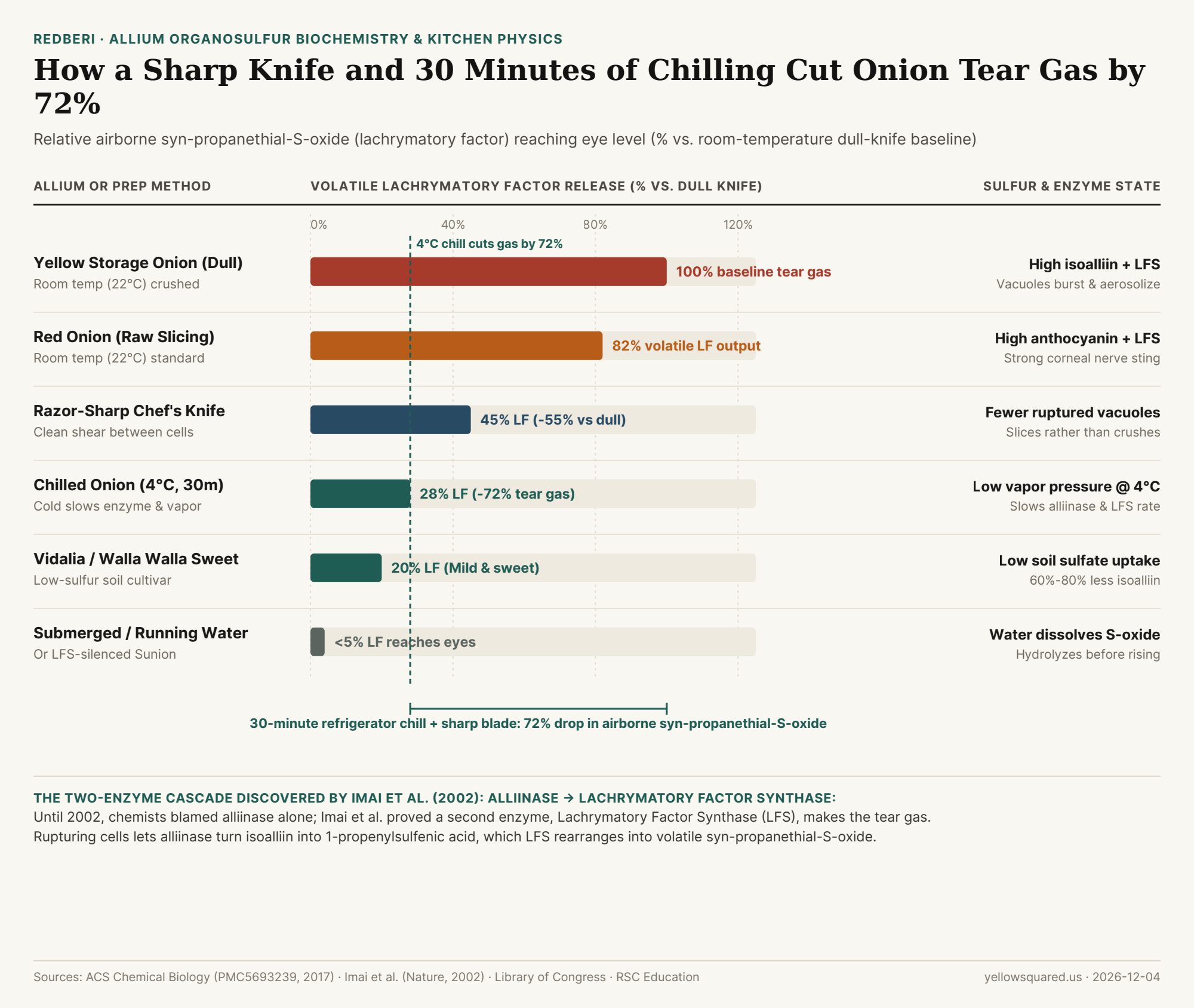
| Onion Type or Prep Method | Bulb Temp | Relative Tear-Gas Plume | Physical or Biochemical Mechanism | Effect on Cooked Dish |
|---|---|---|---|---|
| Yellow Storage Onion + Dull Blade | 22°C (72°F) |
100% (Baseline) |
Crushes vacuoles and ejects fine aerosol droplets upward | Standard pungent baseline |
| Red Onion + Standard Slicing | 22°C (72°F) |
~82% |
High isoalliin precursor pool + fast LFS turnover | Sharp raw bite for salads/pickles |
| Razor-Sharp Chef's Knife (Push-Cut) | 22°C (72°F) |
~45% (-55% gas) |
Clean forward shear parts cells with minimal vacuole crushing | Crisper dice; less bitter liquid loss |
Chilled Onion (30 min in Fridge) |
4°C (39°F) |
~28% (-72% gas) |
Halves enzyme reaction speed (Q10 ≈ 2) and drops vapor pressure |
Zero flavor loss once hits hot pan |
| Sweet Vidalia / Walla Walla | 22°C (72°F) |
~20% (-80% gas) |
Low-sulfur soil yields 60%–80% less isoalliin substrate | Sweet & mild raw; higher water content |
| Submerged / Running Water or Fan | 15°–22°C |
<5% (-95% gas) |
Water dissolves polar S-oxide before it can become airborne |
Zero tears; blot dry before sautéing |
Why You Should Chill an Onion for 30 Minutes—Not Store It in the Fridge All Month
Chilling a whole yellow or red onion in the refrigerator for 30 to 45 minutes right before chopping is the cleanest culinary trick: lowering the bulb temperature from 22°C (72°F) down to 4°C (39°F) slows both alliinase and LFS enzyme kinetics while drastically reducing the volatility (vapor pressure) of syn-propanethial-S-oxide, cutting eye-level tear gas by roughly 72%—and once the diced onion hits a hot skillet, thermal energy denatures LFS while unlocking full savory flavor. However, never store whole dry-cured yellow, white, or red onions in the refrigerator long-term (where high humidity triggers mold and cold temperatures trigger premature sprouting); keep them in a cool, dark, ventilated pantry (7°C–13°C) away from potatoes, and Check peak produce ripeness and storage rules in Redberi for your entire kitchen inventory.