
Why Do Circular Polarizer Filters Make Wide-Angle Skies Look Uneven—And What Is Brewster's 53° Glare Angle?
Thread a Circular Polarizer (CPL) filter onto the front of your lens beside an alpine lake or tidal pool, rotate the outer ring, and the transformation feels like optical magic: blinding white surface glare vanishes, revealing submerged river stones and trout beneath crystal-clear water. Yet if you leave that exact same polarizer rotated to maximum strength on a 16mm or 20mm wide-angle lens under a cloudless afternoon sky, your photo comes back with an ugly, unnatural dark-blue band cutting across the middle of the sky while the left and right corners stay pale. Why does a polarizing filter only erase water reflections at a specific camera tilt, why does it fail completely on bare metal, and why does it band wide-angle skies? As derived in Sir David Brewster's 1815 optical law, Optica's Applied Optics analysis of water reflection geometry, Luminous Landscape, and Photography Life, two exact geometric angles govern everything a polarizer does: Brewster's Angle (53.1° for water and 56.6° for glass) and the 90° Rayleigh Sky Scattering Rule.
1. How a Circular Polarizer Works—And Why Digital Cameras Need the Quarter-Wave Plate
Sunlight leaves the Sun as unpolarized electromagnetic waves whose electric fields vibrate in every plane perpendicular to the beam. When those waves bounce off a dielectric (electrically insulating, non-metallic) surface like water, glass, wet leaves, or automotive clearcoat—or scatter off nitrogen and oxygen molecules in the atmosphere—they become linearly polarized, vibrating predominantly in a single plane.
As explained in optical filter architecture analyses, a modern Circular Polarizer (CPL) is actually a two-layer sandwich:
- Front Layer — The Linear Polarizer: Rotating the front ring aligns microscopicdichroic polymer chains perpendicular to the polarized glare wave, blocking the reflection while transmitting unpolarized diffuse light from the subject underneath.
- Rear Layer — The Quarter-Wave Retarder Plate (
λ/4): Older SLR autofocus and metering beam-splitters (and some phase-detect optical paths) are themselves polarization-sensitive and could misread exposure if fed purely linearly polarized light. The rear quarter-wave plate spins the filtered light into circularly polarized light before it enters the lens, without changing the glare-removal effect at all.
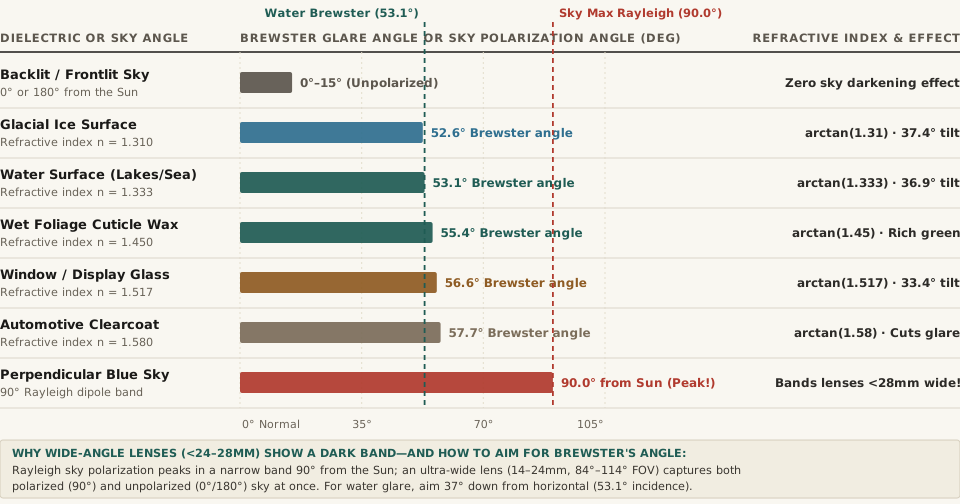
θB = arctan(n2/n1)) for 100% polarized surface glare compared against the 90° solar scattering peak in blue skies (Wikipedia — Brewster's Angle; Optica Applied Optics; Luminous Landscape).2. Brewster's Law (θB = arctan(n2/n1)): Why Water Glare Vanishes at 53.1°
Have you ever noticed that a polarizer removes zero reflection when you shoot straight down into a puddle (0° angle of incidence) or skim right along the horizon (85°–90°), but wipes out 100% of the reflection when you look down at a moderate diagonal angle? In 1814–1815, Scottish physicist Sir David Brewster proved that when unpolarized light strikes a transparent dielectric boundary where the reflected ray and the refracted ray inside the material form an exact 90° right angle, the oscillating surface electrons cannot radiate parallel (p-polarized) waves into the reflected beam (Wikipedia — Brewster's Angle; Brewster dipole derivation). At that exact angle, 100% of the reflected glare is s-polarized (vibrating horizontally parallel to the surface) and can be completely extinguished by a polarizer!
By Snell's Law, Brewster's angle depends solely on the ratio of the refractive index of the reflecting surface (n2) to air (n1 ≈ 1.000): θB = arctan(n2 / n1) (measured from the perpendicular surface normal):
- Freshwater & Seawater (
n2 = 1.333):θB = arctan(1.333) = 53.1°from the vertical normal—which means aiming your camera downward at an angle of36.9°(~37°) below the horizontal plane of the water. As noted in Optica's Applied Optics study, this53.1°zone creates the classic dark, transparent patch on lakes and tidal pools. - Wet Plant Leaves & Waxy Cuticles (
n2 ≈ 1.45):θB = arctan(1.45) = 55.4°. Rotating a CPL in a rainforest or autumn woodland strips the white specular sky sheen off the waxy leaf cuticle so the underlying green or gold pigments saturate naturally. - Storefront & Museum Window Glass (
n2 = 1.517):θB = arctan(1.517) = 56.6°from the normal—which means standing at a33.4°oblique angle to the glass pane (not straight on!) to erase street reflections completely (StackExchange Optics Reference). - Why Bare Metal Never Polarizes: Because free conduction electrons in unpainted aluminum, chrome, or silver mirrors do not obey dielectric dipole locking, specular reflections off bare metal remain unpolarized at every angle.
"Brewster's angle is often referred to as the 'polarizing angle', because light that reflects from a surface at this angle is entirely polarized perpendicular to the plane of incidence ('s-polarized')."
3. The 90° Rayleigh Sky Rule—And Why Ultra-Wide Lenses (<28mm) Band the Sky
The second physical mechanism occurs high in the atmosphere. Under Rayleigh scattering, sunlight striking air molecules scatters polarized light maximally at a 90° right angle to the Sun's rays, while light scattered directly toward the Sun (0°) or directly away from the Sun (180°) is virtually unpolarized (Luminous Landscape; Kase Filters CPL Guide):
- The Thumb-and-Index "L" Rule: Point your index finger directly at the Sun and extend your thumb at a
90°angle. Whatever direction your thumb points as you rotate your wrist traces the circular band across the sky where a polarizer will turn the sky its deepest navy blue. (Note that at solar noon when the Sun is directly overhead, the entire horizon 360° around you sits 90° from the Sun!). - Why Lenses Wider Than
24mm–28mmCreate the "Dreaded Polarizer Blob": A50mmor85mmlens covers a narrow horizontal field of view (40°or24°), so the polarization across the frame is uniform. By contrast, a16mmfull-frame lens spans a massive96.7°horizontal field of view (Photo Cascadia; Ken Koskela Photography). If part of your16mmframe points at90°to the Sun (where the sky is 80% polarized) while the edges of the frame reach toward30°or150°from the Sun (where the sky is barely polarized), a fully rotated CPL will carve a dark V-shaped or oval inkblot across the middle of the sky. - How to Shoot Wide With a CPL Without Banding: When shooting wider than
24mmwith open blue sky in the frame, rotate the CPL only halfway to maximum—or orient the filter to suppress foreground water/foliage glare during golden hour or overcast conditions when the sky is covered by clouds.
4. Complete Data Table: Brewster Glare Angles & Sky Polarization Benchmarks
The reproducible table below—matching the companion CSV (circular-polarizer-brewsters-angle-water-glass-and-90-degree-sky-polarization.csv)—lists the refractive indices, exact Brewster incidence angles, camera tilt angles, and sky scattering zones:
| Surface or Sky Zone | Refractive Index (n2) / Geometry |
Optical Formula | Brewster / Peak Angle | Angle From Surface Plane | Polarized Share | Field Photography Application |
|---|---|---|---|---|---|---|
| Frontlit / Backlit Sky | 0° or 180° from Sun |
Forward/backward Rayleigh | 0°–15° |
Along solar azimuth | < 10% |
Zero sky darkening; costs ~1.5 stops of light |
| Glacial Ice / Wet Snow | n2 = 1.310 |
arctan(1.310) |
52.6° |
37.4° depression tilt |
~100% at 52.6° |
Cuts specular sheen on blue glacier ice |
| Freshwater / Seawater | n2 = 1.333 |
arctan(1.333) |
53.1° |
36.9° depression tilt |
100% at 53.1° |
Erases lake & stream reflections completely |
| Waxy Foliage Cuticle | n2 ≈ 1.450 |
arctan(1.450) |
55.4° |
34.6° grazing angle |
95%–100% |
Removes silver sky glare from wet forest leaves |
| Window / Display Glass | n2 = 1.517 (Crown) |
arctan(1.517) |
56.6° |
33.4° off window plane |
100% at 56.6° |
Stand ~33° sideways to see through glass windows |
| Automotive Clearcoat | n2 ≈ 1.580 |
arctan(1.580) |
57.7° |
32.3° off body panel |
100% (Non-metal) |
Eliminates windshield & clearcoat reflections |
| Perpendicular Blue Sky | 90° orthogonal to Sun |
Rayleigh dipole scattering | 90.0° |
Thumb-index "L" rule | 75%–85% |
Peak sky contrast; dial back on lenses <28mm |
Before heading out with a polarizer for reflection-free lake views or golden-hour portraits, Plan natural-light sessions in PhotoSpots to check the exact solar azimuth and elevation angle at your shooting location.