
Why Do Refrigerated Potatoes Taste Sweet and Fry Dark—And What Temperature Keeps Them From Sprouting or Turning Green?
Toss a 5-pound bag of Russet or Yukon Gold potatoes into a standard home refrigerator (35°F to 38°F / 1.7°C to 3.3°C) for two weeks, and the tubers will look firm and sprout-free when you pull them out. Slice them into French fries or roast wedges at 375°F, however, and the outside scorches into a bitter, dark mahogany-black crust before the center is even tender—while boiled or mashed potatoes take on a noticeably sugary aftertaste. Leave the next bag on a sunny 70°F kitchen counter instead, and the skins turn bright green inside 48 hours and sprout within two weeks. That two-sided trap is governed by two separate postharvest mechanisms documented by the USDA Agricultural Research Service (ARS) and the UC Davis Postharvest Research and Extension Center: cold-induced sweetening (CIS) below 40°F (4.4°C) and light-activated chlorophyll and glycoalkaloid (solanine) synthesis.
Reader outcome: You will learn the exact enzymatic cutoff (40°F) where potato starch turns into reducing sugars, why green potato skin signals elevated solanine that cooking cannot destroy, and how to store fresh potatoes at 45°F to 50°F in darkness so they stay firm, golden-frying, and sprout-free for 3 to 5 months.
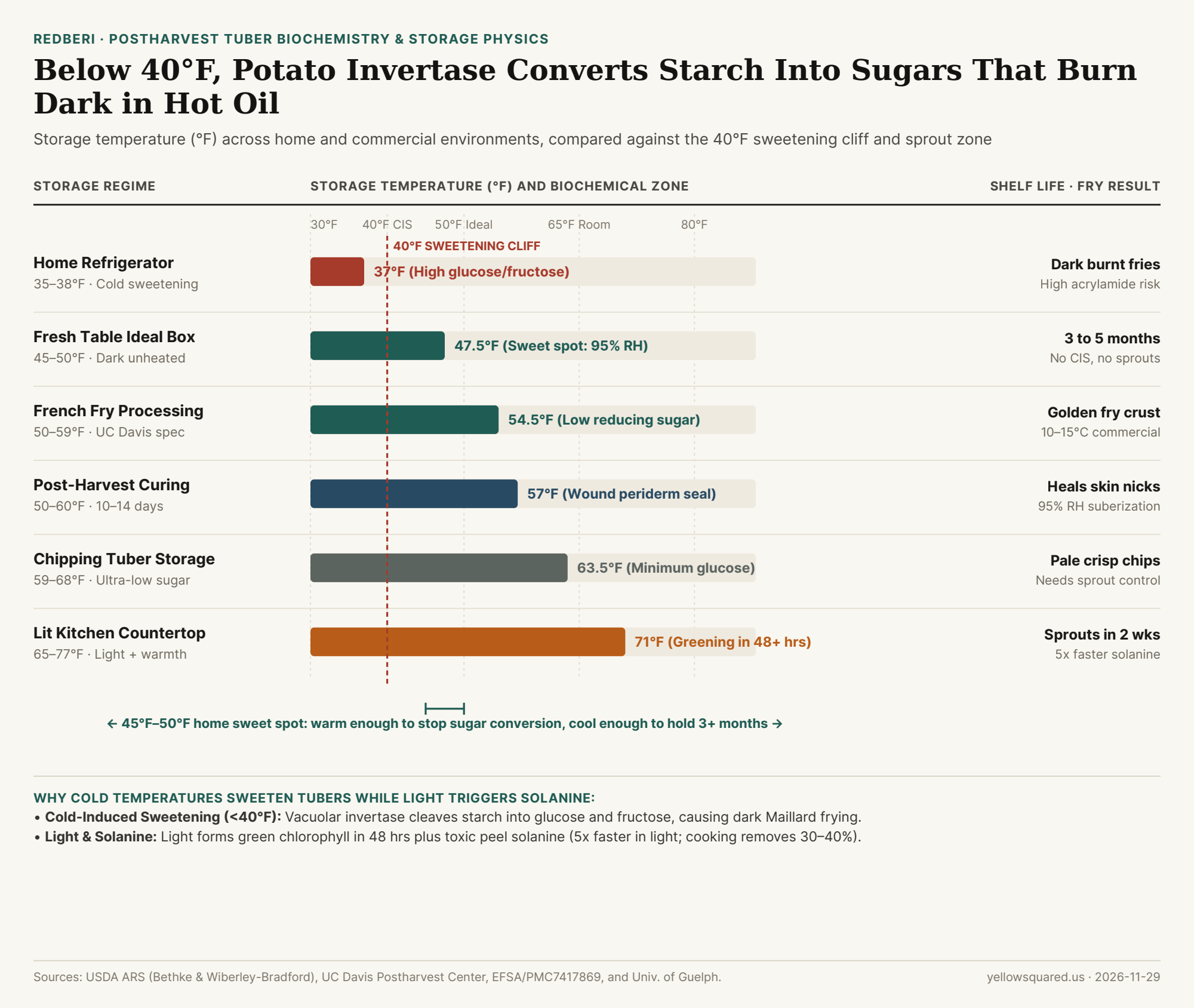
What Is Cold-Induced Sweetening (And Why Do Refrigerated Potatoes Fry Dark)?
A harvested potato tuber is a living, respiring stem organ whose dry weight is roughly 70% to 80% starch. When ambient temperature drops below 40°F (4.4°C), the tuber's cold-stress response shifts its carbohydrate balance to protect cellular membranes from freezing. As USDA ARS researchers Paul Bethke and Amelia Wiberley-Bradford and University of Guelph biochemists detail, low temperatures upregulate starch-breakdown pathways—specifically plastidial starch phosphorylase (Pho1), UDP-glucose pyrophosphorylase, and vacuolar acid invertase (StVInv).
First, starch granules are cleaved into sucrose; then, vacuolar invertase splits each non-reducing sucrose molecule into two reducing sugars: glucose and fructose. Why does that distinction matter in the skillet? Sucrose does not participate directly in the Maillard browning reaction until it hydrolyzes, whereas free glucose and fructose have reactive carbonyl groups that combine rapidly with the free amino acid asparagine at frying temperatures above 285°F (140°C). The result is twofold:
- Premature Dark Browning & Bitter Scorch: High glucose and fructose concentrations caramelize and char the exterior of fries and chips dark brown-black long before interior moisture has cooked off. In commercial French fry and potato chip plants, cold-induced sweetening causes 15% to 20% of tuber rejections.
- Acrylamide Formation: The Maillard reaction between reducing sugars (glucose/fructose) and free asparagine at high heat is the primary chemical pathway producing acrylamide in fried and roasted potato products.
Storing potatoes at 45°F to 50°F (7°C to 10°C) stays safely above the 40°F invertase cliff while keeping respiration slow enough to prevent sprouting for 3 to 5 months.
Temperature Regimes Compared: Refrigerator vs. Cellar vs. Processing Specs
Because different culinary methods tolerate different reducing-sugar baselines, the UC Davis Postharvest Center and postharvest agronomy standards specify distinct temperature and humidity targets depending on whether tubers are boiled, fried into French fries, or sliced thin into potato chips:
| Storage Environment | Temperature Range | Relative Humidity | Dormancy / Shelf Life | Reducing Sugar Accumulation | Fry Color & Culinary Outcome |
|---|---|---|---|---|---|
| Home Refrigerator | 35°F to 38°F (1.7°C–3.3°C) |
30% to 50% RH |
Sprout-free 3+ months | High (Invertase cleaves starch to glucose/fructose) | Fries burn dark brown-black; elevated acrylamide |
| Commercial Cold Warehouse | 39°F (4.0°C) + CIPC/Ethylene |
95% to 98% RH |
10 to 12 months | High unless reconditioned at 59°F | 15% to 20% processor rejection if unconditioned |
| Fresh Table Optimal Cellar | 45°F to 50°F (7.2°C–10.0°C) |
95% to 98% RH |
Up to 3 to 5 months | Low (Above 40°F CIS threshold) | Clean golden roasting, mashing, and boiling |
| French Fry Processing Spec | 50°F to 59°F (10.0°C–15.0°C) |
95% RH |
2 to 4 months | Minimal reducing sugars | Uniform light-gold French fry Maillard crust |
| Potato Chip Processing Spec | 59°F to 68°F (15.0°C–20.0°C) |
95% RH |
1 to 2 months | Lowest glucose/fructose baseline | Pale crisp potato chips without bitter scorch |
| Warm Lit Kitchen Countertop | 65°F to 77°F (18.3°C–25.0°C) |
40% to 60% RH |
Sprouts in 14 days; green in 48 hrs | Low sugar, 5x faster solanine synthesis | Bitter peel glycoalkaloids; shriveling & sprouts |
Why Potatoes Turn Green in Light—And Why Peeling Matters More Than Cooking
When a potato sits under grocery store fluorescents or kitchen daylight, two parallel biochemical pathways switch on simultaneously in the outer cortex. The green pigment itself is chlorophyll, which is completely non-toxic and tasteless. However, light exposure simultaneously activates the synthesis of steroid glycoalkaloids—primarily alpha-solanine and alpha-chaconine, the plant's natural defense toxins against insects and fungi.
According to the European Food Safety Authority (EFSA) risk assessment on glycoalkaloids and postharvest toxicology studies, glycoalkaloid synthesis occurs 5 times faster in light than in darkness, and concentrations are 3 to 10 times higher in the peel and eyes than in the inner flesh. Because solanine is heat-stable up to roughly 340°F–390°F, standard boiling, baking, or frying reduces solanine levels by only 30% to 40%. Thoroughly peeling away the skin and any green layer removes the vast majority of glycoalkaloids on mildly greened tubers—and if a cooked potato ever tastes bitter or causes a burning sensation on the tongue, discard it immediately. If you accidentally refrigerated a bag of potatoes, you can partially reverse cold-induced sweetening by reconditioning them in a dark paper bag at 55°F to 60°F for 1 to 2 weeks before frying so respiration burns off excess glucose. For room-by-room storage temperatures and ethylene pairings across 100+ fruits and vegetables, Check produce ripeness and storage in Redberi.