
Why Do Refrigerated Tomatoes Lose Their Flavor, and Why Doesn't Warming Them Up Bring It Back?
Bite into a vine-ripened heirloom or garden tomato sitting on a summer kitchen counter at 20°C (68°F), and it bursts with complex, sweet-savory flavor. Put its identical twin from the exact same vine into a 4°C to 5°C (39°F to 41°F) refrigerator for a week—even if you let it warm back up to room temperature on the counter before slicing—and it tastes flat, watery, and cardboard-like.
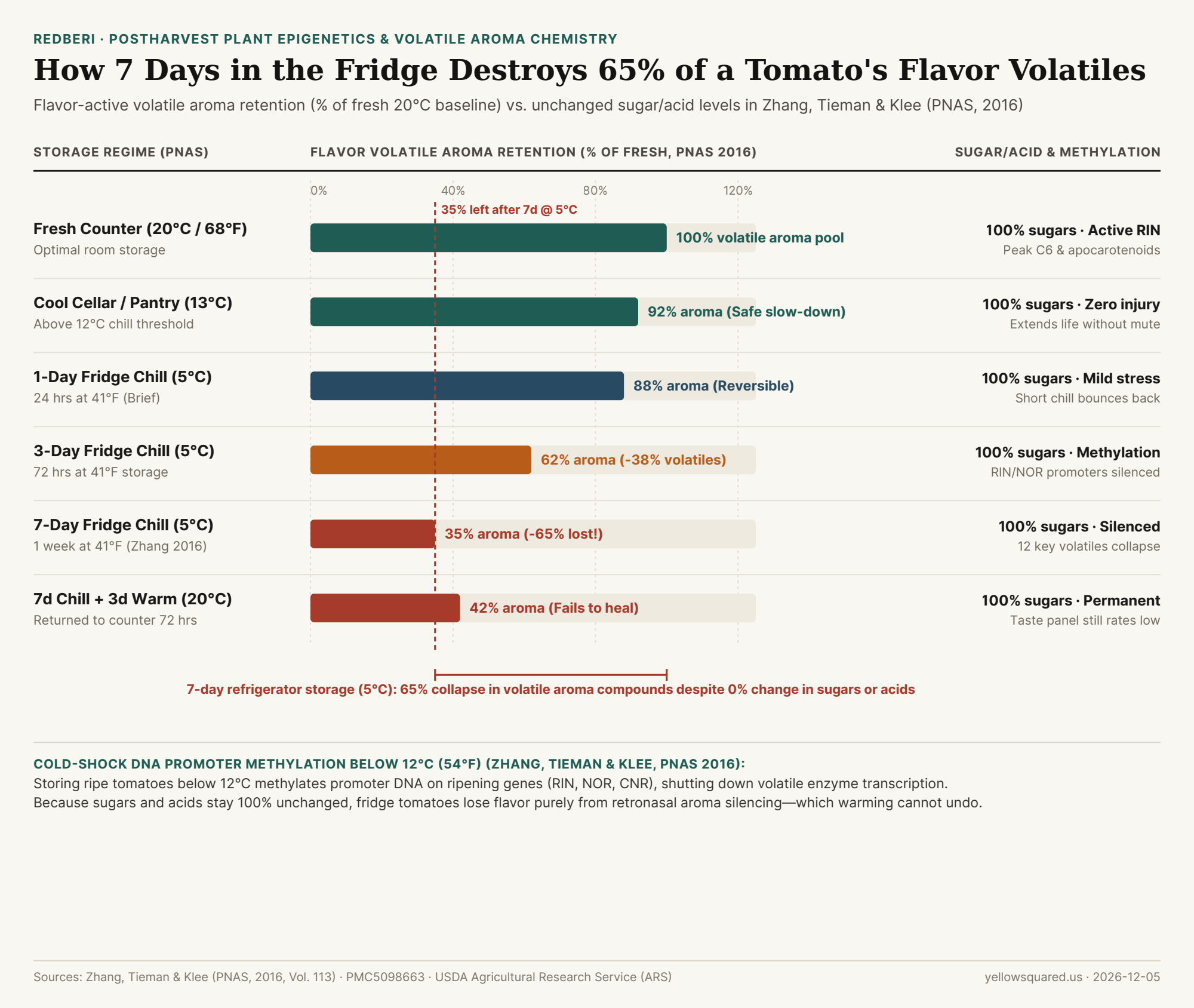
For years, cooks assumed refrigeration somehow degraded a tomato's sugars or organic acids. Then in October 2016, plant geneticists Bo Zhang, Denise M. Tieman, and Harry J. Klee (working across the University of Florida, Zhejiang University, and the USDA) published a landmark genomic and metabolomic study in the Proceedings of the National Academy of Sciences (PNAS, 2016, Vol. 113, No. 44). Their chemical assays revealed a startling surprise: refrigerating a tomato for 7 days changes its sugar and acid content by 0%—yet wipes out 65% of its volatile aroma compounds via cold-shock DNA methylation! Before unpacking your next farmers-market or grocery haul, you can Check peak produce ripeness and storage rules in Redberi to separate cold-sensitive tropical fruits from fridge-loving greens.
Sugars + Acids + Volatiles: Why 70% of 'Tomato Flavor' Is Actually Retronasal Smell
As summarized by the USDA Agricultural Research Service, human perception of tomato flavor is built from two separate sensory channels:
- Tongue Taste Receptors (Sugars & Acids — Unchanged by Cold): Taste buds on your tongue detect only non-volatile dissolved solids—principally fructose and glucose (
3% to 5%of fresh weight) balanced against citric and malic acid (pH ~4.2 to 4.5). When Zhang and Klee chilled both modern commercial inbred tomatoes (FLA 8059) and classic heirloom tomatoes (Ailsa Craig) at5°C(41°F) for 1, 3, and 7 days, soluble sugars and titratable acidity remained100%unchanged. - Retronasal Olfaction (30+ Volatile Aroma Compounds — Crushed by Cold): When you chew a tomato, volatile organic compounds evaporate in the warmth of your mouth and travel up the back of your throat (
nasopharynx) to your olfactory epithelium. Unlike bananas or strawberries—which owe their aroma to a single dominant ester—a tomato's signature flavor requires a delicate symphony of over 30 volatile compounds synthesized continuously from branched-chain amino acids (isovaleraldehyde, 2-methylbutanol), fatty acids (cis-3-hexenal, giving freshly cut grass and vine notes), and carotenoid pigments (6-methyl-5-hepten-2-oneandgeranylacetone, which trick the brain into perceiving the fruit as sweeter than its actual sugar content!).
"A chilled tomato contains the exact same grams of glucose, fructose, and citric acid as a counter-stored tomato—it tastes bland because cold storage below 12°C silences the 12 volatile-aroma enzymes that create retronasal tomato flavor."
How Cold Shock Below 12°C (54°F) Methylates DNA Promoters
Why does a tomato shut down its volatile-aroma factories in the fridge, and why doesn't warming it back up on the counter fix the problem? Using whole-genome bisulfite sequencing and RNA-Seq transcriptomics (available in full in PubMed Central PMC5098663), Zhang, Tieman, and Klee tracked the fruit's epigenetic response to cold stress:
- The
12°C(54°F) Subtropical Threshold: Cultivated tomatoes (Solanum lycopersicum) originated in warm Andean and Mesoamerican climates and lack cold-acclimation machinery. Once ambient temperature drops below12°C(54°F) for more than 48 hours, the fruit enters a physiological cold-shock state. - DNA Promoter Hyper-Methylation: Between Day 3 and Day 7 at
5°C, the tomato cell attaches chemical methyl groups (-CH3) to cytosine bases in the promoter regions of master ripening transcription factors—includingRIN(RIPENING INHIBITOR),NOR(NONRIPENING), andCNR(COLORLESS NONRIPENING). - 65% Collapse in Volatile Output & Irreversible Silencing: Methylating those master switches cuts mRNA transcription of downstream volatile-synthesis enzymes (
such as lipoxygenase TomloxC and alcohol dehydrogenase ADH2) by50% to 90%. Total flavor-volatile concentration plummets by65%after 7 days at5°C(leaving only 35% of the fresh aroma pool). When the researchers moved the 7-day-chilled tomatoes back to a warm20°C(68°F) room for 3 full days (72 hours), expression of the key carotenoid and C6 volatile genes failed to recover (reaching only ~42% of baseline), and a 76-member blind consumer sensory panel rated the chilled-and-warmed tomatoes significantly less flavorful than fresh fruit.
| Tomato Storage Regime | Temperature | Volatile Aroma Pool | Sugar & Acid Pool | Epigenetic & Culinary Outcome |
|---|---|---|---|---|
| Fresh Counter Baseline | 20°C (68°F) |
100% (Baseline) |
100% |
Unmethylated RIN/NOR; full sweet-savory aroma |
| Cool Cellar / Wine Fridge | 13°C (55°F) |
~92% |
100% |
Safely above 12°C threshold; slows softening without mute |
| 1-Day Brief Fridge Chill | 5°C (41°F, 24h) |
~88% |
100% |
Short chill is mostly reversible before methylation locks in |
| 3-Day Fridge Storage | 5°C (41°F, 72h) |
~62% (-38% lost) |
100% |
Cytosine hyper-methylation begins silencing volatile genes |
| 7-Day Fridge Storage | 5°C (41°F, 7d) |
35% (-65% lost) |
100% |
12 key aroma volatiles collapse; tastes flat and watery |
| 7d Chill + 3d Warm Counter | 5°C → 20°C (72h) |
~42% (Fails to heal) |
100% |
Aroma enzymes stay silenced; blind panel rates flavor poor |
The Practical Kitchen Rule: Stem-Side Down on the Counter (and the 24-Hour Exception)
To preserve every microgram of volatile aroma in whole tomatoes: store them at room temperature (15°C–21°C / 60°F–70°F) out of direct sunlight, resting stem-scar down (the stem scar is where 90% of moisture evaporation and mold entry occurs). What if a fully ripe heirloom tomato is on the verge of splitting or rotting before you can eat it? Because Zhang and Klee's data shows that 1 to 2 days at 5°C causes minimal permanent methylation (~88% aroma retained), you can safely park an overripe tomato in the warmest front shelf of your fridge for 24 to 36 hours—or cook refrigerated tomatoes into roasted sauces where caramelization and umami glutamate concentration compensate for lost fresh volatiles. For exact temperature thresholds across every fruit and vegetable in your kitchen, Check peak produce ripeness and storage rules in Redberi.