
Why Do So Many Popular Girl Names End in 'A'? The Phonetics of Olivia, Emma, Amelia, and Sophia
Scan the U.S. Social Security Administration's (SSA) National Top Baby Names for girls, and a striking phonetic pattern jumps off the page: Olivia (#1), Emma (#2), Amelia (#3), Sophia (#5), Mia (#6), Isabella (#7), Ava (#8), and Luna (#10) all end with the exact same letter. In fact, 70% of the Top 10 (and 38% of the Top 100) American girl names end in the letter A — accounting for 29.2% of all baby girls born in the United States — compared to just 2% of Top 100 boy names (Luca and Ezra).
Why has a single final vowel (-a, pronounced as an unstressed open schwa /ə/ or /ɑː/ in English) become the near-universal acoustic signature of female names across English, Spanish, Italian, German, Polish, and Russian? As demonstrated in psycholinguistic and evolutionary sound-symbolism research (Cambridge University Press's Evolutionary Human Sciences Study of Sex-Biased Sound Symbolism in First Names, building on Cutler, McQueen & Robinson, 1990), the answer combines 3,000 years of Indo-European grammar with human vocal-tract acoustics. To filter thousands of names by ending sound, syllable count, and historical rank, Explore historical baby name trends in Name Scout.
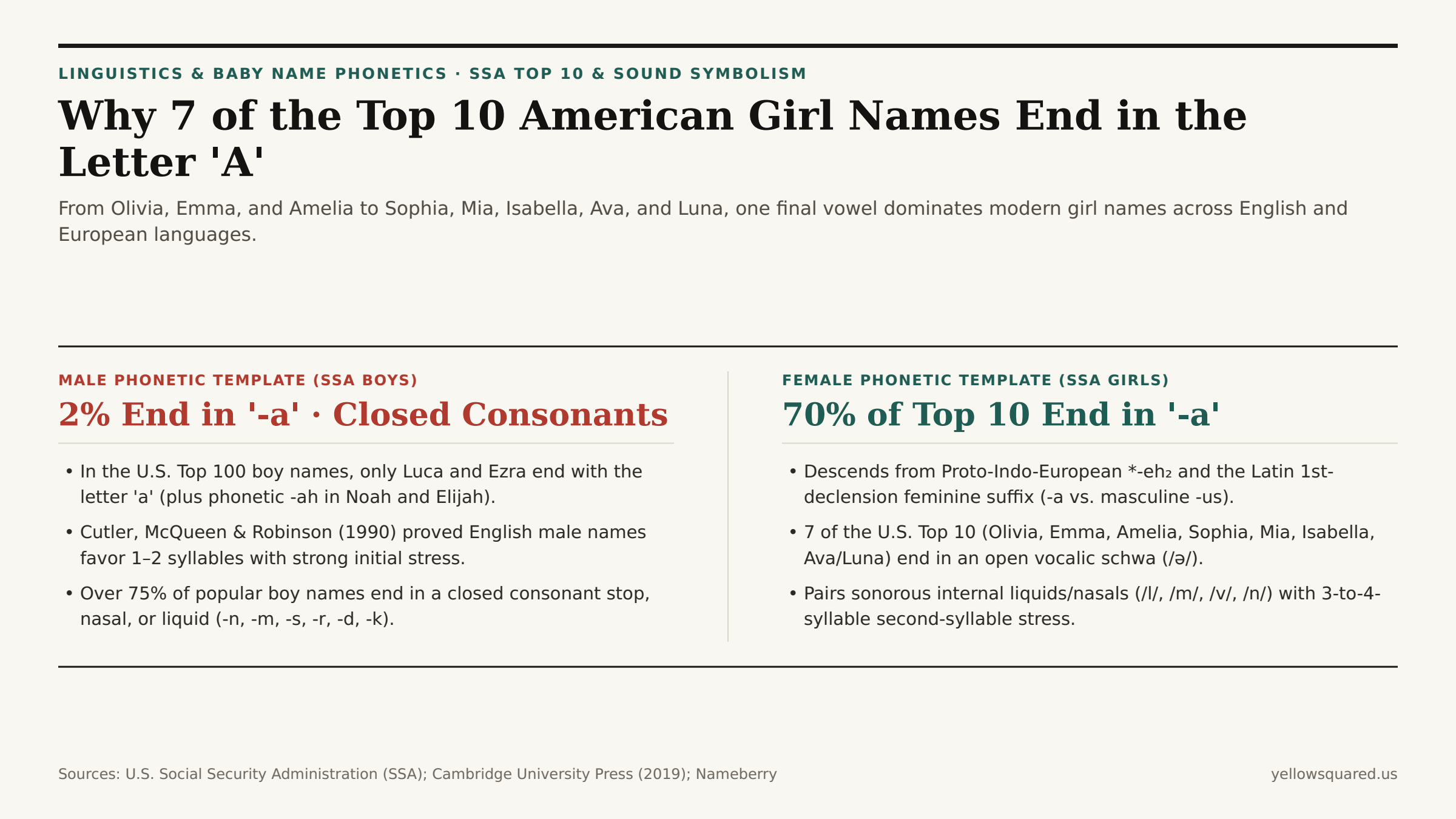
-a (Olivia, Emma, Amelia, Sophia, Mia, Isabella, Ava/Luna), fewer than 2% of Top 100 boy names end with the letter a (Luca, Ezra).1. From Proto-Indo-European *-eh₂ and Latin -a to Modern English
Although Modern English lost grammatical gender on everyday nouns centuries ago, its inventory of personal names preserved the ancient morphological markers of Latin, Greek, and Romance languages (Nameberry Onomastic Corpus):
- The Latin First Declension (
-avs.-us): In Proto-Indo-European, the suffix*-eh₂marked feminine and abstract nouns, which evolved into the Latin First Declension feminine ending-a(contrasted against the Second Declension masculine ending-us). When Roman family and saint names were feminized — Julius → Julia, Claudius → Claudia, Aemilius → Amelia, Octavius → Octavia, Silvius → Silvia — the masculine-uswas dropped or reduced in English and French (Jules, Claude, Emil), while the feminine-asurvived completely intact. - The Cross-Cultural Convergence: Unlike
-ie/-y(which feels specifically English/Scottish) or-ette/-ine(which feels specifically French), the-aending is shared across Latin/Romance (Olivia, Camilla, Sofia, Isabella, Elena), Greek (Sophia, Chloe/Cora, Maia), Germanic (Emma, Freya, Matilda, Clara), Slavic (Mila, Nadia), Hebrew (Eva, Hannah/Anna), and Sanskrit/Arabic (Maya, Layla, Aaliyah). In a multicultural country,-anames travel effortlessly across language borders.
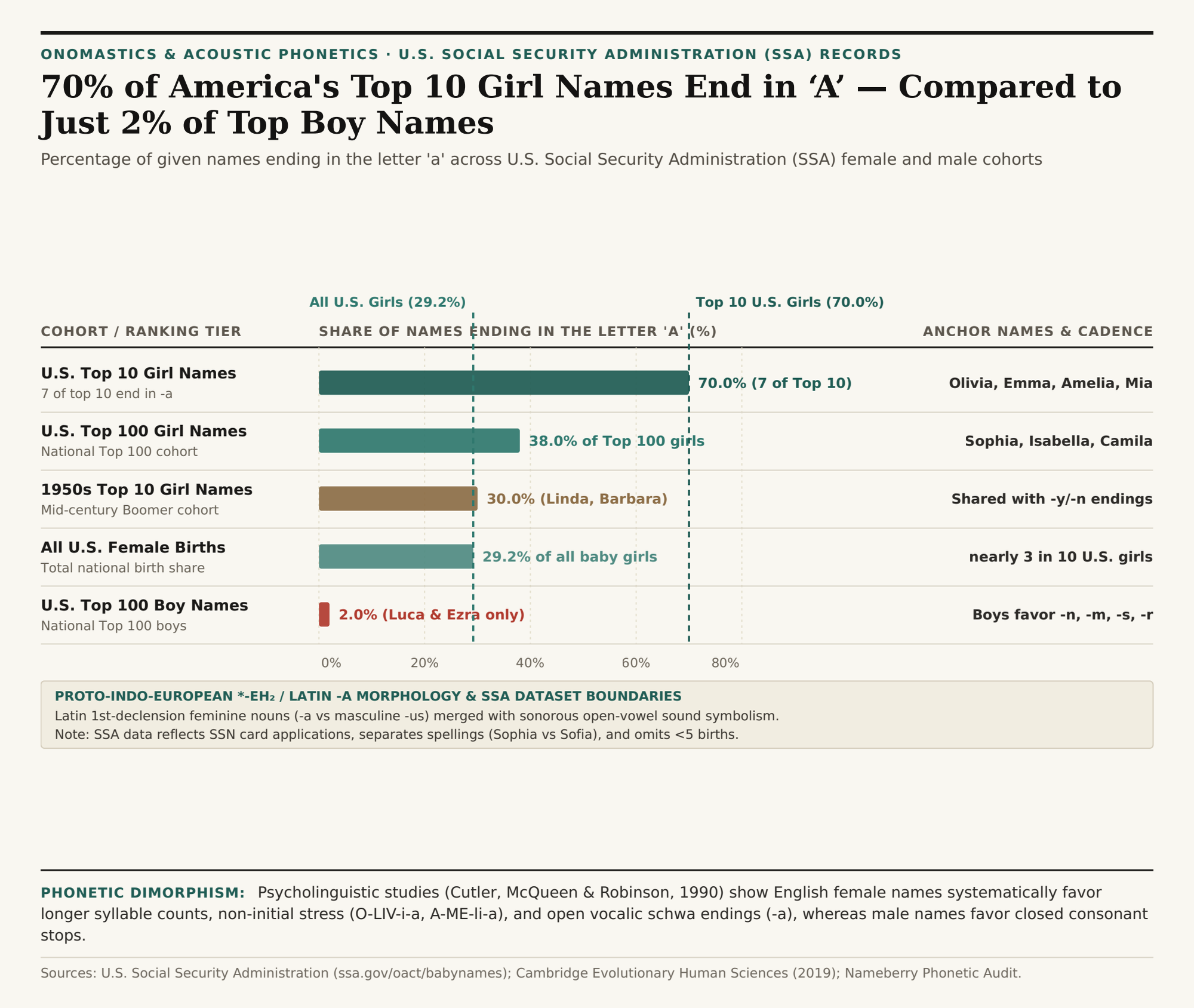
A across U.S. Social Security Administration cohorts. Download the SSA girl-name phonetic share dataset (CSV).2. Acoustic Phonetics: Why 3-Syllable -ia Names Replaced Mid-Century 1-Syllable Names
In their landmark 1990 study "Elizabeth and John: Sound Patterns of Men's and Women's Names" (and extended in Cambridge's Sex-Biased Sound Symbolism Analysis), linguists Anne Cutler, James McQueen, and Ken Robinson discovered three structural rules that distinguish English female names from male names:
- Syllable Length & Non-Initial Stress: Male names are overwhelmingly monosyllabic or trochaic (stressed on the very first syllable:
JAMES,LI-am,NO-ah,JACK-son). Female names are significantly longer (averaging2.8 to 3.2 syllablesin the Top 10) and frequently place primary stress on the second syllable (O-LIV-i-a,A-ME-li-a,So-PHI-a,I-sa-BEL-la,Ca-MI-la). - Open Vocalic vs. Obstruent Endings: Ending a word with an open vowel (
/ə/) elongates the final acoustic decay and avoids the abrupt glottal or alveolar cutoff of a stop consonant (/t/, /d/, /k/, /p/). Combined with liquid and nasal interior consonants (/l/, /m/, /n/, /v/), names like Olivia, Amelia, Elena, and Gianna maximize continuous vocalic sonority. - The Generational Shift From
-y/-n(1950s–1980s) to-a(2000s–2020s): In the 1950s (Mary, Susan, Karen, Donna, Nancy) and 1980s (Jessica, Ashley, Amanda, Sarah, Brittany, Jennifer),-anames shared the stage with-y/-ieand-nendings. Today, as those mid-century-yand-nsuffixes aged into "mom and grandma" territory, parents consolidated around liquid-iaand-aendings.
"Take the exact same liquid-and-nasal consonant skeleton — L, M, V, or N — and add a final closed consonant for a boy (Liam, Evan, Julian, Emil) or an open '-ia' vowel cadence for a girl (Lilia, Eva, Juliana, Amelia)."
| Name Cohort | Benchmark Source | Ends in -A |
Mean Syllables | Anchor Examples | Dominant Phonetic Trait |
|---|---|---|---|---|---|
| U.S. Top 10 Girl Names | SSA National Top 10 | 70.0% | 3.1 syllables | Olivia, Emma, Amelia, Sophia, Mia | Open schwa /ə/ + liquid /l/, /m/ |
| U.S. Top 100 Girl Names | SSA National Top 100 | 38.0% | 2.8 syllables | Isabella, Camila, Aria, Gianna, Nora | 2nd-syllable stress + -ia / -a |
| All U.S. Female Births | Nameberry / SSA Total | 29.2% | 2.6 syllables | Nearly 3 in 10 U.S. baby girls | Cross-linguistic Romance/Germanic fit |
| 1950s Top 10 Girl Names | SSA 1950–1959 Cohort | 30.0% | 2.2 syllables | Linda, Patricia, Barbara (vs Mary, Susan) | Balanced with -y and -n endings |
| U.S. Top 100 Boy Names | SSA National Top 100 | 2.0% | 2.1 syllables | Luca & Ezra (plus -ah Noah, Elijah) |
Closed nasal/stop endings (-n, -m, -s) |
Important SSA Dataset Boundaries & Phonetic -ah Variants
When interpreting ending-letter statistics, keep in mind the official U.S. Social Security Administration Baby Names Dataset Limits: SSA records reflect Social Security Number (SSN) card applications, every exact spelling is tabulated separately (so Sophia and Sofia, or Amelia and Emilia, are ranked as independent names rather than merged), and names with fewer than 5 occurrences (<5) in a calendar year are omitted for privacy. In addition, counting strictly by final letter -a excludes names that end in the identical spoken schwa sound spelled with -ah — such as Hannah, Sarah, Delilah, Savannah, and Aaliyah for girls, or Hebrew -ah names like Noah, Elijah, Jonah, and Micah for boys. Explore historical baby name trends in Name Scout to search by both spelling and phonetic ending, and download the girl-name -a ending share CSV dataset.