
Why Do Tomatoes Lose Flavor in the Fridge?
Refrigerating a tomato for more than three days below 54°F (12°C) cuts its aroma volatiles by 65 percent while leaving its sugars and acids almost untouched at 97 percent. However, if a tomato is already fully ripe on your counter and on the verge of going soft, chilling it for just one to two days pauses decay without triggering permanent flavor loss — especially if you let slices warm on the cutting board for 30 minutes before serving.
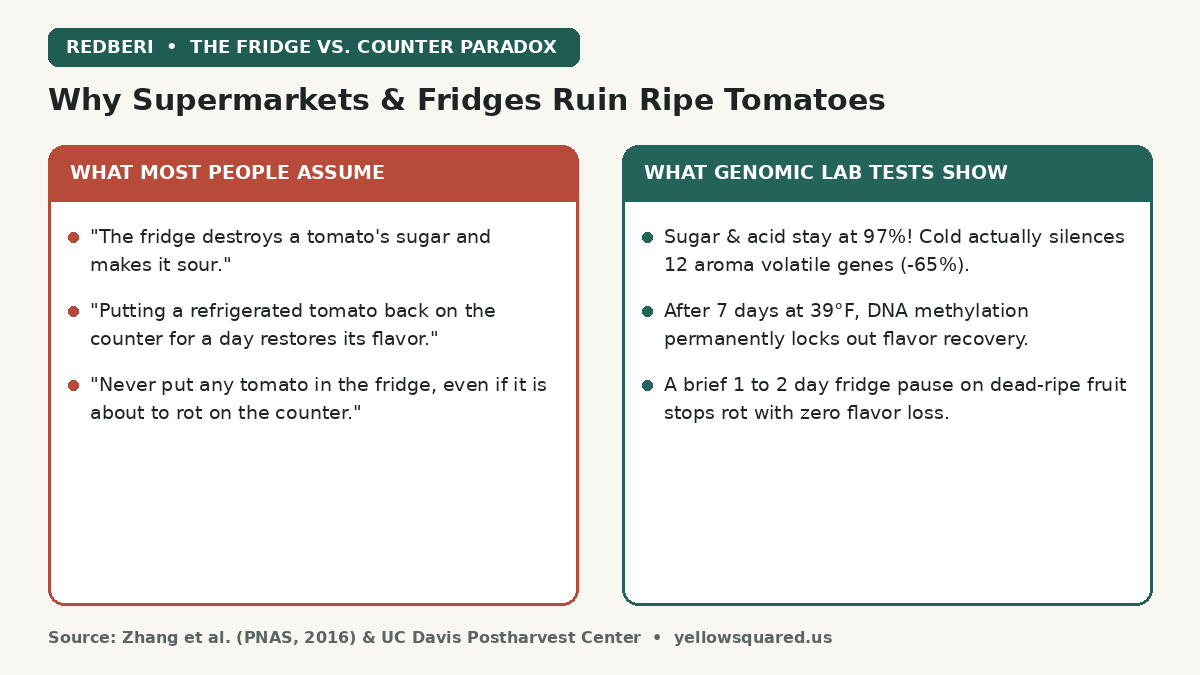
Every summer, home cooks repeat the blanket rule that a tomato should never touch the inside of a refrigerator. Yet anyone who has bought five pounds of peak-season heirloom or Roma tomatoes knows the other half of the dilemma: left on a 72°F kitchen counter, a dead-ripe tomato turns mealy or molds at the stem scar within 48 hours. When plant geneticists actually measured the sugars, acids, and volatile organic compounds inside chilled fruit, they discovered a clear three-day biochemical threshold that resolves the counter-versus-fridge debate.
A refrigerated tomato tastes flat not because cold destroys its sugar, but because temperatures below 54°F methylate the fruit's DNA and switch off the enzymes that synthesize aroma.
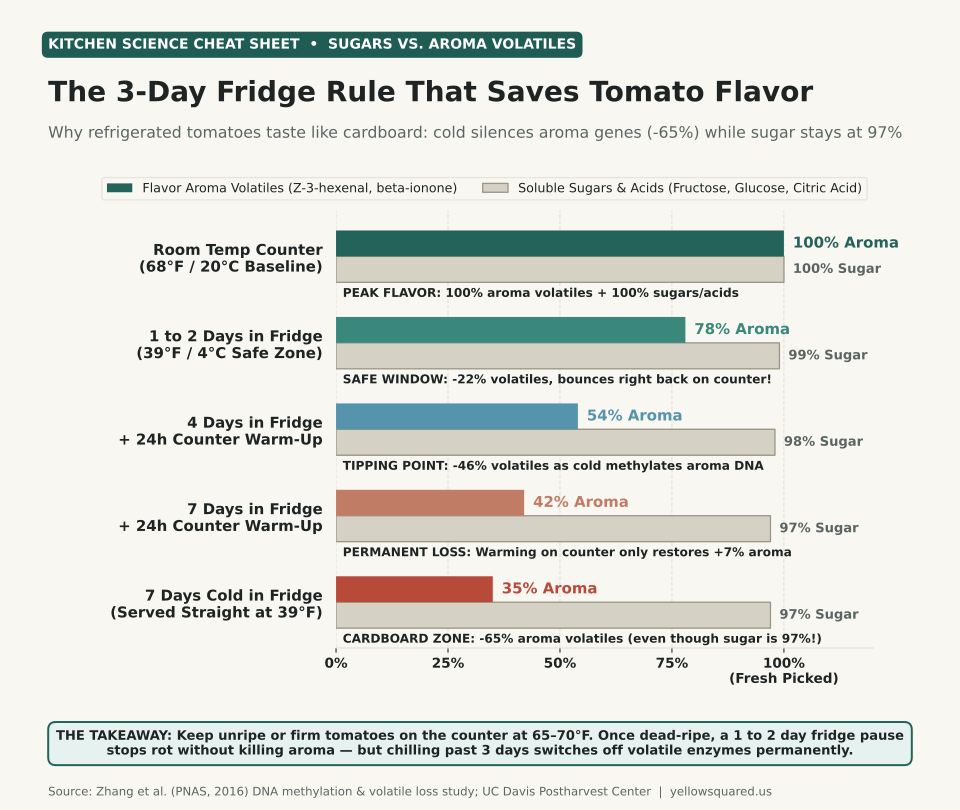
Why Sugar Stays at 97% While Flavor Drops by Two-Thirds
Human perception of "sweetness" and "rich tomato flavor" relies on two separate sensory pathways: taste buds on the tongue detect non-volatile soluble sugars (fructose and glucose) and organic acids (citric and malic acid), while olfactory receptors in the back of the nasal cavity detect retronasal volatile compounds released as you chew.
In a landmark 2016 study published in the Proceedings of the National Academy of Sciences (PNAS), Harry Klee, Bo Zhang, and colleagues at the University of Florida and Cornell University stored ripe tomatoes at 39°F (4°C) for 1, 3, and 7 days, followed by a 24-hour recovery period at room temperature (68°F / 20°C). Gas chromatography and consumer sensory panels revealed three crucial findings:
- Soluble sugars and acids do not budge: Even after 7 full days at 39°F, total soluble solids (°Brix), glucose, fructose, and titratable acidity remained at 97 to 99 percent of fresh-picked counter levels.
- Volatile synthesis collapses by 65 percent after day 3: Twelve volatile aroma compounds derived from amino acids (such as 3-methylbutanal), fatty acids (such as Z-3-hexenal, which provides fresh green-vine notes), and carotenoids (such as beta-ionone and 6-methyl-5-hepten-2-one, which amplify perceived sweetness) dropped bynearly two-thirds when chilled for 7 days.
- Epigenetic silencing blocks recovery after prolonged chill: Chilling past 3 days caused cytosine methylation in the promoter regions of ripening genes (including RIN, NOR, and volatile synthesis enzymes AAT1 and BCAT1). Even after moving 7-day-chilled tomatoes back to a warm 68°F counter for 24 hours, aroma levels only recovered from 35 percent to 42 percent.
How Long Can You Refrigerate Ripe Tomatoes Without Ruining Them?
Because the epigenetic methylation lock builds progressively over 72 hours of cold exposure, short-term chilling behaves very differently from week-long storage. The table below outlines how tomato chemistry responds at each stage:
| Storage Regime | Aroma Volatiles | Sugars & Acids | Kitchen Verdict & Best Use |
|---|---|---|---|
| Room Temp Counter (65–70°F) | 100% | 100% | Gold Standard: Keep all pink, breaker-stage, or firm-ripe tomatoes here stem-side down. |
| 1 to 2 Days in Fridge (39°F) | 78% (recovers to ~95%) | 99% | Safe Pause Window: Halts softening on dead-ripe fruit without permanent gene silencing. |
| 4 Days in Fridge + 24h Counter | 54% | 98% | Noticeable Flatness: Fine for cooked sauces or stews, but raw slices lose top aromatic notes. |
| 7 Days in Fridge (Served Cold) | 35% (-65%) | 97% | Cardboard Effect: Severe volatile depletion plus cold-suppressed vapor pressure on the palate. |
| 7 Days in Fridge + 24h Counter | 42% (-58%) | 97% | Permanent Loss: Roast with olive oil and garlic to compensate for lost fresh volatiles. |
Why You Should Store Tomatoes Stem-Side Down on the Counter
According to postharvest handling guidelines from the UC Davis Postharvest Technology Center and the USDA ARS Commercial Storage Handbook, a tomato's waxy cuticle is nearly impermeable to moisture and mold spores everywhere except one spot: the Corky stem scar at the top shoulder. Placing ripe tomatoes stem-side down (shoulders flat on a plate or towel) seals that porous scar against air circulation, cutting moisture loss in half and preventing airborne mold from colonizing the core — the same ripening discipline we apply when evaluating which climacteric fruits ripen on the counter.
If your tomatoes hit peak ripeness on Tuesday and you plan to slice them for sandwiches on Thursday, move them into the warmer front shelf of your refrigerator (∼40°F to 42°F) for 24 to 48 hours, then pull them onto the counter an hour before slicing. To compare sugar-to-acid profiles and seasonal ripeness markers across produce varieties, explore the Redberi produce quality guide.