
Why Do You Forget 70% of What You Study Within 24 Hours? (The Ebbinghaus Forgetting Curve & Spaced Repetition)
You spend an entire evening reading a textbook chapter or sitting through a dense technical workshop, feeling confident that you understand every concept—only to blank on two-thirds of the details by the next afternoon. That rapid mental wipeout is not a personal flaw; it is the classic Ebbinghaus Forgetting Curve, first quantified by German psychologist Hermann Ebbinghaus in 1885 (and successfully replicated in modern cognitive trials such as Murre & Dros in 2015).
As detailed in SuperMemo's analysis of Ebbinghaus's Chapter 7 experiments and cognitive memory reviews citing Cepeda et al. (2008), unreviewed rote information decays at its fastest rate in the first 60 minutes to 24 hours—losing roughly 70% of retention savings within a single day unless active retrieval interrupts the curve. Schedule spaced review blocks and study intervals in Timeli so your hardest material comes back right before it fades.
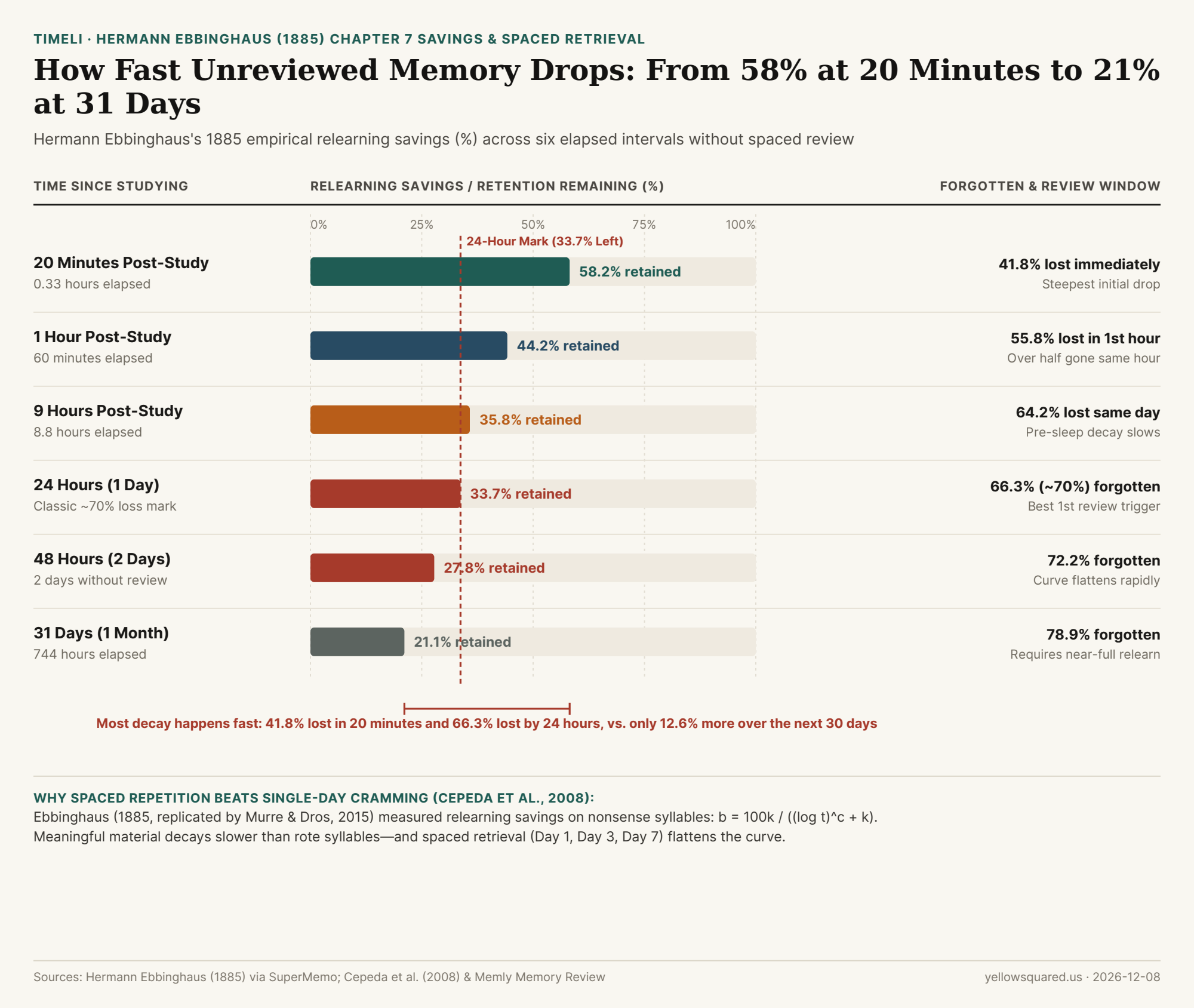
% retained) across six intervals from 20 minutes to 31 days without spaced review. Sources: Ebbinghaus Chapter 7 Savings Data (SuperMemo) and Cepeda et al. (2008) Review (Memly) · Download CSV dataset.The 1885 Savings Formula: Where the "70% in 24 Hours" Figure Comes From
To measure pure memory decay without distortion from prior knowledge, Ebbinghaus spent years memorizing lists of 2,300 three-letter consonant-vowel-consonant nonsense syllables (like WID or ZOF) and timing how much faster he could relearn a list after a delay—a metric he called relearning savings (b):
b = 100k / ((log t)^c + k)
His empirical table revealed a steep logarithmic drop rather than a steady straight-line decline:
- First 20 Minutes: Relearning savings dropped immediately to
58.2%(meaning41.8%of effort was already lost). - 1 Hour: Savings fell to
44.2%(55.8%lost within the very first hour). - 9 Hours (
8.8 hrs): Savings reached35.8%(64.2%lost by bedtime). - 24 Hours (1 Day): Savings hit
33.7%—leaving roughly66.3%(commonly rounded to~70%) forgotten without review. - 31 Days (1 Month): The curve flattened out almost completely, hovering at
21.1%(78.9%lost).
"More memory is lost in the first 60 minutes after studying (55.8%) than over the entire next 30 days combined (an additional 23.1%)—which is why timing your very first review within 24 hours changes everything."
Important Nuance: Meaningful Knowledge Decays Slower Than Nonsense Syllables
While Ebbinghaus's ~70% 24-hour benchmark is a reliable warning for unreviewed rote facts (vocabulary, formulas, acronyms, or names), cognitive psychologists emphasize an important boundary: meaningful, connected material decays more slowly than isolated nonsense syllables. When you link a new concept to something you already understand—or test yourself with active recall rather than passive rereading—your starting retention curve starts higher and decays more gently.
Ebbinghaus Forgetting Curve & Spaced Review Table
The table below lists Ebbinghaus's exact Chapter 7 relearning savings across seven intervals alongside the corresponding spaced repetition intervention (download the raw CSV dataset):
| Time Since Initial Learning | Elapsed Hours | Ebbinghaus Savings (%) |
Unreviewed Loss (%) |
Spaced Repetition Strategy |
|---|---|---|---|---|
| 20 Minutes | 0.33 hrs |
58.2% |
41.8% lost |
Close the book and summarize 3 key takeaways from memory |
| 1 Hour | 1.0 hr |
44.2% |
55.8% lost |
Quick 2-minute flashcard or self-quiz check |
9 Hours (8.8 hrs) |
8.8 hrs |
35.8% |
64.2% lost |
Sleep consolidates hippocampal traces into neocortex |
| 24 Hours (1 Day) | 24.0 hrs |
33.7% |
66.3% (~70%) lost |
Review #1: 5-minute active recall resets decay slope |
| 48 Hours (2 Days) | 48.0 hrs |
27.8% |
72.2% lost |
Review #2 (Day 3): Reconstruct core concepts without notes |
| 6 Days | 144.0 hrs |
25.4% |
74.6% lost |
Review #3 (Day 7): Final weekly consolidation check |
| 31 Days (1 Month) | 744.0 hrs |
21.1% |
78.9% lost |
Monthly maintenance review locks long-term recall |
The 1-3-7 Spaced Study Schedule
Instead of spending 4 straight hours rereading notes on Sunday night, split that exact same time into four short active-recall sessions: 2.5 hours on Day 0, plus three 30-minute retrieval quizzes on Day 1, Day 3, and Day 7. Letting the memory partially fade between sessions forces your brain to work harder to retrieve it—and that "desirable difficulty" is what converts fragile short-term notes into durable long-term recall. Schedule spaced review blocks and study intervals in Timeli to automate your Day-1, Day-3, and Day-7 study blocks.