
Why Does a 90 °C (194 °F) Sauna Feel Bearable While 50 °C (122 °F) Water Scalds Skin?
Step into a traditional Finnish wood-lined sauna heated to 90 °C (194 °F)—Just 10 degrees below the boiling point of water—and you can sit comfortably on the cedar bench for 15 minutes without a single blister. Yet if you dip your hand into a pot of water heated to just 55 °C (131 °F), you will yank it back in pain as your skin suffers a second-degree scald burn in under 25 seconds. Even stranger, if you walk into a wet Turkish bath or gym steam room set to 90 °C at 100% relative humidity, you would suffer life-threatening thermal burns within moments—which is why commercial steam rooms are strictly capped around 43 to 48 °C (110 to 118 °F).
How can human skin effortlessly tolerate 90 °C dry air while suffering severe tissue destruction in 55 °C liquid water or 55 °C saturated steam? The answer lies in one of the most important distinctions in thermodynamics and human thermoregulation: the difference between temperature (how fast molecules are vibrating) and conductive/evaporative heat flux (how many joules of thermal energy cross into your skin per second). Here is the exact physics.
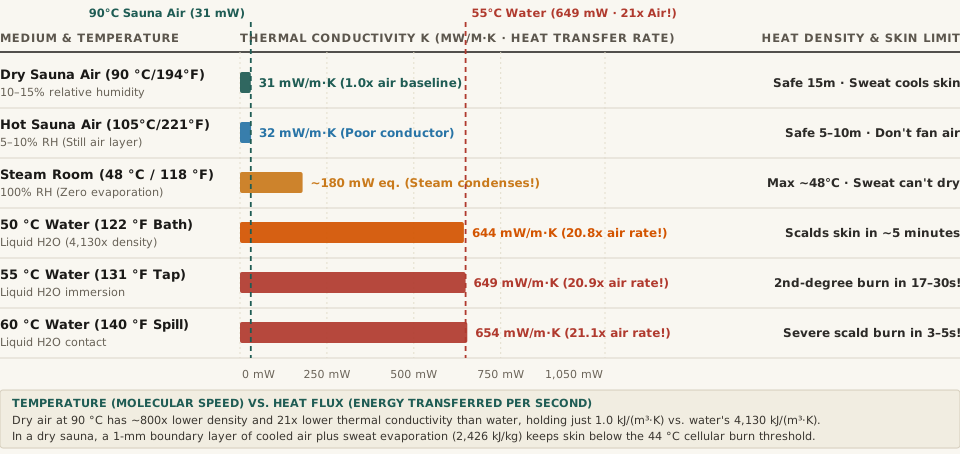
mW/m·K) and effective heat-transfer behavior across dry sauna air (90–105 °C), saturated steam rooms (48 °C), and hot liquid water (50–60 °C). Download the full dataset: sauna-dry-air-vs-steam-and-hot-water-thermal-conductivity-and-burn-thresholds.csv.1. Temperature Is Not Heat: Water Packs 4,130× More Heat per Cubic Centimeter and Conducts 21× Faster
In everyday speech, we treat “temperature” and “heat” as synonyms. In physics, temperature is merely the average kinetic energy per molecule, whereas thermal burn damage occurs only when enough total energy flows into your epidermis to raise living basal skin cells above their protein-denaturation threshold of 44 °C (111.2 °F) (first quantified in the classic 1947 Moritz and Henriques time-temperature burn curve).
Why does liquid water at 55 °C drive your skin past 44 °C almost instantaneously while 90 °C air does not? Compare two fundamental physical properties of dry air versus liquid water:
- Volumetric Heat Capacity (ρ × cp — A 4,130× Difference!): At 90 °C, dry air has a density (ρ) of roughly 0.97 kg/m3 and a specific heat capacity (cp) of 1.01 kJ/(kg·K), meaning one cubic meter of sauna air stores less than 1.0 kilojoule per kelvin. Liquid water at 50–55 °C has a density of 986 kg/m3 (~1,000× denser than hot air) and a specific heat of 4.18 kJ/(kg·K) (4.1× higher per kilogram)—giving water a volumetric heat capacity of 4,130 kJ/(m3·K). A single cubic centimeter of hot bathwater touching your skin carries over 4,100 times more thermal energy per degree than a cubic centimeter of sauna air!
- Thermal Conductivity (k — A 21× Difference!): According to Fourier's Law of Heat Conduction (q = −k ∇T), the rate at which heat flows through a medium is proportional to its thermal conductivity k. Dry air at 90 °C is an exceptional thermal insulator with k = 0.031 W/(m·K) (31 milliwatts per meter-kelvin). Liquid water at 50–60 °C has k = 0.644 to 0.654 W/(m·K)—21 times higher than air.
Because air is both low-density and a poor conductor, the moment you sit motionless on a sauna bench, your 37 °C skin cools a thin 1-to-2-millimeter boundary layer of still air clinging to your body. That microscopic air blanket insulates you from the 90 °C room air—which is why blowing on your arm or having someone wave a towel (Aufguss) in a 90 °C sauna suddenly feels searingly hot: moving air strips away your insulating boundary layer!
2. The Evaporative Shield: How Sweating Pumps Out 2,426 Kilojoules per Liter
Even with an insulating air layer, sitting in a 90 °C room for 15 minutes would eventually overheat your skin if not for the human body's primary high-temperature cooling engine: evaporative sweating. As detailed in physiological analyses of human thermoregulation and clinical reviews of sauna physiology, in a traditional dry Finnish sauna where relative humidity is kept low (typically 10% to 20% RH), your sympathetic nervous system activates eccrine sweat glands at rates of up to 0.6 to 1.5 liters per hour.
Every gram of liquid sweat that evaporates from your skin into that dry air absorbs the latent heat of vaporization of water: 2,426 joules per gram (580 kcal per liter) directly out of your epidermis—actively refrigerating your skin surface so it stays near 39–41 °C even while the air two inches away is 90 °C.
“In a 90 °C dry sauna at 10% humidity, evaporating sweat pulls 2,426 kilojoules of heat per liter out of your skin. In a 48 °C steam room at 100% humidity, evaporation drops to zero—and condensing steam dumps those exact 2,426 kilojoules per liter ONTO your skin.”
3. Why a 48 °C Steam Room Feels As Hot As a 90 °C Dry Sauna
Now compare all six thermal environments side by side to see why humidity and phase changes completely alter human heat tolerance:
| Thermal Environment or Medium | Temperature (°C / °F) | Thermal Conductivity k (W/m·K) |
Volumetric Heat Capacity (kJ/m3·K) |
Conductivity vs. Dry Air | Sweat Evaporation & Skin Burn Threshold |
|---|---|---|---|---|---|
| Dry Finnish Sauna Air (10–15% RH) | 90 °C (194 °F) | 0.031 W/(m·K) | 1.00 kJ/(m3·K) | 1.0× Baseline | Safe 10–20 min; sweat evaporation removes 2,426 kJ/kg |
| Extreme Dry Sauna Air (5–10% RH) | 105 °C (221 °F) | 0.032 W/(m·K) | 0.96 kJ/(m3·K) | 1.03× Baseline | Tolerable briefly if motionless; moving air strips boundary layer |
| 100%-Humidity Steam Room (Hammam) | 48 °C (118 °F) | 0.028 + latent steam | 1.10 + condensation | ~4–6× heat load | 0% evaporation! Water vapor condenses heat onto 37 °C skin |
| Hot Bath / Scald Threshold Water | 50 °C (122 °F) | 0.644 W/(m·K) | 4,130 kJ/(m3·K) | 20.8× air rate | Full-thickness epidermal scald burn in ~5 minutes |
| Hot Tap Water (High-Temp Heater) | 55 °C (131 °F) | 0.649 W/(m·K) | 4,120 kJ/(m3·K) | 20.9× air rate | Second-degree blistering scald burn in 17 to 30 seconds! |
| Scalding Water / Beverage Spill | 60 °C (140 °F) | 0.654 W/(m·K) | 4,110 kJ/(m3·K) | 21.1× air rate | Severe second-degree skin burn in just 3 to 5 seconds! |
Look at why throwing a ladle of water onto the superheated stones of a Finnish sauna stove (creating a burst of steam known as löyly) produces an immediate, intense wave of heat across your shoulders: first, rising water vapor increases air humidity, slowing down evaporative cooling from your sweat. Second, because your skin (~38 °C) is cooler than the dew point of the hot steam plume, microscopic droplets of water vapor condense directly onto your skin—running the phase change in reverse and releasing 2,426 joules of latent heat per gram of condensed water straight into your epidermis! That is also why you should never wear metal necklaces or rings into a 90 °C sauna: silver and gold have thermal conductivities above 310 to 420 W/(m·K) (10,000 times higher than air) and will Brand your skin on contact.
Explore Humidity, Dew Point, and Psychrometric Profiles on Eranorms
Whether you are comparing how dry-bulb temperature, relative humidity, and wet-bulb globe temperature (WBGT) govern human heat stress outdoors or how latent heat drives atmospheric convection, Analyze atmospheric soundings on Eranorms to inspect real-world temperature, dew-point, and humidity profiles.