
Why Does Alaska Have Only One Mainland Time Zone?
Why Does Alaska Have Only One Mainland Time Zone?
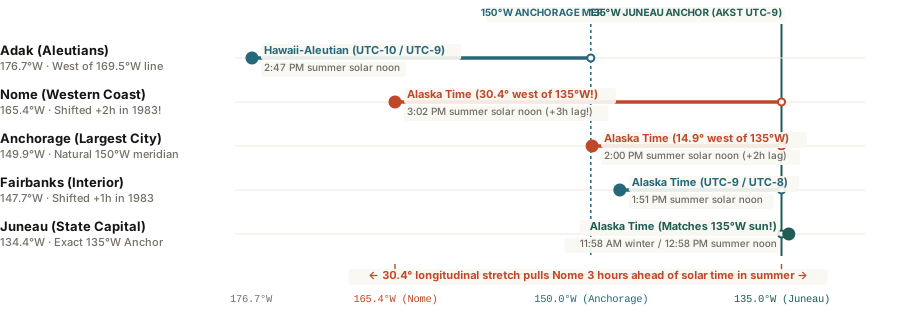
On October 30, 1983, Alaska collapsed four separate time zones onto the 135°W Juneau meridian (AKST, UTC-9 / AKDT, UTC-8) to synchronize state commerce—pulling Anchorage 2 hours and Nome 3 hours ahead of summer solar time.
Superimpose a map of Alaska over the contiguous United States and the scale is staggering: from the southeastern Panhandle at Hyder (`130.0°W`) to Attu Island at the western tip of the Aleutian chain (`172.9°E`), Alaska spans nearly 58 degrees of longitude—roughly the same east-to-west width as the distance from Savannah, Georgia, to San Francisco, California. By standard 15-degree astronomical geometry, Alaska is wide enough to require four separate time zones.
In fact, until October 30, 1983, Alaska did have four time zones. Today, however, 99% of the state's population—from Ketchikan and Juneau in the southeast to Anchorage, Fairbanks, Utqiagvik, and Nome on the Bering Strait—shares a single clock: Alaska Standard Time (`AKST, UTC-9` in winter and `AKDT, UTC-8` in summer). Understanding why Alaska abolished three of its time zones in 1983 explains why summer solar noon in western Alaska does not arrive until 3:02 PM in the afternoon.
Before October 1983: When Juneau Was Two Hours Ahead of Anchorage
Prior to autumn 1983, conducting business or state government across Alaska was a logistical nightmare. The state was carved into four federal zones from east to west:
- Pacific Time (`UTC-8` / `UTC-7`): Observed in Juneau (the state capital), Ketchikan, and Sitka in the Southeast Panhandle.
- Yukon Time (`UTC-9` / `UTC-8`): Observed in a narrow, sparsely populated strip around Yakutat (`139.7°W`).
- Alaska-Hawaii Time (`UTC-10` / `UTC-9`): Observed in Anchorage (`149.9°W`) and Fairbanks (`147.7°W`)—which held nearly three-quarters of the state's residents and matched the natural `150°W` solar meridian.
- Bering Time (`UTC-11` / `UTC-10`): Observed in Nome (`165.4°W`), Bethel, and the western Aleutians.
Because Juneau sat on Pacific Time while Anchorage and Fairbanks sat on Alaska-Hawaii Time, the state capital was two hours ahead of its largest city—and three hours ahead of Nome. Once you subtracted lunch hours, citizens in Anchorage had barely four hours a day to reach state agencies in Juneau by phone, and Anchorage businesses sat a punishing 5 hours behind New York and Washington, D.C.
Rather than moving the state capital out of Juneau, Alaska moved the clocks of Anchorage, Fairbanks, and Nome eastward to meet Juneau on the 135°W meridian.
How the 1983 Consolidation Created a 3-Hour Solar Lag in Nome
Following a formal petition from the Alaska Legislature and Governor Bill Sheffield, the U.S. Department of Transportation issued a historic ruling that took effect on October 30, 1983 (the autumn Daylight Saving transition day):
- 99% of Alaska Merged Onto `135°W` (`UTC-9`): Juneau stepped back one hour from Pacific Time (`UTC-8`) to `UTC-9`, while Anchorage and Fairbanks skipped their autumn "fall back" and shifted permanently forward from `UTC-10` to `UTC-9` (renamed Alaska Standard Time). Only the Aleutian Islands west of `169°30'W` (`America/Adak`) remained on `UTC-10 / UTC-9` (renamed Hawaii–Aleutian Time).
- Anchorage's 2-Hour Summer Solar Lag: Because Anchorage sits at `149.9°W` (the natural `UTC-10` meridian), adopting `UTC-9` in winter and `UTC-8` in summer puts Anchorage 2 full hours ahead of solar time from March to November (`2:00 PM` solar noon).
- Nome's 3-Hour Summer Solar Lag: In Nome (`165.41°W`), which shifted two full time zones eastward from Bering Time (`UTC-11`) to Alaska Time (`UTC-9`), summer Daylight Saving Time (`AKDT, UTC-8`) pushes true astronomical midday to 3:02 PM on the clock.
When planning flights, expedition logistics, or remote calls across Seattle, Juneau, Anchorage, and Honolulu, you can Open Tempo in your browser to compare Alaska and Hawaii–Aleutian offsets across seasonal DST changes.