
Why Does Arizona Not Observe Daylight Saving Time?
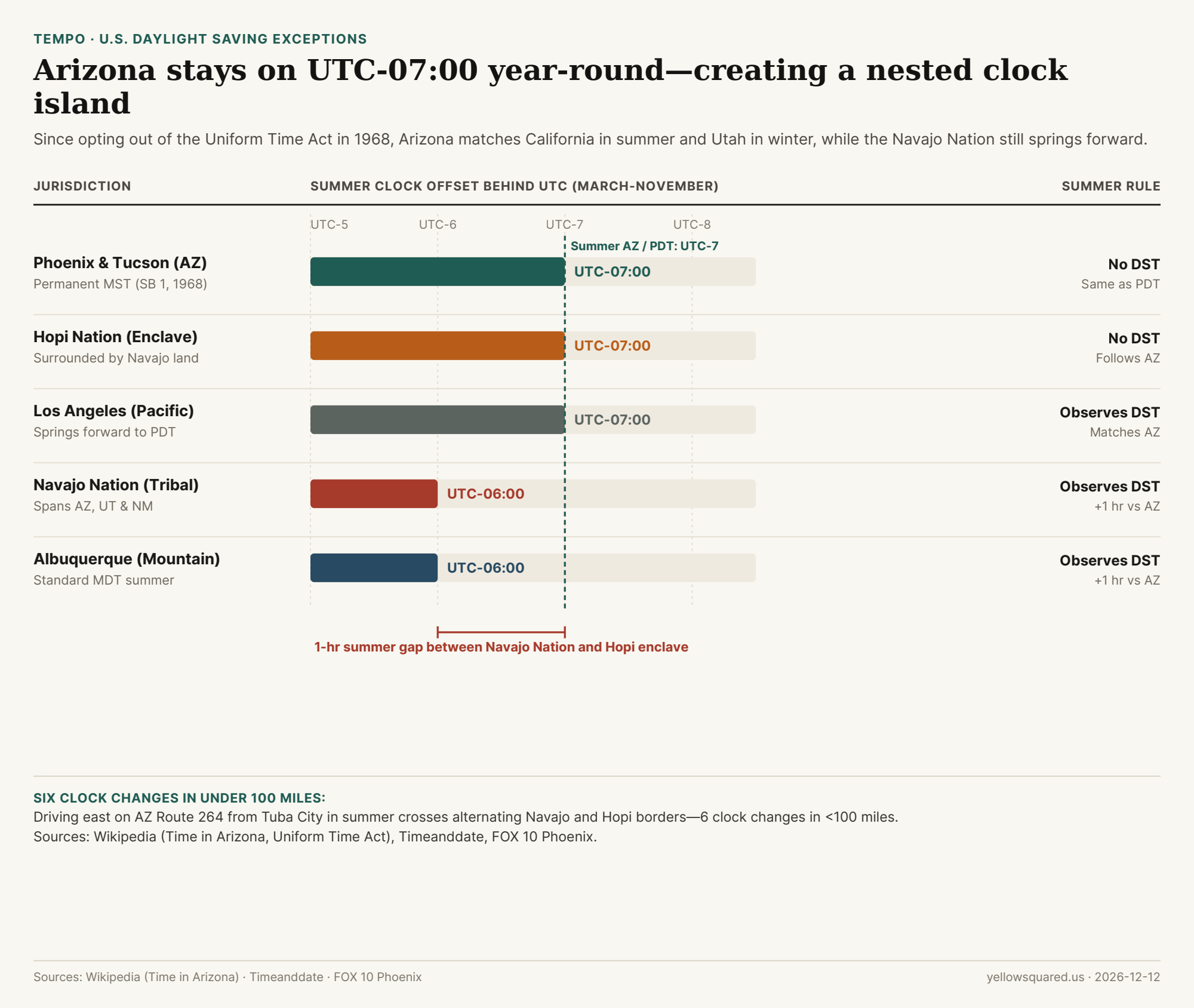
Every March and November, while nearly the entire United States springs forward and falls back, most of Arizona leaves its clocks untouched on Mountain Standard Time (UTC-07:00). As a result, Phoenix shares the exact same time as Los Angeles (Pacific Daylight Time) from March to November, then matches Denver and Albuquerque (Mountain Standard Time) from November to March.
Why Arizona Opted Out in 1968
When Congress passed the Uniform Time Act of 1966, Arizona tried Daylight Saving Time once in 1967. According to Wikipedia's Time in Arizona records and Arizona State Historian Marshall Trimble, pushing summer sunsets past 9:00 PM kept air conditioners running longer during peak evening heat and hurt drive-in theaters and restaurants. On March 21, 1968, the Arizona legislature passed SB 1 to keep the state on Mountain Standard Time year-round.
"Traveling east on Arizona State Route 264 from Tuba City during DST involves six time zone changes in less than 100 miles." — Time in Arizona, Wikipedia
The Navajo and Hopi Clock Donut Hole
Because tribal nations set their own clock rules, the Navajo Nation—whose territory extends into Utah and New Mexico—observes Daylight Saving Time to keep a single schedule across its reservation. However, the Hopi Reservation, an enclave completely surrounded by the Navajo Nation inside Arizona, follows Arizona's no-DST rule. From March to November, driving across northeastern Arizona jumps back and forth between UTC-07:00 and UTC-06:00 six times in under 100 miles.
To check whether Phoenix matches Los Angeles or Denver on any date of the year before sending a calendar invite, Open Tempo in your browser.