
Why Does Arizona Not Observe Daylight Saving Time (Except the Navajo Nation)?
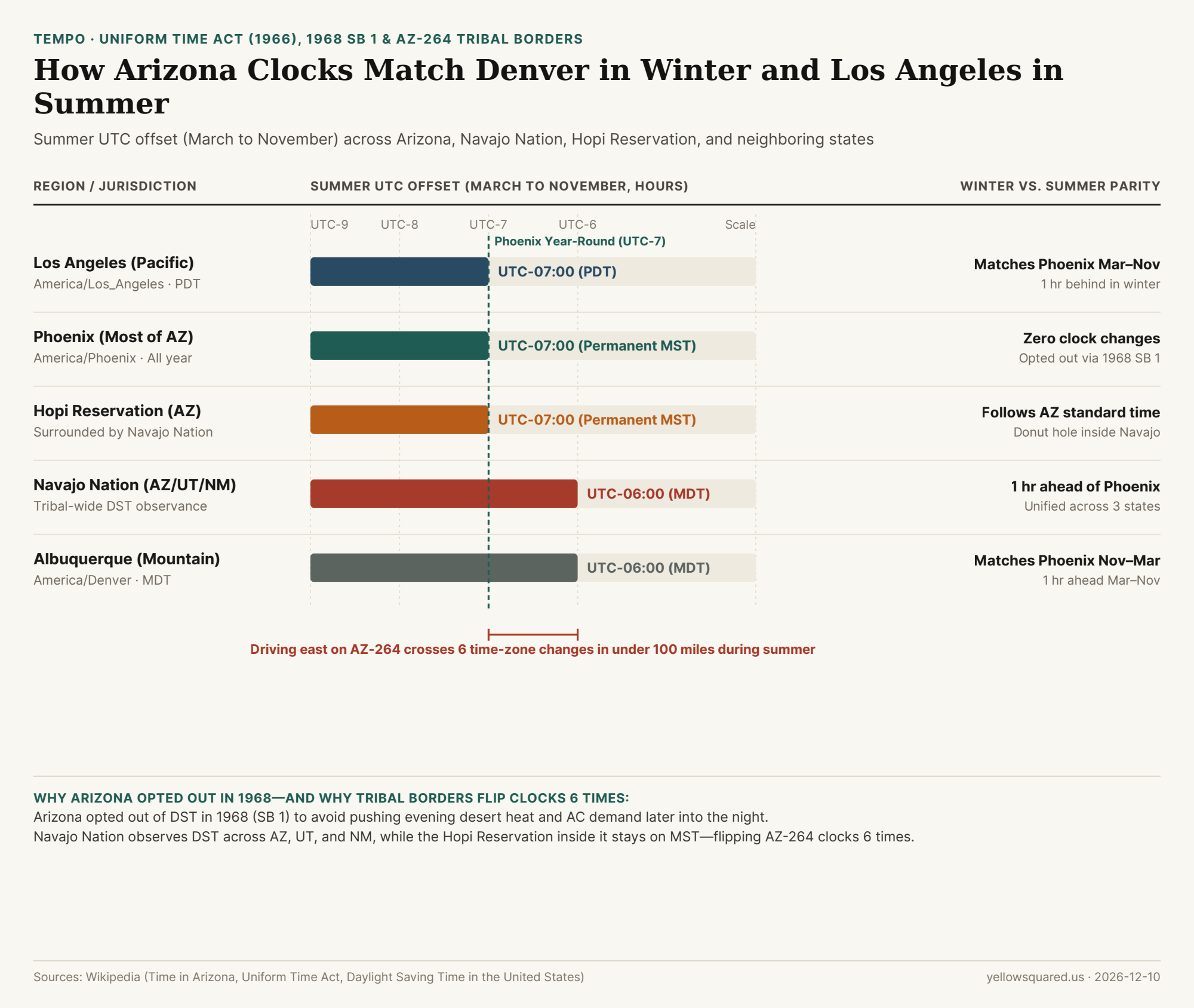
Along with Hawaii and five U.S. territories, Arizona is one of only two U.S. states that does not change its clocks twice a year. Since 1968, most of Arizona (America/Phoenix) has remained permanently on Mountain Standard Time (UTC-07:00)—meaning Phoenix shares the same clock time as Albuquerque and Denver from November to March, then matches Los Angeles and Seattle (PDT, UTC-07:00) from March to November.
As documented in Time in Arizona, the Uniform Time Act, and Daylight saving time in the United States, there is one famous exception inside state lines: the Navajo Nation observes Daylight Saving Time, while the Hopi Reservation surrounded by it does not. Open Tempo in your browser to check whether America/Phoenix currently matches Pacific or Mountain time for your next meeting.
Why Arizona Opted Out in 1968
When Congress passed the Uniform Time Act of 1966, states were allowed to exempt themselves by passing a statewide law. Arizona briefly tried DST in 1967, then passed Senate Bill 1 on March 21, 1968, locking the state onto permanent Mountain Standard Time:
- Desert Heat & Air Conditioning: In Phoenix and Tucson, pushing sunset an hour later in June and July keeps outdoor activities and peak cooling demand running later into the evening—increasing rather than reducing electricity use for air conditioning.
- Seasonal Neighbor Parity: Because California and Nevada spring forward to
UTC-07:00on the second Sunday of March, Arizona automatically aligns with the West Coast all summer without touching a single clock.
"Traveling east on Arizona State Route 264 from Tuba City during Daylight Saving Time crosses six time-zone changes in less than 100 miles because Navajo Nation observes DST while Arizona and the Hopi Reservation do not."
The Navajo Nation and Hopi Reservation Donut Hole
Because the Navajo Nation spans northeastern Arizona, northwestern New Mexico, and southeastern Utah, tribal law applies Daylight Saving Time (UTC-06:00 in summer) across the entire reservation so government and schools stay on one clock. However, the Hopi Reservation—geographically enclaved inside the Arizona portion of the Navajo Nation—follows Arizona standard time (UTC-07:00). Driving AZ-264 in summer therefore flips your car clock back and forth six times in under 100 miles.
Arizona & Neighboring Time Zone Reference Table
The table below compares winter and summer UTC offsets across the Southwest (download the raw CSV dataset):
| Jurisdiction | IANA Zone | Winter (Nov–Mar) | Summer (Mar–Nov) | DST Observed | Neighbor Parity |
|---|---|---|---|---|---|
| Phoenix / Arizona | America/Phoenix |
UTC-07:00 (MST) |
UTC-07:00 (MST) |
No (1968 SB 1) | Denver in winter; LA in summer |
| Hopi Reservation | America/Phoenix |
UTC-07:00 (MST) |
UTC-07:00 (MST) |
No | Matches Phoenix year-round |
| Navajo Nation | America/Denver |
UTC-07:00 (MST) |
UTC-06:00 (MDT) |
Yes (3 states) | Matches Albuquerque year-round |
| Los Angeles | America/Los_Angeles |
UTC-08:00 (PST) |
UTC-07:00 (PDT) |
Yes | Matches Phoenix Mar–Nov |