
Why Does Asparagus Make Urine Smell—And Why Can Only Some People Smell It?
Eat half a dozen roasted spears of spring asparagus (Asparagus officinalis), and within 15 to 30 minutes a sharp, unmistakable sulfurous aroma—somewhere between cooked cabbage and wet matchsticks—appears in the bathroom. Yet if you mention this at the dinner table, more than half the room will look at you in total confusion and insist their body never produces the smell at all. According to the landmark December 2016 genome-wide association study published in The BMJ by Harvard T.H. Chan School of Public Health researchers Sarah C. Markt, Lorelei A. Mucci, and colleagues ("Sniffing out significant 'Pee values': genome wide association study of asparagus anosmia", BMJ 2016;355:i6071), across 6,909 genotyped adults, roughly 60.2% of people (4,161 of 6,909) cannot smell asparagus metabolites in urine—not primarily because their kidneys fail to excrete the compounds, but because of 871 genetic variants on chromosome 1q44 governing the OR2M7 olfactory receptor in their nose.
Why is Asparagus officinalis the only vegetable in the produce aisle that triggers this rapid sulfur reaction, why did French chemist Louis Lémery link the phenomenon to oil of turpentine in 1702, and why do jeunes/young spring tips produce a far stronger aroma than woody late-season stalks? Here is the complete organic chemistry and human genetics breakdown.
1. The Molecule Unique to Asparagus: Asparagusic Acid (C4H6O2S2)
Garlic, onions, leeks, and broccoli are packed with organosulfur compounds, yet none of them produce the instantaneous, hyper-volatile urinary aroma of asparagus. As detailed in the biochemical literature cited in Markt et al.'s 2016 BMJ study, the culprit is a five-membered disulfide ring molecule found uniquely in Asparagus officinalis: asparagusic acid (1,2-dithiolane-4-carboxylic acid) and its reduced dithiol derivative, dihydroasparagusic acid.
- Why the Plant Synthesizes It: Growing asparagus spears synthesize asparagusic acid heavily in their fast-dividing meristematic shoot tips as a natural defense against soil nematodes and fungal pathogens. Young, tender spring spears and dark-purple or tight-budded tips contain significantly higher concentrations of asparagusic acid than fibrous, woody bottom stalks.
- The 15-Minute Metabolic Breakdown into Volatile Sulfur Gases: Asparagusic acid itself is completely odorless in raw or cooked spears. However, as soon as your digestive tract absorbs it, hepatic and renal enzymes cleave the
1,2-dithiolanedisulfide bridge into a cocktail of low-molecular-weight, high-vapor-pressure volatile organic sulfur compounds (VOCs):- Methanethiol (methyl mercaptan,
CH3SH— boiling point5.95°C, a gas at room and body temperature); - Dimethyl sulfide (
(CH3)2S— boiling point37.3°C, virtually identical to human body temperature of37.0°C); - Dimethyl disulfide (
CH3SSCH3), dimethyl sulfoxide, and dimethyl sulfone.
- Methanethiol (methyl mercaptan,
- Why You Smell It Immediately: Because methanethiol boils at
5.95°Cand dimethyl sulfide boils right at body temperature (37.3°C), these dissolved sulfur molecules flash out of liquid solution into the air the instant warm urine leaves the body—reaching the human nose within seconds, starting as early as 15 to 30 minutes after your first bite.
"In 1702, Louis Lémery, a French chemist, noted that 'asparagus... cause a filthy and disagreeable smell in the urine, as everybody knows.'"
As Markt et al. (2016) recount, historical writers noticed that this odor only became widespread after kitchens began fertilizing agricultural soils with sulfate-rich mineral salts in the late 17th and 18th centuries—boosting the sulfur available for the plant to synthesize asparagusic acid.
2. Inside Harvard's 6,909-Person BMJ Genome-Wide Association Study
For decades, scientists debated two competing hypotheses: the production hypothesis (that some people lack the enzymes to metabolize asparagusic acid) versus the perception hypothesis (that nearly everyone produces the volatile sulfur compounds, but many people have a specific genetic blindness—specific anosmia—to those exact molecules). In December 2016, Harvard epidemiologists tested 6,909 men and women of European-American descent enrolled in the Nurses' Health Study (NHS, 4,409 women) and the Health Professionals Follow-Up Study (HPFS, 2,500 men) (BMJ 355:i6071).
Participants were asked a straightforward question after eating asparagus: whether they agreed with the statement "After eating asparagus, you notice a strong characteristic odor in your urine." Researchers categorized those who answered "Strongly agree" as asparagus smellers and all others as having asparagus anosmia, then ran a genome-wide association study across more than 9 million genetic variants:
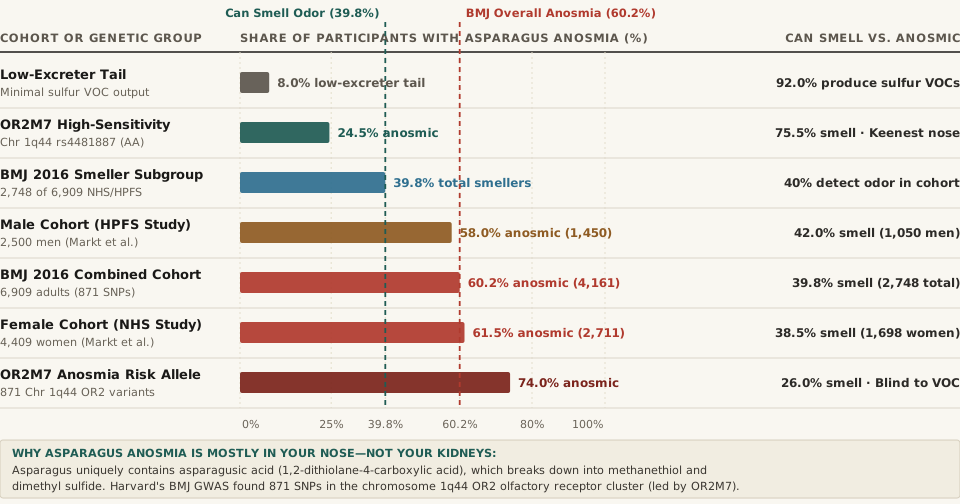
60.2%Anosmic vs.39.8%Smellers: Out of6,909participants, exactly2,748(39.8%) could smell the characteristic odor, while4,161(60.2%) were classified as having asparagus anosmia.- The Gender Split (
58.0%of Men vs.61.5%of Women): In the male HPFS cohort,58.0%(1,450of2,500men) reported asparagus anosmia compared to42.0%(1,050men) who smelled it. In the female NHS cohort, an even higher share—61.5%(2,711of4,409women)—reported asparagus anosmia compared to38.5%(1,698women) who smelled it, despite women typically outperforming men on general olfactory tests. - 871 Genome-Wide Significant SNPs on Chromosome
1q44: Every single one of the871single-nucleotide polymorphisms (SNPs) that crossed the strict genome-wide significance threshold (p < 5 × 10^-8) mapped to a single tight cluster on chromosome 1 (1q44) spanning the Olfactory Receptor 2 (OR2) gene family, led by the index variants inOR2M7(rs4481887) andOR2L13/OR2M3(rs6689553, correlated atr = 0.80). - Cross-Smelling Proof: As Markt et al. (2016) highlight, controlled psychophysical sniffing trials show that individuals who claim their body "does not make smelly asparagus urine" are equally unable to smell the odor when presented with a urine sample from a confirmed excreter—proving that the
1q44OR2M7mutation creates a targeted olfactory blind spot for methanethiol/dimethyl sulfide mixtures.
3. Complete Data Table: Asparagus Anosmia Cohorts & Chromosome 1q44 Genetics
The reproducible table below—matching the companion CSV (asparagus-pee-smell-asparagusic-acid-bmj-2016-gwas-or2m7-anosmia-rates.csv)—summarizes the cohort breakdown, genetic loci, and biochemical pathways from Markt, Mucci et al. (The BMJ 2016;355:i6071):
| Cohort or Genetic Group | Sample Size / Locus | Biochemical / Receptor Mechanism | Asparagus Anosmia (%) | Can Smell Odor (%) | Primary Finding (BMJ 2016) |
|---|---|---|---|---|---|
| Volatile Sulfur Excreters | Asparagus officinalis consumers | 1,2-dithiolane-4-carboxylic acid → methanethiol + dimethyl sulfide |
~8.0% (Low excreters) |
~92.0% (Excrete VOCs) |
Rapid enzymatic cleavage begins 15–30 minutes post-ingestion |
OR2M7 High-Sensitivity Genotype |
Chr 1q44 — rs4481887 protective allele |
Intact Olfactory Receptor 2M7 binding pocket for sulfur thiols | 24.5% |
75.5% |
Each copy of protective allele sharply lowers anosmia risk |
| BMJ 2016 Total Smeller Subgroup | 2,748 of 6,909 adults |
Reported unmistakable odor after eating asparagus | 39.8% (Smeller share) |
39.8% of total cohort |
Minority of European-American cohort can smell the VOCs |
| Male Cohort (HPFS) | 2,500 men |
Health Professionals Follow-Up Study GWAS | 58.0% (1,450 men) |
42.0% (1,050 men) |
Men slightly more likely than women to detect asparagus odor |
| BMJ 2016 Combined Study Total | 6,909 adults (NHS + HPFS) |
871 genome-wide significant SNPs on chromosome 1q44 |
60.2% (4,161 total) |
39.8% (2,748 total) |
3 in 5 adults have specific anosmia to asparagus metabolites |
| Female Cohort (NHS) | 4,409 women |
Nurses' Health Study GWAS | 61.5% (2,711 women) |
38.5% (1,698 women) |
Higher reported anosmia rate among women despite keen general olfaction |
OR2M7 Anosmia Risk Homozygote |
Chr 1q44 — rs4481887 / rs6689553 (r=0.80) |
Altered OR2 receptor unable to bind methanethiol/sulfide blend |
74.0% |
26.0% |
Anosmics also cannot smell odor in a known excreter's sample |
4. How to Pick Peak-Season Asparagus Spears and Store Them Upright
Because asparagusic acid and natural sugars are concentrated in young, rapidly growing shoot tips—and because harvested asparagus has one of the highest respiration rates of any spring vegetable—picking and storing spears properly makes the difference between crisp, sweet stalks and limp, woody fiber:
- Inspect the Apical Bud Tips First: Always check the spear tips before the stem thickness. Freshly harvested spears have tightly closed, compact scales with dark green or purplish-tinted buds. Once tips begin to splay open, turn mushy, or show yellowing bracts, the spear has already exhausted its internal sugars and begun lignifying from the base upward.
- Thick vs. Pencil-Thin Spears: Contrary to kitchen myth, thick asparagus spears are not "older" than thin spears—spear diameter is determined by the age and vigor of the underground crown, not how long the individual stalk sat above ground. Thick spears actually have a lower skin-to-interior ratio, making them juicier for high-heat roasting or grilling.
- Store Upright in 1 Inch of Water at
36°F(2°C): Unlike tree fruits, cut asparagus stalks continue drawing moisture through their vascular bundles. Trim0.5 inchoff the dry cut ends, stand the bunch upright in a jar with1 inchof cold water (or wrap the base in a damp paper towel inside a perforated bag), and store in the main refrigerator compartment away from ethylene-producing apples or bananas.
To check ripeness markers, respiration rates, and refrigerator storage benchmarks across spring vegetables and seasonal fruit, Explore storage benchmarks in Redberi before your next grocery run.