
Why Does Australia Have 5 Time Zones in Summer? Half-Hour Clocks and Daylight Saving Explained
Schedule a nationwide conference call across Australia in July (austral winter), and the country divides neatly into three standard time zones: Western (AWST, UTC+8), Central (ACST, UTC+9:30), and Eastern (AEST, UTC+10). Schedule that exact same meeting between the first Sunday in October and the first Sunday in April (austral summer), and Australia splinters into five main time zones — with Adelaide (UTC+10:30) jumping 30 minutes ahead of Brisbane (UTC+10:00) even though Adelaide sits 1,400 kilometers further west.
As documented in Wikipedia's Time in Australia Statutory & Historical Record and Time and Date's Australian World Clock Directory, this seasonal checkerboard happens because Australia's southern states observe Daylight Saving Time while its northern and western states do not. To compare live offsets across Sydney, Brisbane, Adelaide, Darwin, and Perth without mental math, Open Tempo in your browser.
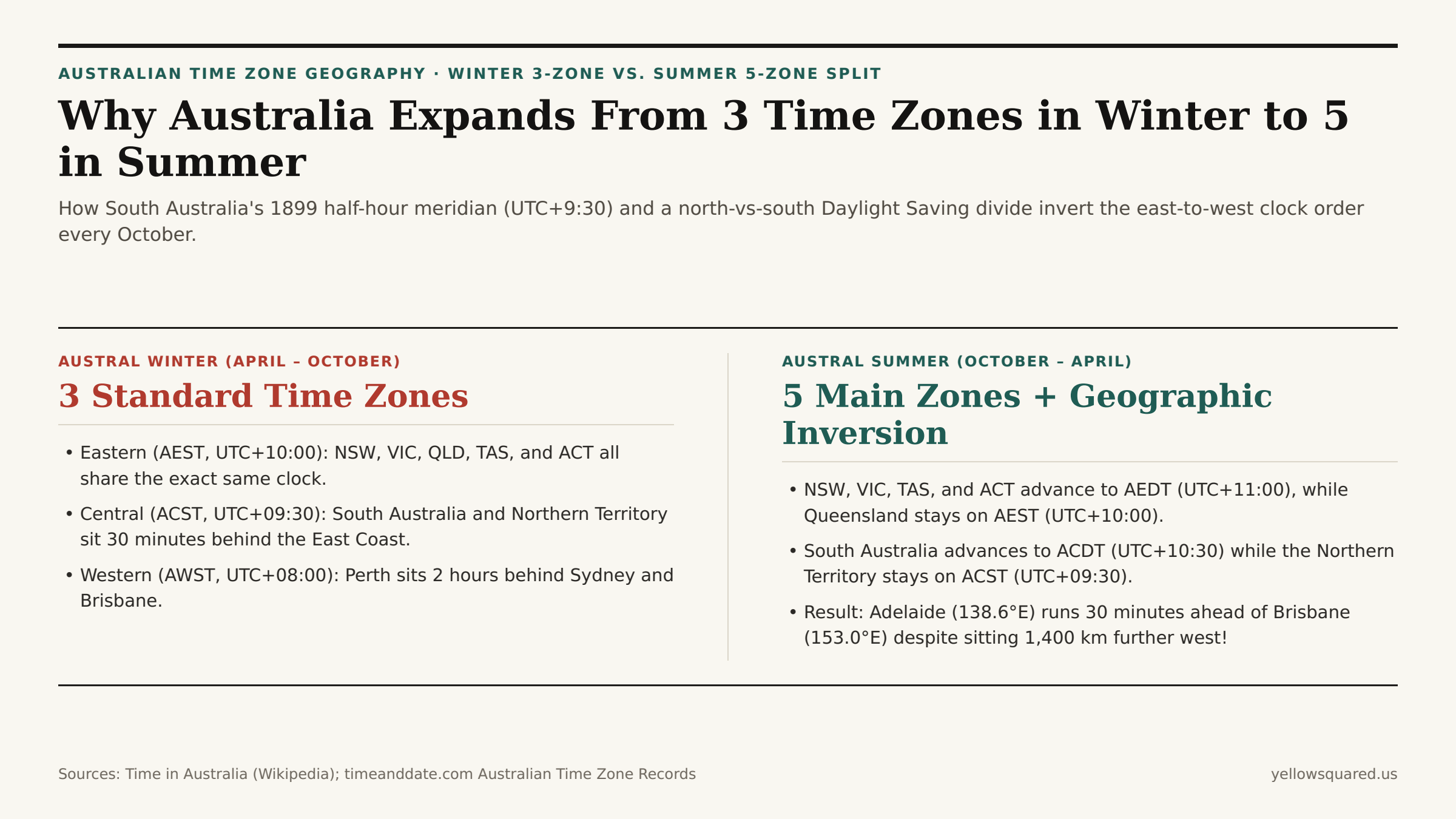
UTC+10:30) 30 minutes ahead of Queensland (UTC+10:00).1. Why South Australia and the Northern Territory Use a Half-Hour Offset (UTC+9:30)
When the Australian colonies first standardized their clocks in February 1895, South Australia (which then administered the Northern Territory) initially adopted GMT+9:00 based on the 135°E meridian. However, Adelaide's business community and astronomical observatory (located at 138.60°E) protested that GMT+9:00 placed Adelaide a full hour behind Melbourne and Sydney while setting solar noon 14 minutes early, cutting into afternoon commercial and cricket hours.
Under the Standard Time Act of 1898 (taking effect in May 1899), South Australia split the difference by advancing its clocks 30 minutes to GMT+9:30 (anchored to the 142.5°E meridian). Even today, both South Australia and the Northern Territory keep Australian Central Standard Time (ACST, UTC+9:30) as their baseline winter clock — and the remote silver-mining town of Broken Hill, New South Wales (Australia/Broken_Hill), located near the South Australian border, also observes UTC+9:30 due to its historical rail and telegraph links to Adelaide.
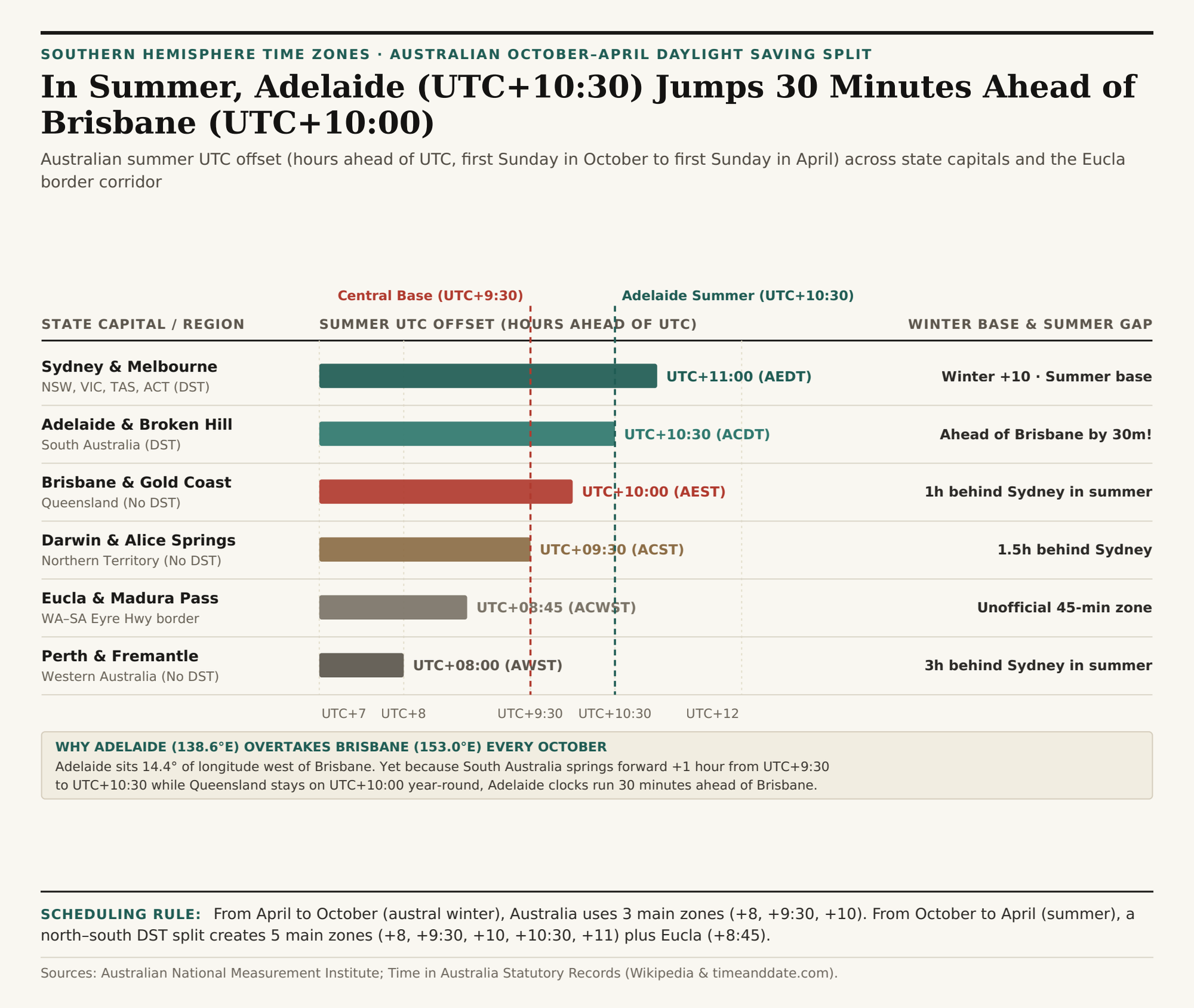
2. How the October–April Daylight Saving Split Creates 5 Main Zones (Plus Eucla's UTC+8:45)
Because northern and tropical Australia (Queensland, the Northern Territory, and Western Australia) sit closer to the equator — where summer day length varies far less and residents prefer earlier sunset cooling — those three jurisdictions rejected Daylight Saving Time in state referendums. Meanwhile, the higher-latitude southern states (New South Wales, Victoria, Tasmania, South Australia, and the Australian Capital Territory) spring forward +1 hour on the first Sunday in October and fall back on the first Sunday in April:
UTC+11:00— Australian Eastern Daylight Time (AEDT): Observed by Sydney (NSW), Melbourne (VIC), Hobart (TAS), and Canberra (ACT).UTC+10:30— Australian Central Daylight Time (ACDT): Observed by Adelaide (SA) and Broken Hill (NSW). Because Adelaide adds+1 hourto itsUTC+9:30base while Brisbane stays still onUTC+10:00, Adelaide runs 30 minutes ahead of Brisbane all summer long.UTC+10:00— Australian Eastern Standard Time (AEST): Observed year-round by Brisbane, the Gold Coast, and Cairns (QLD).UTC+09:30— Australian Central Standard Time (ACST): Observed year-round by Darwin and Alice Springs (NT).UTC+08:00— Australian Western Standard Time (AWST): Observed year-round by Perth (WA) — sitting 3 full hours behind Sydney in summer.
"Drive across the Nullarbor Plain on the Eyre Highway near the Western Australia–South Australia border, and roadhouses in Eucla, Madura, and Mundrabilla observe an unofficial sixth mainland zone: Australian Central Western Standard Time (UTC+8:45) — splitting the 90-minute gap between Perth and Adelaide into two 45-minute steps."
| City / Region | IANA Time Zone | Longitude | Winter (Apr–Oct) | Summer (Oct–Apr) | Summer Gap vs. Sydney |
|---|---|---|---|---|---|
| Sydney, Melbourne, Canberra & Hobart | Australia/Sydney |
151.21°E | UTC+10:00 (AEST) | UTC+11:00 (AEDT) | 0 min (Baseline) |
| Adelaide (SA) & Broken Hill (NSW) | Australia/Adelaide |
138.60°E | UTC+09:30 (ACST) | UTC+10:30 (ACDT) | -30 min (+30m ahead of QLD) |
| Brisbane & Gold Coast (QLD) | Australia/Brisbane |
153.03°E | UTC+10:00 (AEST) | UTC+10:00 (AEST) | -60 min (No DST) |
| Darwin & Alice Springs (NT) | Australia/Darwin |
130.84°E | UTC+09:30 (ACST) | UTC+09:30 (ACST) | -90 min (No DST) |
| Eucla & Border Village (Eyre Hwy) | Australia/Eucla |
128.88°E | UTC+08:45 (ACWST) | UTC+08:45 (ACWST) | -135 min (45-min offset) |
| Perth & Fremantle (WA) | Australia/Perth |
115.86°E | UTC+08:00 (AWST) | UTC+08:00 (AWST) | -180 min (No DST) |
Coordinating Australian Meetings Across Seasonal Shifts
When booking recurring cross-border meetings between North America or Europe and Australian teams in Sydney (AEDT), Brisbane (AEST), Adelaide (ACDT), and Perth (AWST), remember that Southern Hemisphere Daylight Saving runs in the opposite half of the calendar year (October–April). Open Tempo in your browser to preview exact city-level meeting overlaps on any future date, and download the Australian 5-zone summer split CSV table.