
Why Does Central Australia Use a 30-Minute Time Zone (and Eucla a 45-Minute Zone)?
Why Does Central Australia Use a 30-Minute Time Zone (and Eucla a 45-Minute Zone)?
Look at a time zone map of Australia and two fractional anomalies immediately jump out. Instead of stepping across the continent in clean one-hour increments from Perth (AWST, UTC+08:00) to Sydney and Melbourne (AEST, UTC+10:00), the entire central third of the continent—covering South Australia, the Northern Territory, and the New South Wales outback mining city of Broken Hill—sits on a 30-minute offset: Australian Central Standard Time (ACST, UTC+09:30). Even stranger, drive across the Nullarbor Plain on the Eyre Highway near the Western Australia–South Australia border, and roadside signs instruct you to set your watch to Central Western Standard Time (CWST, UTC+08:45)—one of only three 45-minute time zones on Earth.
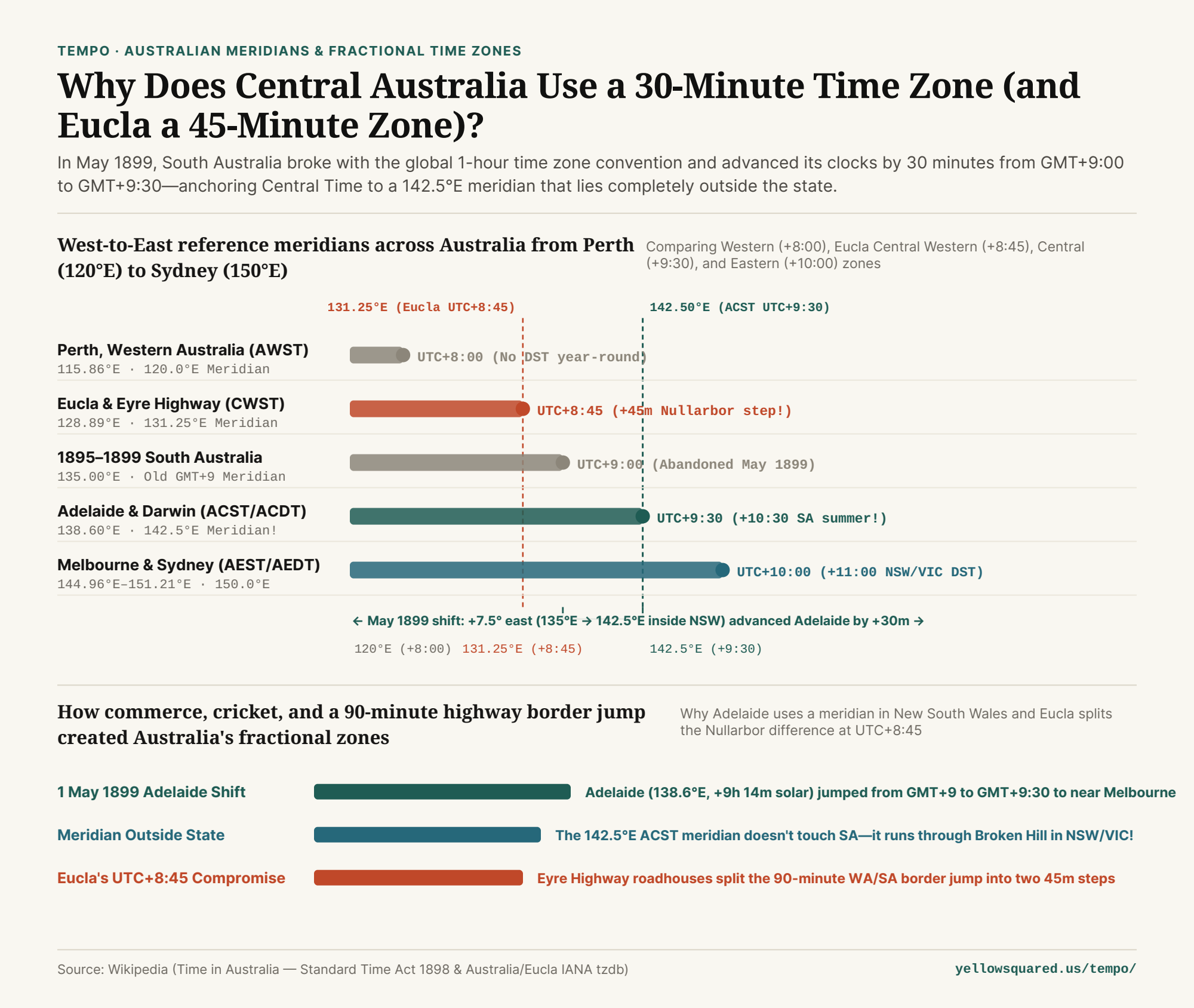
UTC+08:00), Eucla Central Western (UTC+08:45), Central (UTC+09:30), and Eastern (UTC+10:00) zones. Reproducible dataset: why-does-australia-have-a-30-and-45-minute-time-zone-acst-cwst.csv.1. The May 1899 Shift: Why Adelaide Uses a Meridian Outside Its Own Borders
When the Australian colonies first adopted standard time zones in February 1895 (following the 1892 Intercolonial Postal and Telegraphic Conference led by South Australian Postmaster-General and astronomer Sir Charles Todd), Australia actually used whole-hour zones: Western Australia adopted GMT+08:00 (120°E), South Australia (which then administered the Northern Territory) adopted GMT+09:00 (135°E), and the eastern colonies adopted GMT+10:00 (150°E).
However, as documented in the legislative history of Time in Australia, almost all of South Australia's population lived in the far southeastern corner around Adelaide (138.60°E), where true local mean solar time is 9 hours, 14 minutes, and 24 seconds ahead of Greenwich. Under GMT+09:00, solar noon arrived 14 minutes early on the clock, and Adelaide businesses sat a full hour behind their commercial rivals in Melbourne (GMT+10:00). Backed by telegraph merchants as well as local cricket and football clubs who wanted an extra half-hour of evening daylight for after-work practice, the South Australian Parliament passed the Standard Time Act of 1898. On 1 May 1899, South Australia advanced its clocks by 30 minutes to GMT+09:30—anchoring the state's clock to the 142.5° East meridian, which lies completely east of the South Australian border inside New South Wales and Victoria.
"By advancing its clocks 30 minutes in May 1899, South Australia became one of the only jurisdictions on Earth governed by a reference meridian (142.5°E) that never touches its own territory."
2. How a 90-Minute Border Jump Created Eucla's UTC+08:45 Zone
While the 1899 shift brought Adelaide within 30 minutes of Melbourne, it created a massive 90-minute time jump (and a 2.5-hour jump during South Australian summer Daylight Saving Time) on the western border between South Australia (UTC+09:30) and Western Australia (UTC+08:00).
Along the remote Eyre Highway crossing the Nullarbor Plain, roadhouse operators, telegraph repeater stations, and pastoralists in five communities spanning 350 kilometers east of Caiguna—Cocklebiddy, Madura, Mundrabilla, Eucla (in southeastern Western Australia, near 128.89°E), and Border Village (just inside South Australia)—found a 90-minute border jump unworkable for daily logistics. As recorded in Australian timekeeping and IANA tzdb records, they split the difference squarely in half, adopting Central Western Standard Time (UTC+08:45, Australia/Eucla)—45 minutes ahead of Perth and 45 minutes behind Adelaide.
3. Australian Mainland Time Zones & Meridians Comparison Table
In summer (from the first Sunday in October to the first Sunday in April), Queensland and the Northern Territory skip Daylight Saving Time while New South Wales, Victoria, and South Australia advance by 1 hour—splitting Australia into five mainland clock zones (available in why-does-australia-have-a-30-and-45-minute-time-zone-acst-cwst.csv):
| Australian Time Zone | Reference City & Longitude | Reference Meridian | Winter Standard | Summer Clock Time | IANA Identifier |
|---|---|---|---|---|---|
| Western Standard (AWST) | Perth, WA (115.86°E) | 120.00° E (+8h 00m) | UTC+08:00 | UTC+08:00 (No DST) | Australia/Perth |
| Central Western (CWST) | Eucla, WA (128.89°E) | 131.25° E (+8h 45m) | UTC+08:45 | UTC+08:45 (No DST) | Australia/Eucla |
| Central Standard (NT) | Darwin, NT (130.84°E) | 142.50° E (+9h 30m) | UTC+09:30 | UTC+09:30 (No DST) | Australia/Darwin |
| Central Standard (SA) | Adelaide, SA (138.60°E) | 142.50° E (+9h 30m) | UTC+09:30 | UTC+10:30 (ACDT) | Australia/Adelaide |
| Eastern Standard (AEST) | Melbourne / Sydney | 150.00° E (+10h 00m) | UTC+10:00 | UTC+11:00 (AEDT) | Australia/Sydney |
4. Compare Australian Fractional Offsets Live in Tempo
Note that during the Southern Hemisphere summer (October–April), Darwin (UTC+09:30), Brisbane (UTC+10:00), Adelaide (UTC+10:30), and Sydney/Melbourne (UTC+11:00) are separated by four consecutive 30-minute steps. Before booking a cross-state call or flight across Australia, Open Tempo in your browser to compare exact 30- and 45-minute IANA time zone overlaps.
Verified Primary Sources
- Wikipedia — Time in Australia (May 1899 South Australia 30-Minute Shift, Broken Hill & Eucla UTC+08:45) (Retrieved 2026-10-31).
- Academic Reference Archive — Time in Australia: Colonial Standard Time Acts of 1895 & 1898 and IANA Database Zones (Retrieved 2026-10-31).