
Why Does Australia Split Into 5 Time Zones Every Summer?
Why Does Australia Split Into 5 Time Zones Every Summer?
From October to April, southern Australian states (New South Wales, Victoria, South Australia, Tasmania, and the ACT) advance clocks by one hour while Queensland, the Northern Territory, and Western Australia stay on standard time—splitting 3 winter zones into 5 summer zones.
From April through September, mainland Australia's time map looks relatively straightforward. The continent is divided into three standard time zones from west to east: Australian Western Standard Time (AWST, UTC+8) in Perth, Australian Central Standard Time (ACST, UTC+9:30) across Adelaide and Darwin, and Australian Eastern Standard Time (AEST, UTC+10) stretching from Brisbane down through Sydney, Canberra, Melbourne, and Hobart.
On the first Sunday in October at 2:00 AM, however, that tidy three-zone map fractures into five distinct time zones. Because Australia's Daylight Saving Time boundary runs horizontally between temperate southern states and tropical northern jurisdictions rather than vertically along meridians, a single north-south flight from Melbourne to Brisbane—or Darwin to Adelaide—crosses a time zone boundary for six months of the year.
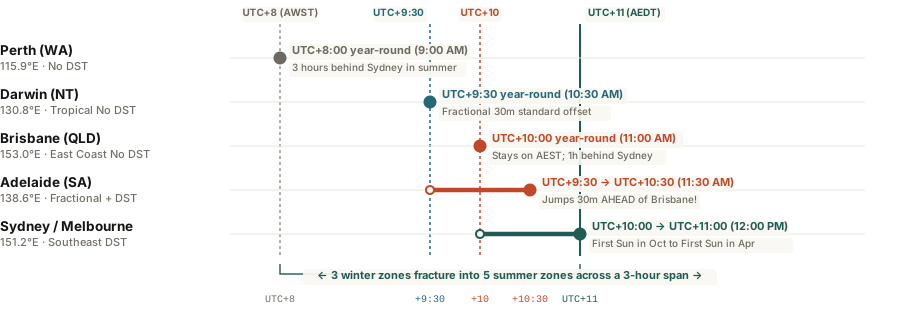
How 3 Winter Zones Fracture Into 5 Summer Clocks
Under Australian law, time zone governance is reserved to individual state and territory parliaments rather than the federal government in Canberra. Because northern Australia sits close to the equator—where daylight length barely varies between December and June—voters in Queensland (in a 1992 referendum) and Western Australia (in four separate referendums, most recently in 2009) rejected Daylight Saving Time to avoid oppressive late-afternoon heat and dark winter-style mornings.
As a result, when Sydney hits 12:00 PM noon during the Southern Hemisphere summer (October to April), clocks across the five mainland regimes read:
- Sydney, Melbourne, Canberra & Hobart (AEDT, UTC+11:00): 12:00 PM (advanced +1 hour from AEST).
- Adelaide & Broken Hill (ACDT, UTC+10:30): 11:30 AM (advanced +1 hour from fractional ACST).
- Brisbane & Queensland (AEST, UTC+10:00): 11:00 AM (unchanged year-round).
- Darwin & Northern Territory (ACST, UTC+9:30): 10:30 AM (unchanged year-round).
- Perth & Western Australia (AWST, UTC+8:00): 9:00 AM (unchanged year-round—a full 3 hours behind Sydney).
From October to April, Adelaide (138.6°E) sets its clocks 30 minutes ahead of Brisbane (153.0°E)—even though Adelaide sits 950 miles further west.
The Adelaide–Brisbane Inversion and the Twin-Town Street Line
This state-by-state split produces two famous scheduling traps. First is the Adelaide–Brisbane flip: during winter, Adelaide (`UTC+9:30`) trails Brisbane (`UTC+10:00`) by 30 minutes, matching their geography. In summer, because South Australia springs forward to `UTC+10:30` while Queensland stays at `UTC+10:00`, western Adelaide leaps 30 minutes *ahead* of eastern Brisbane.
Second is the urban border dividing Coolangatta (Queensland) and Tweed Heads (New South Wales) on the Gold Coast. For half the year, walking across Boundary Street shifts your phone clock by 60 minutes, meaning New Year's Eve fireworks go off twice—an hour apart—on opposite sides of the same street. To coordinate calls across Sydney, Brisbane, Adelaide, and Perth without getting tripped up by October or April transitions, you can Open Tempo in your browser to compare all five Australian time zones side by side.