
Why Does Australia Split Into Five Time Zones in Summer—With Adelaide 30 Minutes Ahead of Brisbane?
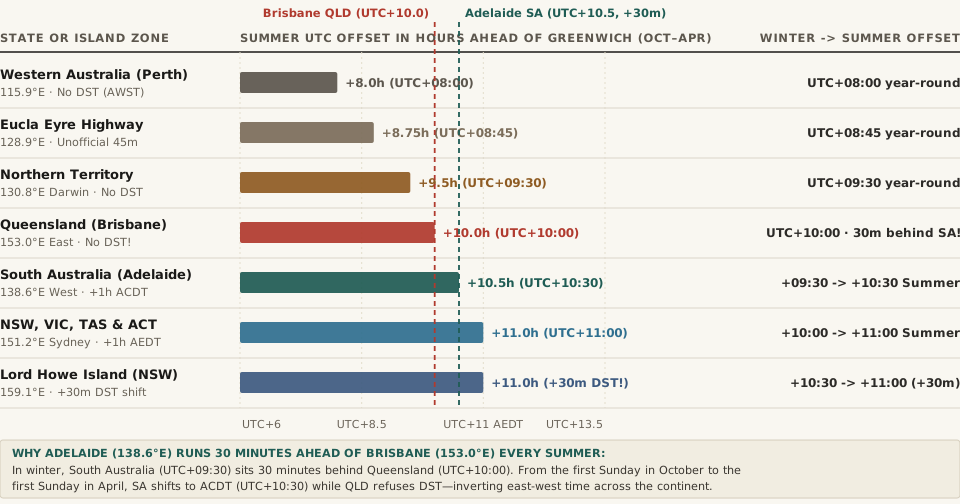
Look at a map of Australia in July—the middle of the Southern Hemisphere winter—and the country's time zones look relatively orderly: Western Australia sits on UTC+08:00 (AWST), the Northern Territory and South Australia share a half-hour offset at UTC+09:30 (ACST), and the entire eastern seaboard from Cairns and Brisbane down to Sydney, Melbourne, Canberra, and Hobart shares UTC+10:00 (AEST). Then arrives 2:00 AM on the first Sunday in October. Because Australian timekeeping is legislated individually by each state and territory under Section 51 of the Australian Constitution, five southern and southeastern jurisdictions spring forward for Daylight Saving Time while three northern and western jurisdictions refuse to touch their clocks. Overnight, as documented in Wikipedia's Time in Australia reference, Daylight Saving Time in Australia, Time and Date's Australian registry, and the Reserve Bank of Australia's official Daylight Saving schedule, continental Australia fractures from three standard time zones into five summer time zones—creating a six-month window where Adelaide runs 30 minutes ahead of Brisbane despite sitting 1,400 kilometers further west.
Why did South Australia and the Northern Territory adopt a 30-minute offset in the 1890s, why do Queensland, Western Australia, and the Northern Territory reject Daylight Saving Time, and why does NSW's Lord Howe Island shift its clocks by only 30 minutes every October? Here is the complete geographic and IANA tzdb breakdown.
1. How Three Winter Zones Fracture Into Five Summer Zones Every October
Since 2008—when New South Wales, Victoria, Tasmania, South Australia, and the Australian Capital Territory harmonized their transition dates following a 12 April 2007 intergovernmental agreement—Australian Daylight Saving Time begins at 02:00 local standard time on the first Sunday in October and ends at 03:00 local daylight time on the first Sunday in April (for example, ending Sunday, 5 April 2026 and starting Sunday, 4 October 2026, per the Reserve Bank of Australia).
Because the tropical and western states opt out, the continent splits along both latitude and longitude lines simultaneously:
UTC+08:00— Australian Western Standard Time (AWST,Australia/Perth): Covers all of Western Australia. Western Australia held a three-year DST trial from 2006 to 2009 and rejected permanent adoption in a May 2009 referendum (the fourth time WA voters rejected DST since 1975). In summer, Perth falls a full 3 hours behind Sydney and Melbourne.UTC+09:30— Australian Central Standard Time (ACST,Australia/Darwin): Covers the Northern Territory year-round. Because Darwin sits in the tropics at12.46°Swhere daylight length barely varies between winter and summer, the Northern Territory stays onUTC+09:30all year.UTC+10:00— Australian Eastern Standard Time (AEST,Australia/Brisbane): Covers Queensland year-round after Queenslanders voted down DST in a 1992 referendum (driven by rural and northern Queensland voters opposing late summer sunrises and evening heat).UTC+10:30— Australian Central Daylight Time (ACDT,Australia/Adelaide&Australia/Broken_Hill): South Australia (plus the far-western New South Wales mining city of Broken Hill) advances one hour fromUTC+09:30toUTC+10:30.UTC+11:00— Australian Eastern Daylight Time (AEDT,Australia/Sydney,Australia/Melbourne,Australia/Hobart,Australia/Canberra): New South Wales, Victoria, Tasmania, Jervis Bay Territory, and the ACT advance one hour fromUTC+10:00toUTC+11:00.
2. The Adelaide–Brisbane Paradox: When West Beats East by 30 Minutes
Normally, because Earth rotates from west to east, moving eastward always advances local clock time. Look at the coordinates of Adelaide and Brisbane:
- Adelaide, South Australia: Longitude
138°36'E(138.60°E). - Brisbane, Queensland: Longitude
153°02'E(153.03°E)—sitting14.43°of longitude (nearly one full15°solar hour, or ~1,400 km) east of Adelaide.
During the Southern Hemisphere winter (April to October), geography behaves normally: Brisbane (UTC+10:00) is 30 minutes ahead of Adelaide (UTC+09:30). However, from October to April, South Australia springs forward to ACDT (UTC+10:30) while Queensland stays frozen at AEST (UTC+10:00). For six months of every year, when it is 12:00 PM noon in Brisbane on the Pacific coast, it is already 12:30 PM in Adelaide 1,400 kilometers to the west!
"During the usual periods of DST, the three standard time zones in Australia become five zones. This includes the areas that do not observe DST: Western Australia (UTC+08:00), the Northern Territory (UTC+09:30), and Queensland (UTC+10:00)."
3. Three More Australian Anomalies: Lord Howe's 30-Minute Shift, Broken Hill, and Coolangatta–Tweed Heads
Beyond the five major state zones, Time and Date's audit of Australia's 9 total time zones and Wikipedia's civil legislation history document three remarkable local edge cases:
- Lord Howe Island's Unique 30-Minute DST Shift (
UTC+10:30→UTC+11:00): Located 600 km east of Port Macquarie in the Tasman Sea, Lord Howe Island (part of New South Wales,Australia/Lord_Howe) operates on Lord Howe Standard Time (LHST,UTC+10:30) during winter. In summer, instead of advancing by 60 minutes like the rest of the world, Lord Howe Island advances its clocks by only 30 minutes to Lord Howe Daylight Time (LHDT,UTC+11:00) so it matches Sydney time during summer tourist season. It is the only jurisdiction on Earth with a 30-minute Daylight Saving shift. - Broken Hill, NSW (
Australia/Broken_Hill): Although the silver-mining city of Broken Hill lies inside the state borders of New South Wales, it sits near the South Australian border at141.45°Eand historically linked by rail to Adelaide rather than Sydney. Broken Hill therefore observes South Australian time (ACST UTC+09:30in winter andACDT UTC+10:30in summer)—the only town in NSW outsideAEST/AEDT. - The Twin-Town New Year's Eve Border (Coolangatta, QLD vs. Tweed Heads, NSW): On the Gold Coast border, Boundary Street divides Coolangatta (Queensland,
UTC+10:00) from Tweed Heads (New South Wales,UTC+11:00in summer). Every December 31, residents celebrate New Year's Eve at midnight in Tweed Heads, walk across the street into Coolangatta, and celebrate New Year's Eve a second time one hour later.
4. Complete Data Table: Australia's Winter vs. Summer Time Zones
The reproducible dataset below—bundled in the downloadable CSV (australia-five-summer-time-zones-awst-acst-aest-acdt-aedt-and-lord-howe.csv)—lists every mainland state, territory, and special island zone across winter and summer:
| State, Territory or Region | IANA tzdb Zone |
Hub Longitude | Winter Standard (Apr–Oct) | Summer Offset (Oct–Apr) | DST Shift | Summer Gap vs. Sydney (UTC+11) |
|---|---|---|---|---|---|---|
| Western Australia (Perth) | Australia/Perth |
115.86°E |
AWST (UTC+08:00) |
AWST (UTC+08:00) |
0 min (No DST) |
3 hr 00 min behind Sydney |
| Eucla / Eyre Highway | Australia/Eucla |
128.88°E |
ACWST (UTC+08:45) |
ACWST (UTC+08:45) |
0 min (Unofficial) |
2 hr 15 min behind Sydney |
| Northern Territory (Darwin) | Australia/Darwin |
130.84°E |
ACST (UTC+09:30) |
ACST (UTC+09:30) |
0 min (No DST) |
1 hr 30 min behind Sydney |
| Queensland (Brisbane) | Australia/Brisbane |
153.03°E |
AEST (UTC+10:00) |
AEST (UTC+10:00) |
0 min (No DST) |
1 hr 00 min behind Sydney (30m behind SA!) |
| South Australia & Broken Hill | Australia/Adelaide |
138.60°E |
ACST (UTC+09:30) |
ACDT (UTC+10:30) |
+60 min DST |
30 min behind Sydney (30m ahead of QLD!) |
| NSW, VIC, TAS & ACT | Australia/Sydney |
151.21°E |
AEST (UTC+10:00) |
AEDT (UTC+11:00) |
+60 min DST |
Baseline (0 min) |
| Lord Howe Island (NSW) | Australia/Lord_Howe |
159.08°E |
LHST (UTC+10:30) |
LHDT (UTC+11:00) |
+30 min DST! |
Matches Sydney in summer (UTC+11:00) |
When you are scheduling calls across Sydney (AEDT), Brisbane (AEST), Adelaide (ACDT), Perth (AWST), and US or European offices between October and April, Open Tempo in your browser to compare all five Australian summer zones on a single live timeline.