
Why Does Australia Have 30-Minute and 45-Minute Time Zones? (Adelaide, Eucla, and Lord Howe Island)
If you look at a standard world map, Adelaide in South Australia sits roughly 960 kilometers (600 miles) west of Brisbane on Australia's Pacific coast. Naturally, you would expect Brisbane's clocks to run ahead of Adelaide's. Yet for six months every year—during the Southern Hemisphere's Daylight Saving Time from the first Sunday in October to the first Sunday in April—Adelaide (UTC+10:30) is actually 30 minutes ahead of Brisbane (UTC+10:00). Drive west across the Nullarbor Plain along the Eyre Highway toward Perth, and road signs instruct you to turn your watch back by 45 minutes upon entering Eucla (UTC+08:45). Fly east from Sydney to Lord Howe Island, and you land in the only jurisdiction on Earth where Daylight Saving Time advances the clock by 30 minutes instead of an hour.
How did a single continent end up with half-hour standard time, an unofficial 45-minute Outback compromise zone, a New South Wales mining city running on South Australian time, and a 30-minute summer clock shift? Here is the complete historical and geographic breakdown of Time in Australia.
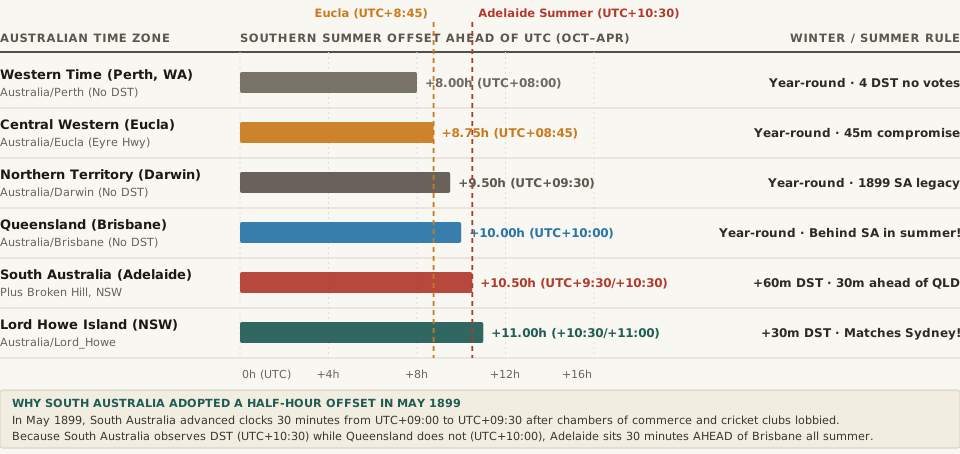
UTC+10:30) half an hour ahead of non-DST Queensland (UTC+10:00). Download the full dataset: australia-time-zones-half-hour-adelaide-darwin-eucla-845-and-lord-howe.csv.1. Why Adelaide and Darwin Sit on a Half-Hour Offset (UTC+09:30): The May 1899 Lobby
When Australia's six colonial governments first standardized civil time in February 1895 (replacing local solar mean time in each city), they adopted three clean, whole-hour zones aligned with Greenwich Mean Time: Western Standard Time (GMT+8) based on the 120°E meridian, Central Standard Time (GMT+9) based on the 135°E meridian for South Australia (which then administered the Northern Territory), and Eastern Standard Time (GMT+10) based on the 150°E meridian for Queensland, New South Wales, Victoria, and Tasmania.
However, Adelaide sits at longitude 138.60°E—meaning that under the 135°E meridian (GMT+9), true solar noon in Adelaide occurred at 11:45 AM, and the sun set 14 minutes earlier on the clock than local solar time. Worse, Adelaide merchants complained that telegraph offices and financial markets in Melbourne and Sydney (GMT+10) closed a full hour before Adelaide's business day ended, while local cricket and Australian rules football associations lobbied for an extra half hour of evening daylight for weekday practice.
As documented in the parliamentary history of Time in Australia, South Australia broke with international whole-hour convention in May 1899 under the Standard Time Act 1898, advancing its clocks by 30 minutes to UTC+09:30 (anchored to the 142.5°E meridian, which actually passes through Victoria and New South Wales east of South Australia's border). When the Northern Territory was separated from South Australia and transferred to the federal government in 1911, Darwin kept the UTC+09:30 offset—and repeated legislative proposals in South Australia to move to either UTC+09:00 or UTC+10:00 (in 1986, 1994, and 2015) have all failed.
“In May 1899, South Australia advanced its clocks by 30 minutes to UTC+09:30 after businesses wanted closer telegraph alignment with Melbourne and local cricketers and footballers lobbied for extra evening practice light.”
2. Why Adelaide Is 30 Minutes Ahead of Brisbane in Summer—and the Broken Hill Exception
During the Southern Hemisphere winter (first Sunday in April to first Sunday in October), mainland Australia follows three ordered bands from west to east: UTC+08:00 (WA), UTC+09:30 (NT and SA), and UTC+10:00 (QLD, NSW, VIC, TAS, ACT). However, Australia's states are sharply divided along latitude lines over Daylight Saving Time:
- Southern States Observe DST (Oct–Apr): New South Wales, Victoria, Tasmania, the Australian Capital Territory (moving from
UTC+10:00to UTC+11:00 AEDT), and South Australia (moving fromUTC+09:30to UTC+10:30 ACDT) advance their clocks by 60 minutes on the first Sunday in October. - Northern & Western States Reject DST: Tropical Queensland (which rejected DST in a 1992 referendum by 54.5% because northern and rural residents did not want hotter, brighter evenings), the Northern Territory, and Western Australia (which rejected DST in four separate referendums in 1975, 1984, 1992, and 2009) remain on standard time year-round.
The result is a famous six-month geographic inversion: from October to April, Adelaide (UTC+10:30) sits 30 minutes ahead of Brisbane (UTC+10:00) despite lying nearly 1,000 km farther west. Furthermore, the Outback mining city of Broken Hill (Yancowinna County) in far-western New South Wales (Australia/Broken_Hill) observes South Australia's UTC+09:30 / UTC+10:30 time zone rather than Sydney's time because it was historically connected by rail and telegraph directly to Adelaide rather than across the Blue Mountains to Sydney.
3. Eucla's UTC+08:45 Highway Zone and Lord Howe Island's 30-Minute DST
Even more remarkable are Australia's two micro-zones at opposite ends of the country. Compare all eight Australian time regimes side by side:
| Australian Time Zone or Territory | IANA Zone Identifier | Standard Offset (Apr–Oct) | Summer / DST Offset (Oct–Apr) | Summer Clock Shift | Reference Meridian & Historical Context |
|---|---|---|---|---|---|
| Western Standard Time (Perth, WA) | Australia/Perth |
UTC+08:00 | UTC+08:00 (No DST) | 0 min | 120°E meridian; rejected DST in 1975, 1984, 1992 & 2009 referendums |
| Central Western Time (Eucla / Eyre Hwy) | Australia/Eucla |
UTC+08:45 | UTC+08:45 (No DST) | 0 min | Splits the 90-min gap between Perth (UTC+8) and South Australia (UTC+9:30) |
| Central Standard Time (Darwin, NT) | Australia/Darwin |
UTC+09:30 | UTC+09:30 (No DST) | 0 min | 142.5°E meridian; retained South Australia's 1899 half-hour shift in 1911 |
| Central Time w/ DST (Adelaide & Broken Hill) | Australia/Adelaide |
UTC+09:30 | UTC+10:30 (ACDT) | +60 min | May 1899 30-min advance; sits 30 min ahead of Brisbane during Oct–Apr summer |
| Eastern Standard Time (Brisbane, QLD) | Australia/Brisbane |
UTC+10:00 | UTC+10:00 (No DST) | 0 min | 150°E meridian; 1992 referendum rejected DST (54.5% No) |
| Eastern Time w/ DST (Sydney / Melbourne) | Australia/Sydney |
UTC+10:00 | UTC+11:00 (AEDT) | +60 min | Covers NSW (except Broken Hill & Lord Howe), VIC, TAS, and ACT |
| Lord Howe Island Time (NSW Offshore) | Australia/Lord_Howe |
UTC+10:30 | UTC+11:00 (LHDT) | +30 min ONLY | World's only 30-minute DST shift; aligns with Sydney (UTC+11:00) in summer |
Central Western Time (UTC+08:45): The 200-Person Eyre Highway Compromise
Along the remote southeastern corner of Western Australia on the Eyre Highway—roughly 1,430 km east of Perth—crossing straight from Western Australia (UTC+08:00) into South Australia (UTC+09:30 in winter, UTC+10:30 in summer) forced truckers and roadhouse staff to jump 90 to 150 minutes across a single state line. To smooth operations between supply bases in both states, five remote roadhouse communities east of Caiguna—Cocklebiddy, Madura, Mundrabilla, Eucla, and Border Village (home to roughly 200 permanent residents)—adopted Central Western Standard Time (CWST, UTC+08:45), splitting the winter gap between Perth and Adelaide exactly in half (45 minutes ahead of Perth, 45 minutes behind Adelaide winter time). Although not formally gazetted by Western Australia's state parliament, official highway signs instruct motorists to adjust their watches by 45 minutes, and the IANA Time Zone Database maintains a dedicated zone identifier (Australia/Eucla) for it.
Lord Howe Island (Australia/Lord_Howe): The World's Only 30-Minute DST Shift
Located 600 kilometers east of Port Macquarie in the Tasman Sea, Lord Howe Island (part of New South Wales, population ~445) instituted Lord Howe Standard Time at UTC+10:30 in 1981 to match its longitudinal position east of the Australian mainland. However, when New South Wales enters Daylight Saving Time (UTC+11:00) each October, island residents wanted their clocks to match Sydney government offices and flight schedules without pushing summer sunsets to 8:30 PM. Their solution: every October, Lord Howe Island advances its clocks by just 30 minutes (from UTC+10:30 to UTC+11:00), and turns them back by 30 minutes every April—making it the only place on the planet with a half-hour Daylight Saving transition.
Check Australian State, Outback, and Island Overlaps in Tempo
When you are scheduling calls across Sydney (Australia/Sydney), Brisbane (Australia/Brisbane), Adelaide (Australia/Adelaide), Darwin (Australia/Darwin), and Perth (Australia/Perth), remembering which states shift in October and which stay fixed—and why Adelaide overtakes Brisbane by 30 minutes every summer—eliminates missed meetings. Open Tempo in your browser to compare live Australian fractional offsets and global workday overlaps side by side.