
Why Does Australia Have 30-Minute and 45-Minute Time Zones?
Why Does Australia Have 30-Minute and 45-Minute Time Zones?
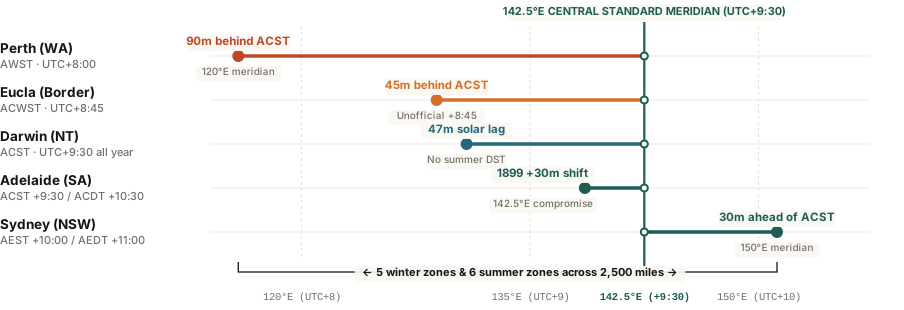
South Australia and the Northern Territory observe a 30-minute offset (UTC+9:30) from an 1899 meridian compromise at 142.5°E, while Eucla on the Eyre Highway runs on an unofficial 45-minute clock (UTC+8:45).
Most continents divide their east-to-west expanse into clean, one-hour time zones separated by 15 degrees of longitude. Australia begins with that textbook logic—anchoring Western Australia to UTC+8:00 and the eastern seaboard to UTC+10:00—before breaking every rule in the middle of the continent. Both South Australia and the Northern Territory operate on a 30-minute fractional offset (Australian Central Standard Time, UTC+9:30), while a stretch of the Nullarbor Plain along the Eyre Highway observes an unofficial 45-minute offset (UTC+8:45).
Even more counterintuitively, when Daylight Saving Time begins each October, South Australia advances its clocks by one hour to UTC+10:30 while northeastern Queensland remains on standard time (UTC+10:00). For six months of the year, Adelaide—located nearly 900 miles west of Brisbane—operates 30 minutes ahead of its eastern neighbor.
The 1899 Adelaide Compromise: Moving From UTC+9 to UTC+9:30
Prior to the 1890s, every Australian town calibrated its local clock to the sun. Following the 1892 Intercolonial Conference of Surveyors in Melbourne, the colonies agreed to adopt standard time zones in 1895 based on Greenwich Mean Time: Western Australia took 120°E (UTC+8), South Australia (which then governed the Northern Territory) took 135°E (UTC+9), and the eastern colonies took 150°E (UTC+10).
However, Adelaide sits at 138°36' East longitude—more than three and a half degrees east of the 135°E meridian. Under UTC+9:00, Adelaide experienced early sunsets in winter, and local wool and shipping merchants complained that sitting a full hour behind Melbourne and Sydney cost them valuable afternoon telegraph trading windows. In May 1899, the South Australian Parliament passed the Standard Time Act 1898 Amendment, shifting the colony's reference meridian 7.5 degrees east to 142°30'E and advancing clocks by 30 minutes to UTC+9:30.
Australia's central time zone is not an astronomical accident; it was an 1899 commercial compromise between solar noon in Adelaide and telegraph trading hours in Melbourne.
Why Australia Splits Into Six Time Zones Every Summer
When the Northern Territory was separated from South Australia in 1911, it retained the 142.5°E meridian (UTC+9:30) despite Darwin sitting at 130.8°E—nearly 12 degrees west of its time zone anchor. Because tropical Darwin experiences minimal seasonal daylight variation, the Northern Territory does not observe Daylight Saving Time, nor do Queensland or Western Australia.
- The Adelaide–Brisbane Inversion: From the first Sunday in October to the first Sunday in April, South Australia shifts to Australian Central Daylight Time (ACDT, UTC+10:30), while Queensland remains on AEST (UTC+10:00). A flight departing Brisbane at 10:00 AM local time lands in Adelaide 2 hours and 35 minutes later at 1:05 PM local time.
- The Border Town of Broken Hill: Located in far-western New South Wales near the South Australian border, the mining city of Broken Hill (IANA key
Australia/Broken_Hill) legally exempts itself from Sydney's UTC+10/+11 clock and observes Adelaide's UTC+9:30/+10:30 time year-round. - Eucla's Unofficial 45-Minute Zone (UTC+8:45): Straddling the Western Australia–South Australia border along the Eyre Highway, the communities of Eucla, Cocklebiddy, and Border Village split the 90-minute jump between Perth (UTC+8:00) and Adelaide (UTC+9:30) in half, operating on Australian Central Western Standard Time (ACWST, UTC+8:45), tracked in the IANA database under
Australia/Eucla.
To coordinate calls across Sydney, Brisbane, Adelaide, Darwin, and Perth without getting tripped up by half-hour summer inversions, you can Open Tempo in your browser to compare live Australian offsets side by side.