
Why Are South Australia and the Northern Territory on a Half-Hour Time Zone?
Why Are South Australia and the Northern Territory on a Half-Hour Time Zone?
Originally placed on GMT+9:00 (the 135°E meridian) in 1895, South Australia jumped 30 minutes forward to UTC+9:30 (the 142.5°E meridian inside Victoria) in May 1899 after Adelaide merchants and athletes lobbied to sit closer to Melbourne time.
Fly west across Australia from Sydney (`AEST, UTC+10:00`) to Perth (`AWST, UTC+8:00`) and the continent spans roughly `38 degrees` of longitude—almost the exact width required for three standard 1-hour time zones (`UTC+8`, `UTC+9`, and `UTC+10`). Yet when you land in Adelaide, South Australia or Darwin, Northern Territory in the middle of the continent, your watch does not step back one hour to `UTC+9:00`.
Instead, central Australia observes Australian Central Standard Time (`ACST, UTC+9:30`)—sitting 30 minutes behind Brisbane and Sydney, and 90 minutes ahead of Perth. Even stranger, once southern Daylight Saving Time begins on the first Sunday in October, Adelaide jumps to `UTC+10:30` (`ACDT`) while Darwin stays on `UTC+9:30`, fracturing mainland Australia into five separate time zones. Tracing the history of the May 1899 Adelaide time shift explains how cricket clubs and telegraph merchants pushed South Australia's clock onto a meridian that does not even pass through the state.
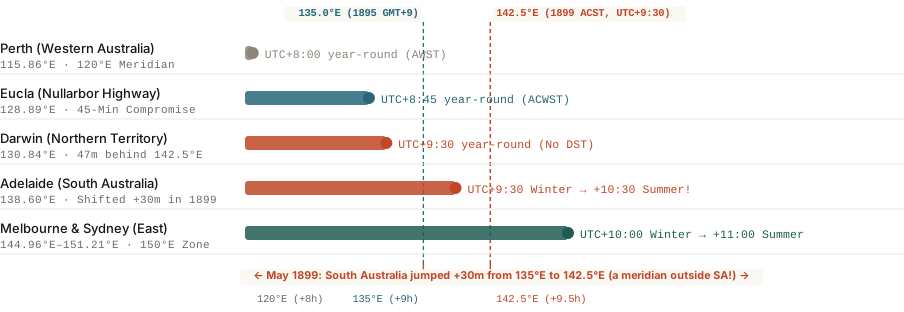
February 1895 to May 1899: Why GMT+9:00 Angered Adelaide
When Sir Charles Todd—South Australia's Postmaster-General and builder of the Overland Telegraph Line—helped negotiate Australia's first standard time laws in February 1895, the six colonies adopted Sandford Fleming's clean 15-degree hourly system:
- Western Standard Time (`120.0°E` Meridian = `GMT+8:00`): Western Australia.
- Central Standard Time (`135.0°E` Meridian = `GMT+9:00`): South Australia and the Northern Territory (which was governed by South Australia until 1911).
- Eastern Standard Time (`150.0°E` Meridian = `GMT+10:00`): Queensland, New South Wales, Victoria, and Tasmania.
While the `135.0°E` meridian ran cleanly through central South Australia, Adelaide (`138.60°E`) sat `3.6°` east of that line—meaning solar noon arrived 14.5 minutes early (`11:45 AM`) under `GMT+9:00`. Within three years, two groups petitioned the South Australian Parliament to change the law: Adelaide businesses (who disliked losing an hour of telegraph trading overlap with Melbourne and Sydney) and local cricket and football associations (who wanted an extra 30 minutes of evening daylight for after-work practice).
On May 1, 1899, South Australia advanced its clocks by 30 minutes to UTC+9:30—adopting the 142.5°E meridian, which lies 150 kilometers east of South Australia inside Victoria and New South Wales.
How Summer DST Turns 3 Mainland Zones Into 5
Because the Northern Territory was administered by South Australia in 1899, Darwin (`130.84°E`) inherited the `UTC+9:30` clock—even though `142.5°E` puts Darwin 47 minutes ahead of natural solar time. Today, differing state Daylight Saving rules create a complex seasonal matrix from October to April:
- `UTC+08:00` (`Australia/Perth`): Western Australia (rejected DST in four referendums, most recently in 2009).
- `UTC+08:45` (`Australia/Eucla`): The unofficial Central Western Standard Time observed by ~200 residents along the Eyre Highway (Eucla, Mundrabilla, Cocklebiddy, Madura, and Border Village)—splitting the 90-minute gap between Perth and Adelaide right down the middle.
- `UTC+09:30` (`Australia/Darwin`): The Northern Territory (no DST).
- `UTC+10:30` (`Australia/Adelaide` & `Australia/Broken_Hill`): South Australia—plus the silver-mining city of Broken Hill (`141.45°E`) in far-western New South Wales, which uses South Australian time because its historic rail link ran to Adelaide rather than Sydney.
- `UTC+10:00` (`Australia/Brisbane`) vs. `UTC+11:00` (`Australia/Sydney`): Queensland stays on `UTC+10:00` year-round, while NSW, Victoria, Tasmania, and the ACT advance to `UTC+11:00` (`AEDT`)—making Adelaide (`UTC+10:30`) 30 minutes ahead of Brisbane in summer despite sitting `1,400 km` farther west!
When scheduling calls across Perth, Darwin, Adelaide, Brisbane, and Sydney during the October–April Daylight Saving window, you can Open Tempo in your browser to track all five mainland Australian offsets automatically.