
Why Does Brazil Have 4 Time Zones (And Why Did It Abolish Daylight Saving Time in 2019)?
If you scheduled recurring video calls or financial market handoffs between New York or London and São Paulo prior to 2019, you likely remember the annual calendar maze: because North America and Europe spring forward in March while Southern Hemisphere countries spring forward in October or November, the time difference between New York and São Paulo shifted four times every single year—jumping from 1 hour in December, to 2 hours in March, to 3 hours in April, and back to 2 hours in November. As documented in Wikipedia's overview of time in Brazil and daylight saving time in Brazil, that four-way seesaw ended on April 25, 2019, when Brazil permanently abolished Daylight Saving Time (Horário de Verão) and locked its four time zones onto year-round standard time.
Why does Brazil need four separate time zones from UTC-02:00 to UTC-05:00, why did voters in the western state of Acre hold a binding referendum in 2010 to take back their UTC-05:00 clock, and how did afternoon air conditioning kill Brazil's summer time? Here is the complete geographic and grid-engineering breakdown—and how to plan clean North-South America overlap blocks in Tempo.
Brazil's 4 Official Time Zones: From Atlantic Islands (UTC-2) to Acre (UTC-5)
Stretching 4,395 kilometers (2,731 miles) from east to west—from the Atlantic archipelago of Fernando de Noronha at 32°25′ W to the Peruvian border in Acre at 73°59′ W—Brazil spans more than 41° of longitude and divides its territory into four permanent offsets referenced against Brasília Time (BRT):
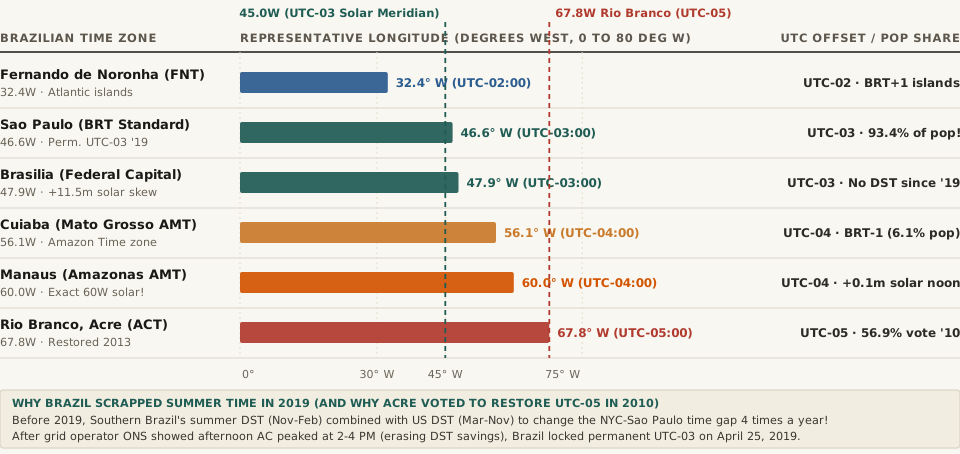
UTC-02:00— Fernando de Noronha Time (FNT,BRT+1): Covers the offshore Atlantic islands of Fernando de Noronha (32.42° W), Rocas Atoll, Saint Peter and Saint Paul Archipelago, and Trindade and Martim Vaz (fewer than0.01%of Brazil's population).UTC-03:00— Brasília Time (BRT,BRT+0): The national standard zone covering93.4%of Brazil's population and all 21 eastern, southern, and northeastern states—including São Paulo (46°38′ W), Rio de Janeiro (43°12′ W), Brasília (47°53′ W), Salvador, Belo Horizonte, and Porto Alegre—plus the eastern state of Pará and Amapá.UTC-04:00— Amazon Time (AMT,BRT−1): Covers6.1%of the population across the central and western interior: Mato Grosso (Cuiabá,56°06′ W), Mato Grosso do Sul, Rondônia, Roraima, and most of Amazonas (Manaus, sitting almost dead-center on the60°01′ Wmeridian, where solar noon occurs within+0.1 minutesof 12:00 PM!).UTC-05:00— Acre Time (ACT,BRT−2): Covers0.5%of the population in the far-western state of Acre (Rio Branco,67°48′ W) and 13 municipalities in southwestern Amazonas—running on the exact same winter clock as New York, Lima, and Bogotá.
The 2008–2013 Acre Time War: The Only Time Zone Restored by Popular Referendum
In April 2008, the Brazilian Congress enacted Law 11,662, which abolished Acre Time (UTC-05:00) and forced Acre and southwestern Amazonas to advance their clocks one hour to UTC-04:00 starting June 24, 2008, so that television broadcasts and federal agencies only had to manage two mainland time zones instead of three.
Residents of Acre immediately rebelled: shifting clocks forward pushed morning school and work commutes into pre-dawn darkness. Demand for a reversal was so intense that the Superior Electoral Court authorized a binding state-wide time zone referendum on October 31, 2010 (held alongside Brazil's presidential runoff). By a margin of 56.87% to 43.13%, Acre voters rejected UTC-04:00 and voted to restore their historical clock—leading Congress to pass Law 12,876, which officially returned Acre to UTC-05:00 on November 10, 2013.
After Congress abolished Acre's UTC-05:00 time zone in 2008, 56.87% of Acre voters voted in a 2010 state referendum to get their hour back—making Acre Time one of the only time zones in history restored by direct ballot.
Why Brazil Abolished Daylight Saving Time on April 25, 2019
From 1985 until early 2019, Brazil observed annual summer time—usually from the third Sunday in October (or first Sunday in November) to the third Sunday in February (with a special rule postponing the fallback by one week whenever the third Sunday in February landed on Carnival, as occurred in 2012 and 2015!). However, because equatorial states in Northern and Northeastern Brazil (Manaus, Belém, Recife, Fortaleza, Salvador) experience almost identical 12-hour daylight year-round, they refused to observe DST—splitting Brazil's eastern seaboard into two different time zones every summer.
Even more decisive was the electrical grid data compiled by Brazil's National Electric System Operator (ONS) and Ministry of Mines and Energy:
- The Shift From Evening Lighting to Afternoon Air Conditioning: In the 1980s and 1990s, Brazil's daily electricity peak occurred between
18:00 and 21:00when residential lighting and electric showers turned on at dusk; shifting clocks forward cut peak evening demand by up to4.5%. - The 2:00 PM–4:00 PM Thermal Peak: By 2017–2018, widespread commercial and residential air conditioning had moved Brazil's daily power peak to the hottest hours of the afternoon (
14:00 to 16:00). Advancing the clock by 1 hour did nothing to reduce afternoon solar heat—and actually increased early-morning cooling and lighting loads. - Permanent
UTC-03:00Since April 2019: On April 25, 2019, Decree 9,772 abolished DST nationwide. Today, São Paulo (America/Sao_Paulo) stays onUTC-03:00all year—only 1 hour ahead of New York during U.S. Daylight Saving Time (March–November) and 2 hours ahead during U.S. standard winter time (November–March).
Complete Reference Table of Brazil's 4 Time Zones and Pre-2019 DST Era
The table below summarizes UTC offsets, population shares, solar noon skews, and U.S. Eastern time gaps across Brazil's time zones (full dataset in brazil-four-time-zones-utc-2-to-utc-5-and-2019-dst-abolition.csv):
| Brazilian Time Zone / Era | UTC Offset (BRT Ref) |
Representative City | Pop. Share | Gap vs. U.S. Eastern (EST / EDT) | Solar Skew & Policy Status |
|---|---|---|---|---|---|
Fernando de Noronha (FNT) |
UTC-02:00 (BRT+1) |
Fernando de Noronha (32.4° W) |
< 0.01% |
+3h (EST) / +2h (EDT) |
+9.7m solar skew; offshore Atlantic islands |
Brasília Time Today (BRT) |
UTC-03:00 (BRT+0) |
São Paulo / Brasília (46.6° W) |
93.4% |
+2h (EST) / +1h (EDT) |
+6.5m skew; permanent year-round since 2019 |
Pre-2019 Summer DST (BRST) |
UTC-02:00 (Nov–Feb) |
South, SE & Central-West | ~62% used |
+3h (EST) — 4 shifts/yr! |
Abolished Apr 25, 2019 after 2–4 PM AC peak shift |
Amazon Time (AMT) |
UTC-04:00 (BRT−1) |
Manaus (60.0° W) / Cuiabá |
6.1% |
+1h (EST) / 0h (Same as EDT) |
+0.1m skew in Manaus; exact 60° W solar match |
| Acre Time (2008–13 Merger) | UTC-04:00 (Forced) |
Rio Branco (67.8° W) |
0.5% |
+1h (EST) / 0h (EDT) |
Rejected by 56.87% in 2010 Acre referendum |
Acre Time Today (ACT) |
UTC-05:00 (BRT−2) |
Rio Branco / Cruzeiro do Sul | 0.5% |
0h (Same as EST) / -1h (EDT) |
Restored Nov 10, 2013 under Law 12,876 |
Scheduling calls across São Paulo, Manaus, New York, and London as Northern Hemisphere clocks shift in March and November? Open Tempo in your browser to compare live UTC offsets and overlapping business hours instantly.