
Why Does Chile Keep Punta Arenas and Magallanes on Permanent Daylight Saving Time (UTC-03:00)?
If you trace the 71°W meridian down the globe from Boston and Miami to South America, it passes directly through Santiago (70°40'W) and Punta Arenas (70°55'W) at the southern tip of Patagonia. By pure solar geometry, every major city in mainland Chile belongs inside the UTC-05:00 time zone centered on the 75°W meridian—the exact same winter clock used by Lima, Bogotá, and New York. Yet as documented in historical civil timekeeping records for Chile and the Wikivoyage Chile regional time guide, Chile operates three distinct official time zones, and its southernmost regions—Magallanes and Chilean Antarctica (America/Punta_Arenas) and Aysén (America/Coyhaique)—never turn their clocks back in winter, remaining locked on permanent Daylight Saving Time (UTC-03:00) all year long.
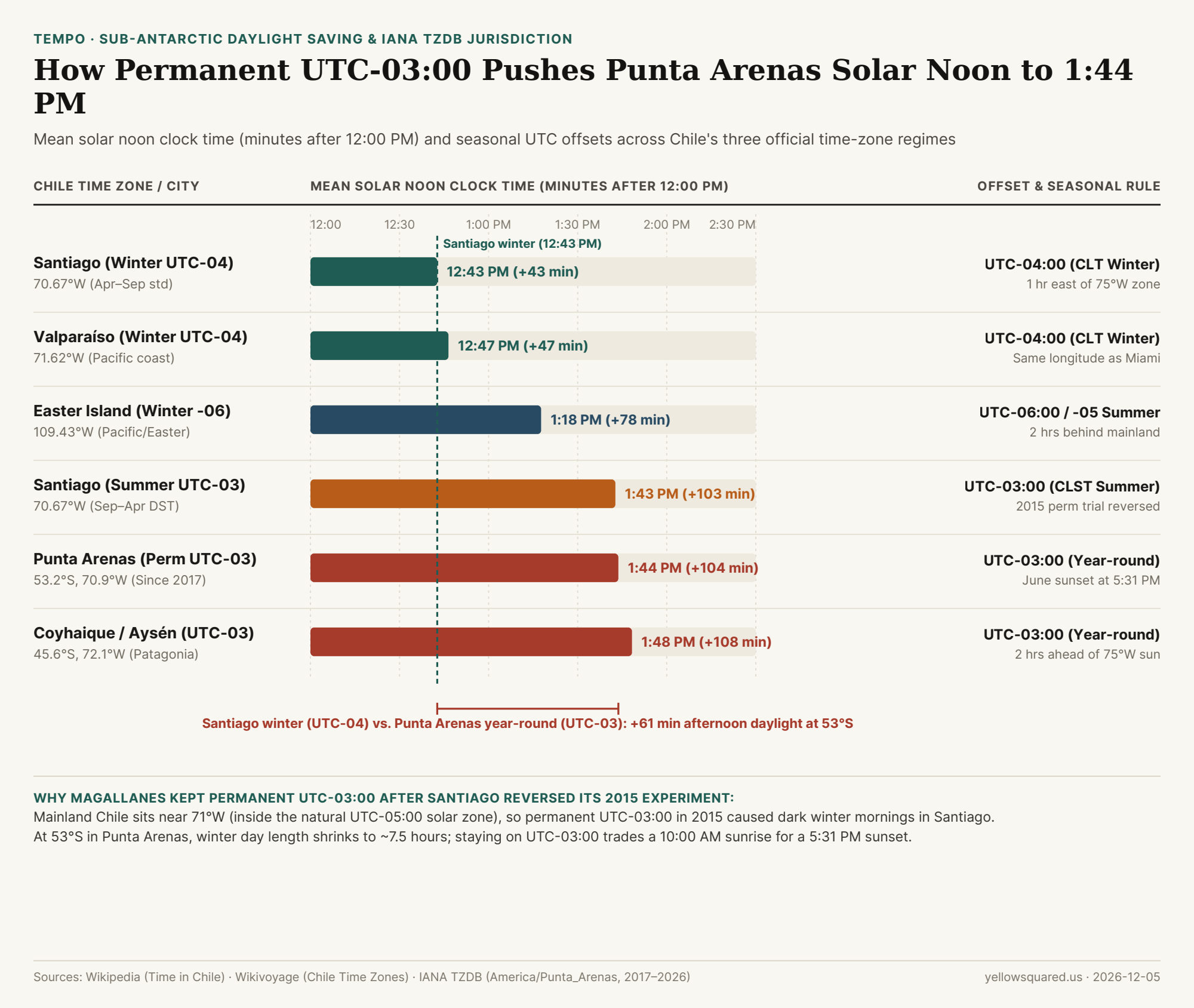
How Mainland Chile Ended Up 1 to 2 Hours Ahead of Its Natural Solar Meridian
Because Earth rotates 15° of longitude every 60 minutes (4 minutes per degree), the sun crosses the local meridian at Santiago (70.67°W) and Punta Arenas (70.92°W) approximately 4 hours and 43 minutes after Greenwich Mean Time (UTC+00:00):
- Natural Solar Noon (
UTC-05:00Baseline): If Chile observed its geographicUTC-05:00zone (used briefly between 1910 and 1916 and again from 1919 to 1927), mean solar noon in Santiago would occur slightly early at11:43 AM, meaning winter sunset would fall before4:45 PM. - Continental Chile Winter Standard Time (
CLT, UTC-04:00): From the first Sunday in April to the first Sunday in September, central and northern Chile shift one hour east of their solar zone toUTC-04:00, placing mean solar noon at12:43 PMin Santiago and12:47 PMin Valparaíso (71.62°W). - Continental Chile Summer Daylight Saving Time (
CLST, UTC-03:00): From September to April, mainland Chile advances another hour toUTC-03:00—two full hours ahead of its75°Wsolar meridian—pushing mean solar noon to1:43 PM.
"When Chile placed the entire mainland on permanent UTC-03:00 in 2015, central valley fruit growers reported a 15% winter productivity loss and school truancy climbed in pitch-black mornings—yet at 53°S in Magallanes, residents demanded to keep the afternoon light."
Why the 2015 Nationwide Permanent DST Trial Failed in Santiago—and Succeeded in Punta Arenas
In January 2015, Chile's Ministry of Energy suspended seasonal clock switches and placed all of mainland Chile on permanent UTC-03:00 (with Easter Island / Rapa Nui at 109.43°W on permanent UTC-05:00). Across central Chile (33°S), the experiment backfired during the austral winter of 2015: sunrise in Santiago did not arrive until 8:47 AM, forcing millions of students and agricultural workers to commute in darkness, increasing school truancy, and causing a reported 15% productivity drop among fruit producers. In March 2016, the Chilean government restored winter standard time (UTC-04:00) for three months each winter, later expanding winter time to five months (April through September).
However, in the sub-antarctic Magallanes and Chilean Antarctica Region—where the capital Punta Arenas sits at 53°09'S latitude along the Strait of Magellan—seasonal day-length extremes change the trade-off completely:
- The 53°S Winter Photoperiod Crunch: At
53.16°Son the June 21 southern winter solstice, total daylight lasts only about 7 hours and 31 minutes. Because the sun is still well below the horizon during standard8:00 AMschool and office arrivals regardless of whether the clock readsUTC-04:00orUTC-03:00, shifting back toUTC-04:00would not give commuters a bright morning. - Trading a 10:00 AM Sunrise for a 5:31 PM Sunset: Under
UTC-04:00, winter sunset in Punta Arenas dropped to4:31 PM, plunging the city into darkness before children finished school. In December 2016, President Michelle Bachelet approved Magallanes's petition to stay on permanentUTC-03:00starting in May 2017 ( prompting the IANA Time Zone Database to createAmerica/Punta_Arenasin release2017a, later joined by neighboring Patagonia's Aysén Region underAmerica/Coyhaique). On permanentUTC-03:00, June solstice sunrise occurs around10:00 AM, mean solar noon arrives at1:44 PM, and sunset holds until5:31 PM.
| Chile Region / City | IANA TZDB Zone | Coordinates | Winter Offset (Apr–Sep) | Summer Offset (Sep–Apr) | Mean Solar Noon | Solar Skew & Solstice Impact |
|---|---|---|---|---|---|---|
| Santiago (Winter CLT) | America/Santiago |
33.45°S, 70.67°W |
UTC-04:00 |
UTC-03:00 |
12:43 PM | +42.7 min · June sunrise ~7:47 AM |
| Valparaíso (Winter CLT) | America/Santiago |
33.05°S, 71.62°W |
UTC-04:00 |
UTC-03:00 |
12:47 PM | +46.5 min · Shares 75°W solar band |
| Easter Island / Rapa Nui | Pacific/Easter |
27.15°S, 109.43°W |
UTC-06:00 |
UTC-05:00 |
1:18 PM | +77.7 min · 2 hrs behind Santiago |
| Santiago (Summer CLST) | America/Santiago |
33.45°S, 70.67°W |
UTC-04:00 |
UTC-03:00 |
1:43 PM | +102.7 min · 2015 perm trial reversed |
| Punta Arenas / Magallanes | America/Punta_Arenas |
53.16°S, 70.92°W |
UTC-03:00 (Perm) |
UTC-03:00 (Perm) |
1:44 PM | +103.7 min · June 10:00 AM–5:31 PM |
| Coyhaique / Aysén Region | America/Coyhaique |
45.57°S, 72.07°W |
UTC-03:00 (Perm) |
UTC-03:00 (Perm) |
1:48 PM | +108.3 min · Joined perm UTC-03 |
How to Coordinate Flights and Calls Between Santiago, Patagonia, and Easter Island
Because Continental Chile still shifts its clocks twice a year while Patagonia stays fixed, domestic flight schedules between Santiago (SCL) and Punta Arenas (PUQ) or Balmaceda/Coyhaique (BBA) change their offset every April and September: from September to April, Santiago and Punta Arenas share the exact same clock (UTC-03:00), but from April to September, Punta Arenas is 1 hour ahead of Santiago (UTC-03:00 vs. UTC-04:00) and 3 hours ahead of Easter Island (UTC-06:00). You can compare live seasonal offsets across Chilean, South American, and North American cities side by side when you Open Tempo in your browser.