
Why Does China Have Only One Time Zone?
Although China geographically spans five international time zones, the entire country has operated on a single official standard—Beijing Time (UTC+8)—since 1949, creating extreme daylight anomalies where the sun rises as late as 10:15 AM in western provinces like Xinjiang. This continental consolidation streamlines national railway timetables, aviation manifests, and financial trading, but forces millions of western residents to wake up and commute in total darkness throughout winter.
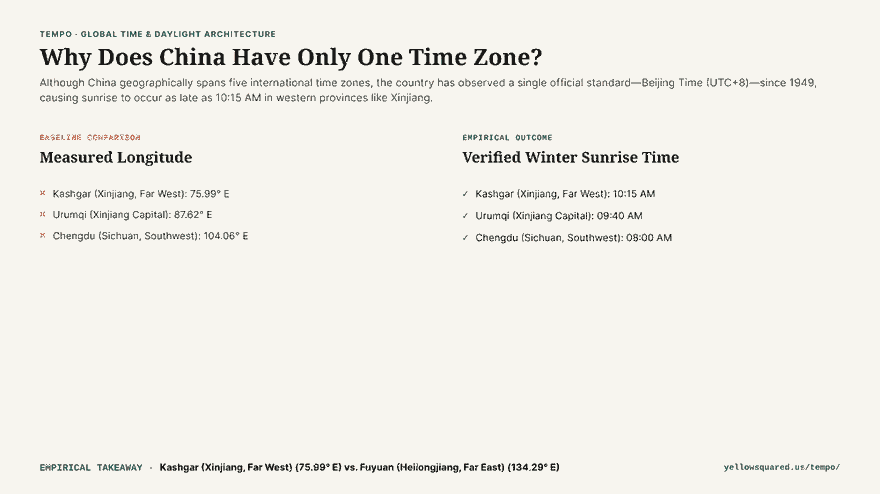
China covers approximately 3,100 miles (5,000 kilometers) from its eastern border along the Amur River to the western peaks of the Pamir Mountains. Geographically, this expanse stretches from 73°E to 135°E longitude, naturally spanning five 15-degree solar time zones. Prior to 1949, China recognized five distinct time zones established by the Central Observatory: Kunlun (UTC+5:30), Sinkiang-Tibet (UTC+6), Kansu-Szechwan (UTC+7), Chungyuan (UTC+8), and Changpai (UTC+8:30). In late 1949, the newly formed government unified the entire territory under UTC+8 to foster national cohesion.
Time zones are legal constructs rather than natural boundaries; when an entire continent shares one clock, geography extracts its price in daylight.
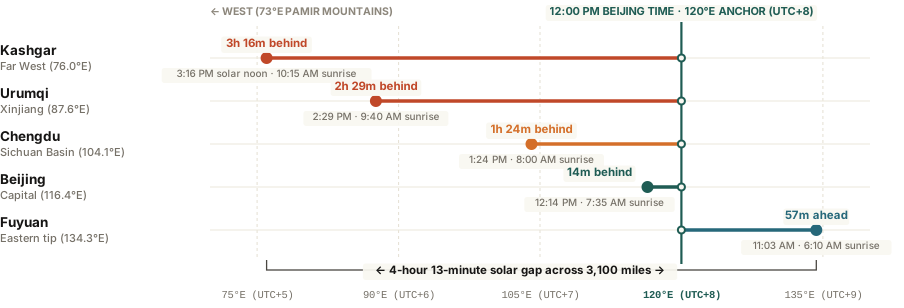
How Western China Lives With a 3-Hour Solar Disconnect
The practical consequence of a single national clock is most visible in the Xinjiang Uyghur Autonomous Region in the far northwest. Because Kashgar lies along the 76°E meridian (geographically UTC+5), solar noon does not arrive until 3:16 PM on the official clock:
- Late Morning Starts: Government offices, schools, and banks in Xinjiang do not open until 10:00 AM or 10:30 AM Beijing Time, adjusting their daily routines to match solar elevation.
- Midnight Dinners: During the height of summer in June and July, the sun does not set until nearly 10:30 PM. Families routinely eat dinner between 9:00 PM and 10:00 PM, and children play outside past 11:00 PM.
- The Dual-Clock System: Many local Uyghur residents unofficially observe “Xinjiang Time” (also known as Urumqi Time, UTC+6), which runs exactly two hours behind Beijing Time. When coordinating appointments in western China, locals routinely clarify whether a proposed time is “Beijing time” or “local time.”
The Far East Anomaly: 3:15 AM Sunrise in Heilongjiang
The opposite phenomenon occurs in China’s northeastern tip. In Fuyuan, located along the Russian border at 134°E longitude (geographically UTC+9), solar noon occurs nearly an hour before the clock strikes 12:00 PM. During midsummer, the sun rises as early as 3:15 AM and sets by 7:15 PM, leaving evening hours unexpectedly dark despite high summer temperatures.
Solar Noon and Sunrise Across China on Beijing Time
| City / Location | Longitude | Natural Solar Zone | Clock Noon (Solar Noon) | Winter Sunrise |
|---|---|---|---|---|
| Fuyuan (Heilongjiang) | 134.3° E | UTC+9 | 11:03 AM (-57 min) | 06:10 AM |
| Beijing (Capital) | 116.4° E | UTC+8 | 12:14 PM (Aligned) | 07:35 AM |
| Chengdu (Sichuan) | 104.1° E | UTC+7 | 01:24 PM (+84 min) | 08:00 AM |
| Urumqi (Xinjiang) | 87.6° E | UTC+6 | 02:29 PM (+149 min) | 09:40 AM |
| Kashgar (Xinjiang) | 76.0° E | UTC+5 | 03:16 PM (+196 min) | 10:15 AM |
How to Coordinate Across Vast Geographical Offsets
- Confirm local office operating windows: While international corporate headquarters in Beijing and Shanghai operate on standard 9-to-5 schedules, branch offices in western provinces typically work 10:00 AM to 7:00 PM.
- Watch out for time zone naming in IANA tzdb: The global tz database lists Chinese time under
Asia/Shanghai, with an alternative entryAsia/Urumqirepresenting the informal UTC+6 offset used by local communities. - Test global meeting windows on interactive dials: You can Open Tempo in your browser to compare synchronized city dials and coordinate calls across complex multi-city schedules.