
Why Does Cilantro Taste Like Soap to Some People? (The OR6A2 Gene and Aldehyde Chemistry)
Few ingredients divide a dinner table faster than fresh cilantro (the leaves of the coriander plant, Coriandrum sativum). To roughly four out of five diners, a handful of chopped cilantro atop tacos, pho, or curry tastes bright, lemony, and herbaceous. To the remaining 4% to 21% of the population, that exact same leaf tastes unmistakably like Dawn dish soap, laundry detergent, or crushed stinkbugs—contaminating every bite it touches.
For decades, cilantro lovers dismissed “cilantro-soap tasters” as picky eaters. Then in September 2012, geneticists led by Nicholas Eriksson at 23andMe published a landmark genome-wide association study (GWAS) across 26,455 participants (“A genetic variant near olfactory receptor genes influences cilantro preference,” arXiv:1209.2096 / Flavour) that pinpointed the exact biological mechanism on chromosome 11. Here is the organic chemistry of why cilantro contains actual soap molecules, how the OR6A2 olfactory receptor works, and the kitchen enzyme trick that neutralizes the soapy taste before serving.
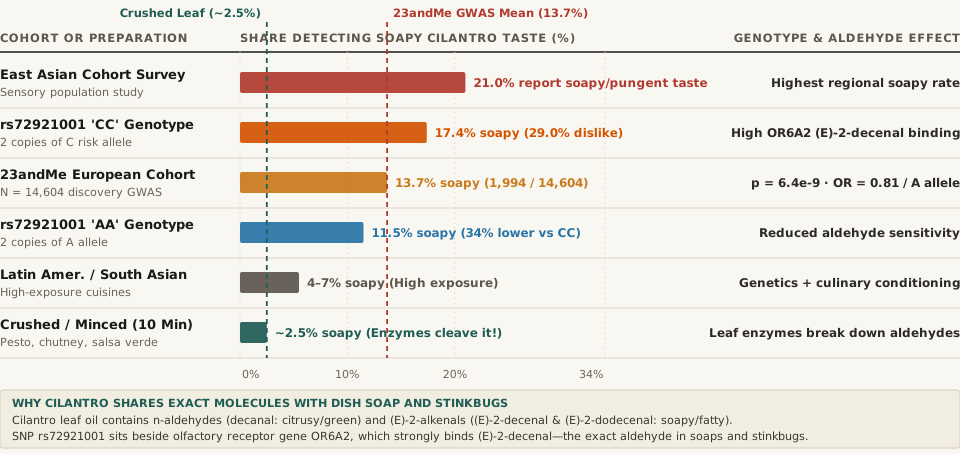
rs72921001 genotypes (Eriksson et al. 2012, N = 14,604 discovery + 11,851 replication), and crushed enzymatic preparation. Download the raw dataset: cilantro-soapy-taste-or6a2-rs72921001-prevalence-and-aldehyde-breakdown.csv.1. The Organic Chemistry: Why Cilantro Actually Contains Soap and Stinkbug Molecules
First, why do cilantro haters specifically compare the herb to soap and bugs rather than dirt or bitterness? Because the essential oil of fresh cilantro leaves is dominated by a class of volatile organic compounds called aldehydes (carbon chains double-bonded to oxygen, -CHO)—and those exact same aldehydes are present in both commercial soaps and insect defense sprays!
Gas-chromatography mass-spectrometry (GC-MS) analyses cited in Eriksson et al. (2012) show that cilantro's aroma profile splits into two competing chemical families:
- Pleasant Citrus & Floral Compounds (
Linalool,Decanal&Dodecanal): Saturated straight-chain n-aldehydes (decanalanddodecanal) along with the terpene alcohollinaloolproduce the fresh, lime-peel, citrusy aroma that cilantro fans love. - Soapy, Fatty Unsaturated Alkenals (
(E)-2-decenal&(E)-2-dodecenal): Unsaturated aldehydes with a carbon-carbon double bond at the second position—specifically (E)-2-decenal and (E)-2-dodecenal—have a penetrating, waxy, soapy odor. Crucially, aldehydes are formed during the saponification of fats and oils when making bar soap and liquid detergent, and(E)-2-decenalis the exact defensive secretion sprayed by Pentatomidae stinkbugs (indeed, the English word coriander derives from the Ancient Greek koriannon / koris, meaning “bedbug,” referencing the unripe leaf's aldehyde smell!).
2. The 2012 Genome-Wide Association Study: SNP rs72921001 and OR6A2
Why do some people smell only the citrusy linalool and decanal while others are overwhelmed by the soapy (E)-2-decenal? Because what we call “flavor” is roughly 80% retronasal olfaction—volatile aroma molecules travelling up the back of your throat into your nasal epithelium as you chew, where the human genome expresses roughly 400 functional olfactory receptor genes.
In their 2012 study of 14,604 discovery participants and 11,851 replication participants, Eriksson and colleagues found that 1,994 of 14,604 European-ancestry respondents (13.7%) reported that cilantro tasted like soap, while 3,181 of 12,087 (26.3%) reported disliking cilantro. Scanning over 500,000 genetic markers across the entire human genome yielded one highly significant peak on chromosome 11 (11p15.4) at single-nucleotide polymorphism rs72921001 (p = 6.4 × 10⁻⁹, odds ratio 0.81 per protective A allele):
“SNP rs72921001 (p = 6.4 × 10⁻⁹) lies within a cluster of eight olfactory receptor genes on chromosome 11. Among them is OR6A2, an olfactory receptor with high binding specificity for the exact unsaturated aldehydes that give cilantro its soapy odor.”
Look at how genotype, ancestry, and preparation shift soapy-taste detection across the empirical data:
| Ancestry Cohort or Culinary Preparation | Sample Size or Group | Report Cilantro Tastes Soapy (%) | Report Disliking Cilantro (%) | Genetic & Biochemical Mechanism |
|---|---|---|---|---|
| East Asian Ancestry Cohort | Population sensory survey | 21.0% | 19.5% | Highest population frequency of aldehyde-sensitive variants |
European CC Homozygotes (rs72921001) |
2 copies of C risk allele | 17.4% | 29.0% | High-affinity OR6A2 receptor binding to (E)-2-decenal |
| European Discovery Cohort (All Genotypes) | N = 14,604 (Eriksson 2012) |
13.7% (1,994 / 14,604) | 26.3% (3,181 / 12,087) | Genome-wide significant hit at rs72921001 (p = 6.4 × 10⁻⁹) |
European AA Homozygotes (rs72921001) |
2 copies of A allele | 11.5% (−34% lower vs. CC) | 21.8% | Protective A allele lowers OR6A2 aldehyde sensitivity |
| South Asian / Latin Amer. / Middle Eastern | High culinary exposure | 4.0%–7.0% | 3.0%–7.0% | Lower risk-allele frequency + positive early-life conditioning |
| Crushed / Minced Leaf (10-Min Rest) | Pesto, chutney, salsa verde | ~2.5% residual | <5.0% | Leaf lipoxygenase enzymes oxidize (E)-2-alkenals into mild alcohols |
3. Nuance & Kitchen Science: Why Genetics Isn't 100% Destiny (And How to Neutralize the Soap)
Notice an important scientific nuance emphasized by Eriksson et al. (2012): while rs72921001 near OR6A2 is indisputably real, common SNPs explain roughly 8.7% of the total phenotypic heritability of soapy taste detection (and even among people who do detect a soapy note, roughly half still report liking or tolerating cilantro when it is integrated into a dish!). Why?
- Crushing Cilantro Unleashes Aldehyde-Destroying Leaf Enzymes: Food chemists have demonstrated that when whole cilantro leaves are chewed raw at the table, intact volatile
(E)-2-decenalbursts straight into your nasal passages. However, when you finely mince, bruise, or pound cilantro leaves in a mortar or food processor (as in Indian green chutney, Mexican blender salsa, or herb pesto) and let the mixture sit for 10 to 15 minutes before serving, rupturing the plant cell walls brings endogenous leaf enzymes (lipoxygenases and aldehyde-reducing enzymes) into contact with the volatile aldehydes—rapidly converting pungent(E)-2-alkenalsinto mild, nearly odorless alcohols! - Coriander Seeds Have Zero Soapy Aldehydes: Even the most sensitive
CC-genotype soap tasters can enjoy toasted coriander seeds, whose essential oil is ~70% citrusylinaloolwith virtually zero(E)-2-decenal.
Master Produce Storage, Ethylene Pairing, and Prep Chemistry in Redberi
Whether you are keeping fresh cilantro stems crisp for three weeks in a mason-jar water bath, neutralizing soapy leaf aldehydes before dinner, or checking which fruits and vegetables must be separated from ethylene emitters in your crisper drawer, Explore storage benchmarks in Redberi for science-backed kitchen prep and shelf-life guides.