
Why Does Cooked Rice Go Bad So Fast at Room Temperature? Bacillus cereus Spores and the 2-Hour Rule
Leave a pot of steamed white or jasmine rice sitting on the kitchen counter for four hours after dinner, and it looks, smells, and tastes completely normal. Yet tossing that room-temperature rice into a blazing-hot wok for fried rice — or microwaving it until piping hot — will not make it safe to eat. Known clinically as "Fried Rice Syndrome," emetic food poisoning from room-temperature cooked rice is caused by Bacillus cereus, a spore-forming bacterium whose dormant endospores survive boiling water (100°C / 212°F) and whose pre-formed emetic toxin (cereulide) withstands temperatures up to 121°C–126°C (250°F–259°F) for 90 minutes.
The thermal survival kinetics and cooling thresholds for cooked rice are detailed in NIH / PubMed Central's Comprehensive Review of Bacillus cereus Risk in Rice and Derivatives (PMC7913059), PMC's Post-Cooking Spore Germination & Survival Study in Rice (PMC9914848), and PMC's Analysis of Ready-to-Eat Cooked Rice Holding Temperatures (PMC12346577). To set automatic cooling and 3-day fridge expiration reminders for your batch-cooked grains and leftovers, Track cooked leftover and fridge timers in Redberi.
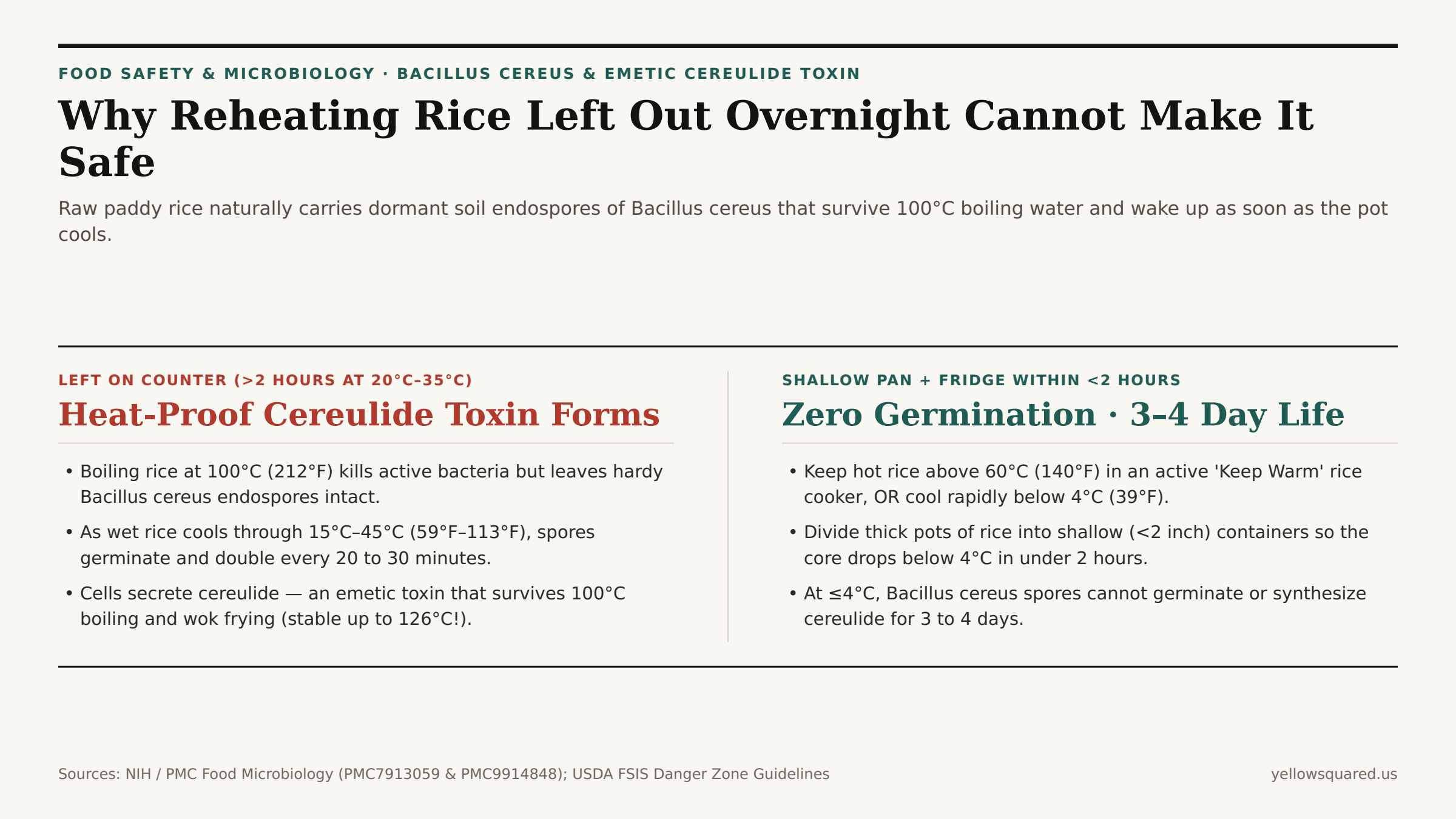
1. The Two-Stage Trap: Heat-Resistant Endospores + Heat-Stable Cereulide Toxin
Why is cooked rice so uniquely vulnerable compared to foods where thorough reheating eliminates bacterial risk? Because Bacillus cereus is a ubiquitous soil bacterium that naturally colonizes raw paddy rice grains in the field and attacks through a two-stage thermal defense (PMC7913059):
- Stage 1 — Endospores Survive
100°CBoiling Water: When you simmer rice at100°C (212°F), vegetative bacterial cells die, but dormant Bacillus cereus endospores survive intact. Worse yet, the heat shock of cooking actually triggers those spores to break dormancy (heat activation), while simultaneously killing off competing non-spore microbes and gelatinizing the rice starch into a moist, neutral-pH (pH ~6.0–6.8) nutrient bed. - Stage 2 — Rapid Germination at
15°C–45°C& Cereulide Synthesis: Once the rice cools below50°C–55°Cand sits at room temperature (20°C–35°C/68°F–95°F), the activated spores germinate into vegetative cells that double every 20 to 30 minutes (PMC9914848). As cell density climbs past 105–106 CFU/g, emetic strains synthesize cereulide — a ring-shaped cyclic dodecadepsipeptide toxin. - Why Reheating Fails (
126°CThreshold): Unlike fragile protein toxins (such as botulinum toxin) that unravel at85°C, cereulide's closed peptide ring is impervious to stomach acid (pH 2), digestive enzymes (pepsin and trypsin), and kitchen heat — requiring 90 minutes of pressurized autoclaving at121°C–126°C (250°F–259°F)to inactivate. Stir-frying contaminated rice in a wok kills the bacteria, but leaves 100% of the pre-formed cereulide active, causing acute nausea and vomiting within0.5 to 6 hours.
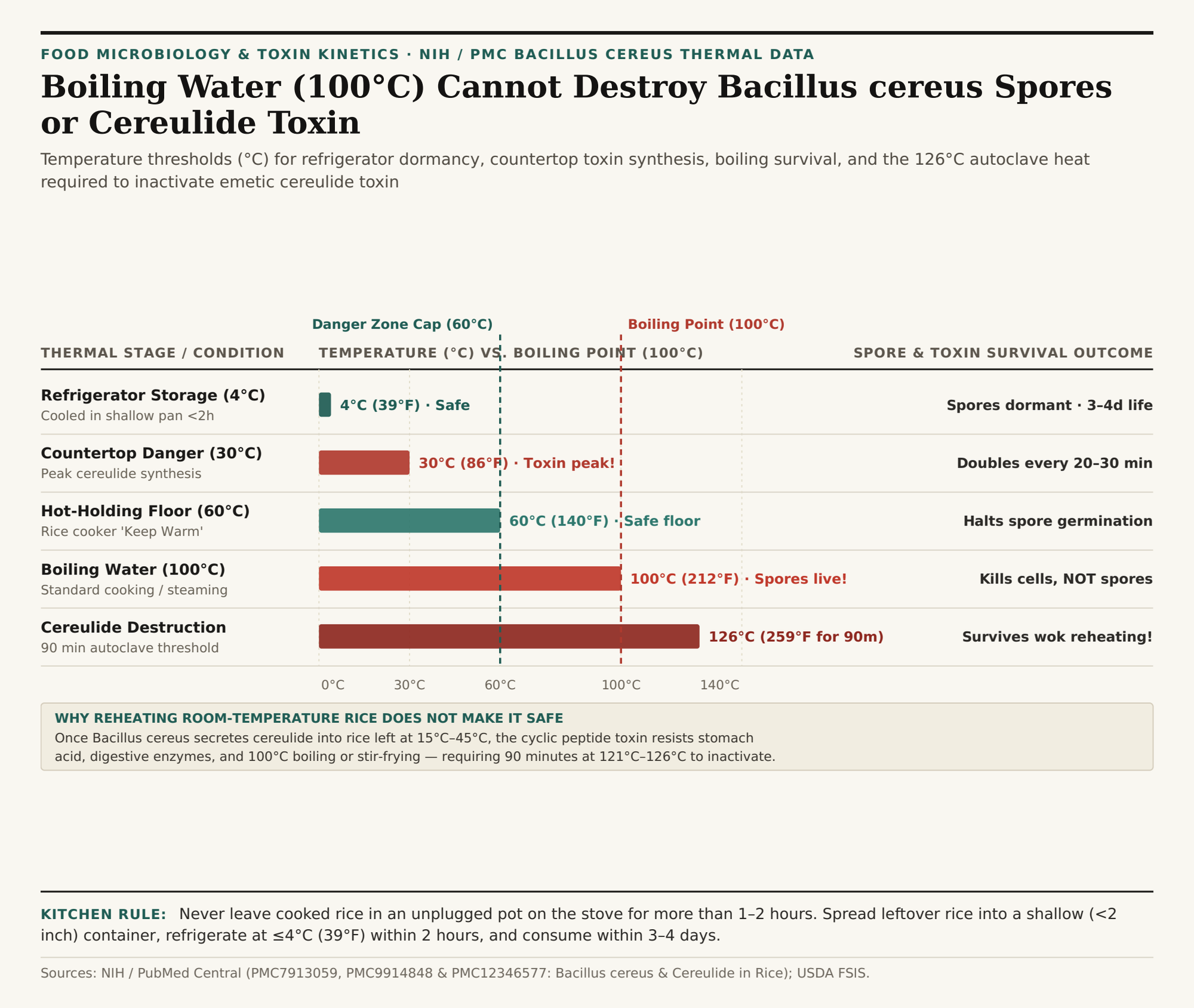
2. The Shallow-Pan Cooling Rule: How to Beat the 2-Hour Window
The most common home-kitchen mistake is leaving cooked rice inside a thick, insulated ceramic pot or an switched-off rice cooker with the lid closed. Because a dense 4-inch mound of wet starch traps heat like insulation, the center of the pot can hover in the 25°C–40°C optimum spore-germination band for 4 to 6 hours (PMC12346577). Follow three rules to keep cooked rice completely safe — including for next-day fried rice:
- Keep Hot Rice Above
60°C (140°F)or Cool It Within1–2 Hours: Modern electric rice cookers hold rice safely on their activeKeep Warmsetting because the thermostat maintains60°C–65°C (140°F–149°F)— above the maximum growth temperature of B. cereus. Never leave the pot unplugged onOffat room temperature for more than 1 to 2 hours. - Spread Into a Shallow (
<2 Inch) Layer Before Refrigerating: To make great fried rice (which needs dry, firm chilled grains), spread freshly cooked rice onto a flat sheet pan or shallow glass container (<5 cm / 2 inchesdeep) for 15 minutes to vent steam, then place it into a≤4°C (39°F)refrigerator within 1 to 2 hours of cooking. - Consume Refrigerated Rice Within
3 to 4 Days: While4°Chalts emetic mesophilic strains completely, rare psychrotolerant (cold-tolerant) strains can slowly grow after 5+ days; finish refrigerated rice within 3–4 days or freeze individual portions at-18°C (0°F)for up to 3 months.
"To make restaurant-grade fried rice safely at home, spread freshly steamed rice onto a shallow tray to vent steam for 15 minutes, chill it uncovered at 4°C (39°F) overnight so the surface dries out without ever spending two hours in the 30°C spore germination zone."
| Thermal Stage / Handling | Temperature | Vegetative Cells | Spores & Cereulide Toxin | Safe Time Limit |
|---|---|---|---|---|
| Refrigerator Storage (Shallow Pan) | ≤4°C (39°F) | Growth halted | Spores dormant; zero toxin | 3–4 days in fridge |
| Room Countertop (Unplugged Pot) | 20°C–35°C (68°F–95°F) | Doubles every 20–30m | Spores germinate & secrete cereulide | Max 1–2 hours total |
| Active Rice Cooker 'Keep Warm' | ≥60°C (140°F) | Growth prevented | Spores cannot germinate | 12–24h (Quality limit) |
| Boiling / Steaming Rice | 100°C (212°F) | Cells killed | Endospores & cereulide SURVIVE! | Does NOT fix old rice |
| Cereulide Toxin Destruction | 121°C–126°C (259°F) | Sterilized | Requires 90 min autoclave pressure | Unachievable in a wok |
Logging Meal-Prep Grain & Leftover Timers
Because cooked rice, pasta, and potatoes show zero visual or odor warning signs when cereulide is present, tracking the exact day a batch was cooked eliminates fridge guesswork. Track cooked leftover and fridge timers in Redberi to manage 3-day grain windows, and download the cooked rice Bacillus cereus thermal survival CSV table.