
Why Does Hawaii Never Change Clocks for Daylight Saving Time? How the 6-Hour Gap With New York Shifts to 5 Hours
If you live on the U.S. Mainland and schedule a recurring weekly check-in with family, clients, or resort teams in Honolulu, you have probably been burned by a twice-a-year calendar shift: from November to March, Hawaii sits 2 hours behind Los Angeles and 5 hours behind New York; from March to November, Hawaii suddenly sits 3 hours behind Los Angeles and 6 hours behind New York. Yet no one in Honolulu ever touched a clock.
As documented in Wikipedia's Time in Hawaii Statutory & Historical Record, the Hawaii–Aleutian Time Zone Reference, and Daylight Saving Time in the United States, Hawaii (Pacific/Honolulu, HST, UTC-10:00) is one of only two U.S. states (alongside Arizona) that permanently opted out of Daylight Saving Time under the federal Uniform Time Act of 1966 (15 U.S.C. § 260a). To compare live clock overlaps between Honolulu and any Mainland or international city across winter and summer dates, Open Tempo in your browser.
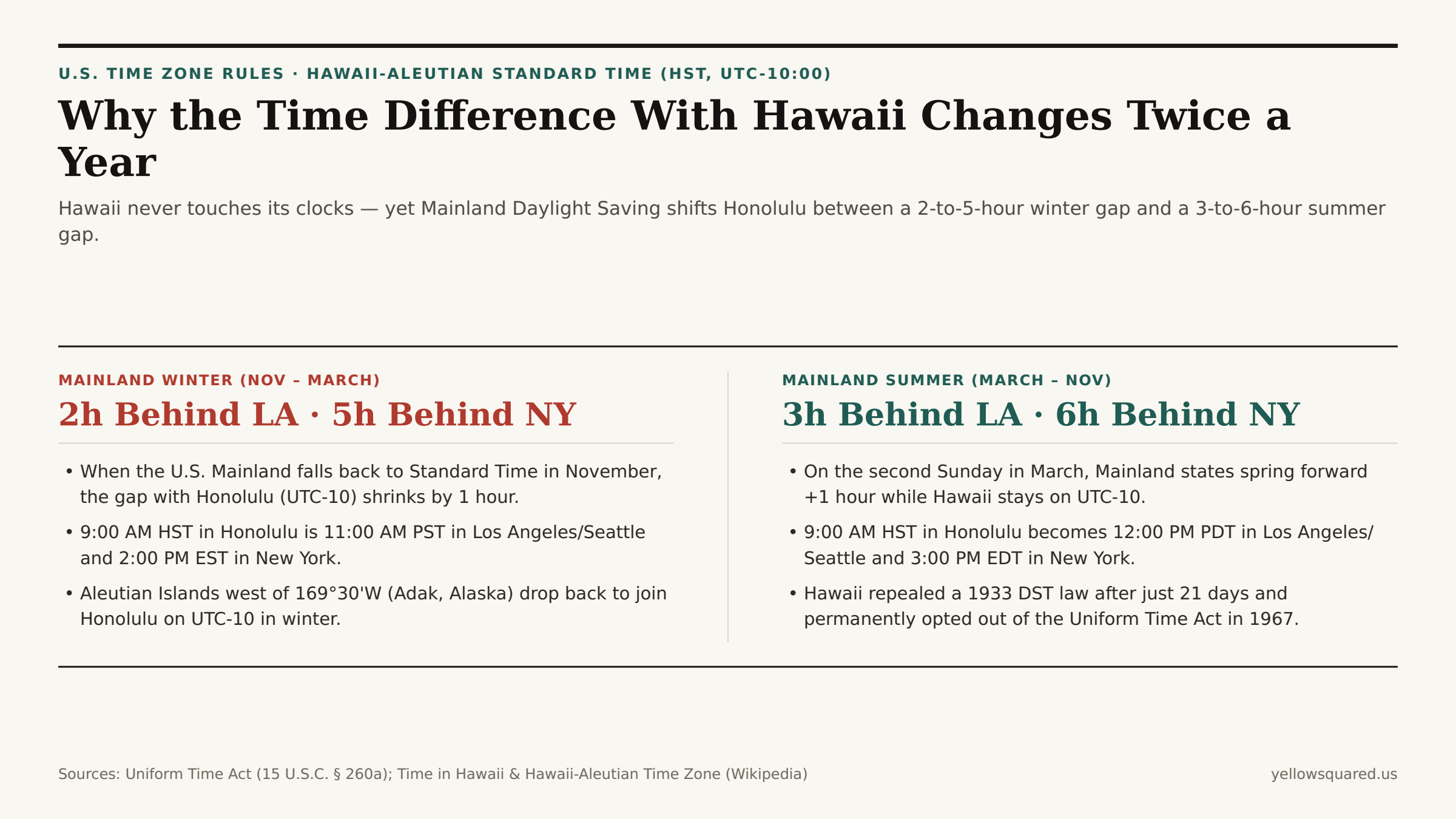
UTC-10:00) all year while 48 Mainland states spring forward in March, Honolulu's time gap with the Mainland widens by a full hour every spring and shrinks every fall.1. The Tropical Latitude Math: Why 21.3°N Has Almost No Extra Summer Daylight to "Save"
Why do high-latitude cities like Seattle (47.6°N), London (51.5°N), or Anchorage (61.2°N) care so much about shifting clocks in summer, whereas Hawaii rejected Daylight Saving Time unanimously in 1967? The answer is spherical astronomy and Earth's 23.44-degree axial tilt:
- Minimal Seasonal Swing Near the Tropics (
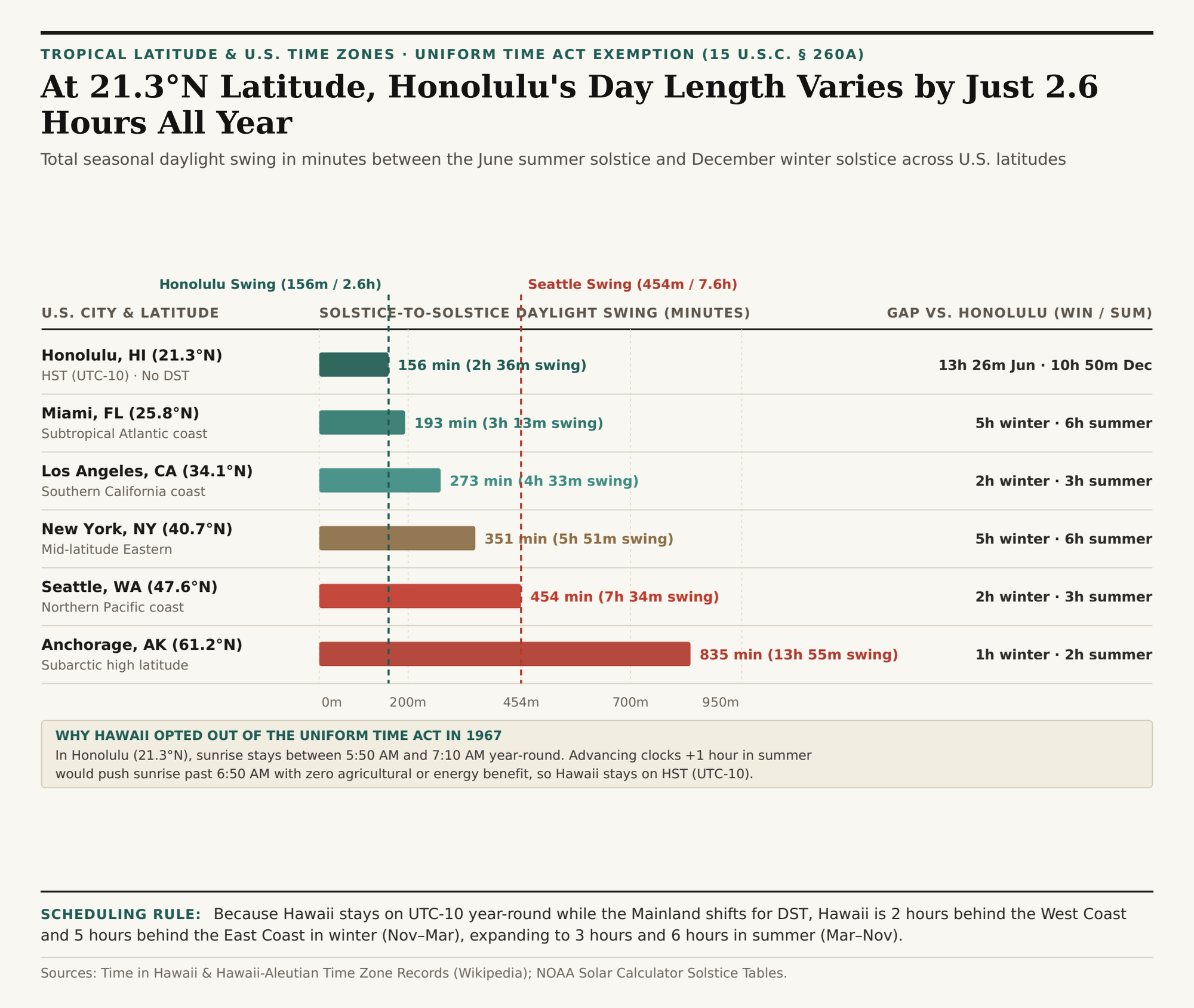
21.3°N): Honolulu sits at21°18'Nlatitude — just two degrees south of the Tropic of Cancer (23.44°N). On the June summer solstice, Honolulu receives13 hours and 26 minutesof daylight (sunrise ~5:50 AM, sunset ~7:16 PM). On the December winter solstice, Honolulu still receives10 hours and 50 minutesof daylight (sunrise ~7:04 AM, sunset ~5:55 PM) — a total seasonal swing of just156 minutes(2 hours and 36 minutes) across the entire year. - Compare That With Mid- and High-Latitude Mainland Cities: In New York (
40.7°N), day length swings by351 minutes(5 hours and 51 minutes, from9h 15min December to15h 06min June). In Seattle (47.6°N), day length swings by454 minutes(7 hours and 34 minutes, from8h 25mto15h 59m). Without DST in June, sunrise in Seattle or Boston would occur near4:10 AMwhile millions of people are asleep. - Why DST Would Backfire in Hawaii: Because Honolulu's summer sun already rises around
5:50 AMand sets past7:15 PM, advancing clocks by an hour (UTC-9:00) would push late-summer and autumn sunrises toward7:00 AM–7:30 AM— forcing morning commuters, schoolkids, and ocean paddlers into darkness with zero energy savings.
2. Hawaii's 21-Day 1933 Experiment, WWII "Hawaii War Time" (UTC-9:30), and the Aleutian Split
While Hawaii never observes Daylight Saving Time today, historical territorial records reveal two fascinating chapters when Hawaiian clocks moved:
- The 21-Day Repeal of 1933: On April 30, 1933, the Territorial Legislature enacted Daylight Saving Time across Hawaii. Public backlash over dark mornings was so immediate and fierce that lawmakers repealed the statute just three weeks later, on May 21, 1933.
- Half-Hour Clocks Until 1947 (
UTC-10:30&UTC-9:30): From 1900 until 1947, Hawaii's standard time was actually a half-hour zone —GMT-10:30, anchored to the157.5°Wmeridian passing directly between Oahu (157.86°W) and Maui (156.33°W). During World War II (between February 9, 1942 and September 30, 1945), the territory shifted one hour ahead to year-round Hawaii War Time (GMT-9:30). In June 1947, Hawaii permanently standardized on whole-hourGMT-10:00(HST). - Why the "Hawaii–Aleutian Time Zone" Splits Every Summer: Hawaii shares the
UTC-10:00zone with the westernmost Aleutian Islands of Alaska (west of169°30'W, such as Adak at51.88°N). Because Alaska does observe Daylight Saving Time, Adak (America/Adak) springs forward to Hawaii–Aleutian Daylight Time (HDT, UTC-9:00) from March to November, while Honolulu (Pacific/Honolulu) stays onHST (UTC-10:00)!
"In 1933, Hawaii tried Daylight Saving Time once — and repealed it after just 21 days. At 21°N latitude, nature already distributes sunlight evenly between 6:00 AM and 7:00 PM all year long."
| City & State | Latitude | June Solstice | Dec Solstice | Annual Swing | Gap vs. Honolulu (Win / Sum) |
|---|---|---|---|---|---|
Honolulu, HI (Pacific/Honolulu) |
21.31°N | 13h 26m | 10h 50m | 156 min (2.6h) | 0h year-round (UTC-10) |
Miami, FL (America/New_York) |
25.76°N | 13h 45m | 10h 32m | 193 min (3.2h) | 5h winter / 6h summer |
Los Angeles, CA (America/Los_Angeles) |
34.05°N | 14h 26m | 9h 53m | 273 min (4.6h) | 2h winter / 3h summer |
New York, NY (America/New_York) |
40.71°N | 15h 06m | 9h 15m | 351 min (5.9h) | 5h winter / 6h summer |
Seattle, WA (America/Los_Angeles) |
47.61°N | 15h 59m | 8h 25m | 454 min (7.6h) | 2h winter / 3h summer |
Anchorage, AK (America/Anchorage) |
61.22°N | 19h 22m | 5h 27m | 835 min (13.9h) | 1h winter / 2h summer |
Checking Mainland-to-Hawaii Overlaps Before You Book
Because a 9:00 AM HST morning kickoff in Honolulu lands at 2:00 PM EST in New York during January but 3:00 PM EDT in July, anchoring recurring invites carefully prevents missed afternoon windows on the East Coast. Open Tempo in your browser to scrub across winter and summer Mainland-to-Hawaii offsets, and download the Hawaii solstice daylight & DST CSV table.