
Why Does Honey Never Spoil — and How Do You Fix Crystallized Honey Without Ruining It?
Archaeologists excavating ancient Egyptian tombs have uncovered sealed clay vessels of honey more than 3,000 years old that remain completely free of bacterial spoilage. Yet buy a jar of raw clover or wildflower honey at the farmers' market and leave it in a cool kitchen or refrigerator for a few weeks, and it turns into a cloudy, gritty, solid white block. Millions of households throw crystallized honey in the trash assuming it has gone bad — or microwave it on High until it boils, unknowingly destroying its natural enzymes and spiking heat-degradation compounds.
The physical chemistry of why sealed honey never spoils — and why glucose crystallization peaks at 10°C–15°C (50°F–59°F) while dissolving cleanly in a 40°C (104°F) water bath — is quantified in NIH / PubMed Central's Study of Honey Fructose-to-Glucose Ratios, Crystallization, and Water Activity (PMC12111295), PMC's Review of 5-Hydroxymethylfurfural (HMF) Thermal Kinetics in Honey (PMC5884753), and PMC's Pathway Analysis of HMF Formation From Fructose and Glucose (PMC6525706). To organize ideal room-temperature versus refrigerator storage zones across every staple in your kitchen, Track pantry and fridge storage rules in Redberi.
1. The Three Chemical Shields That Make Sealed Honey Immortal (aw = 0.56 & pH 3.9)
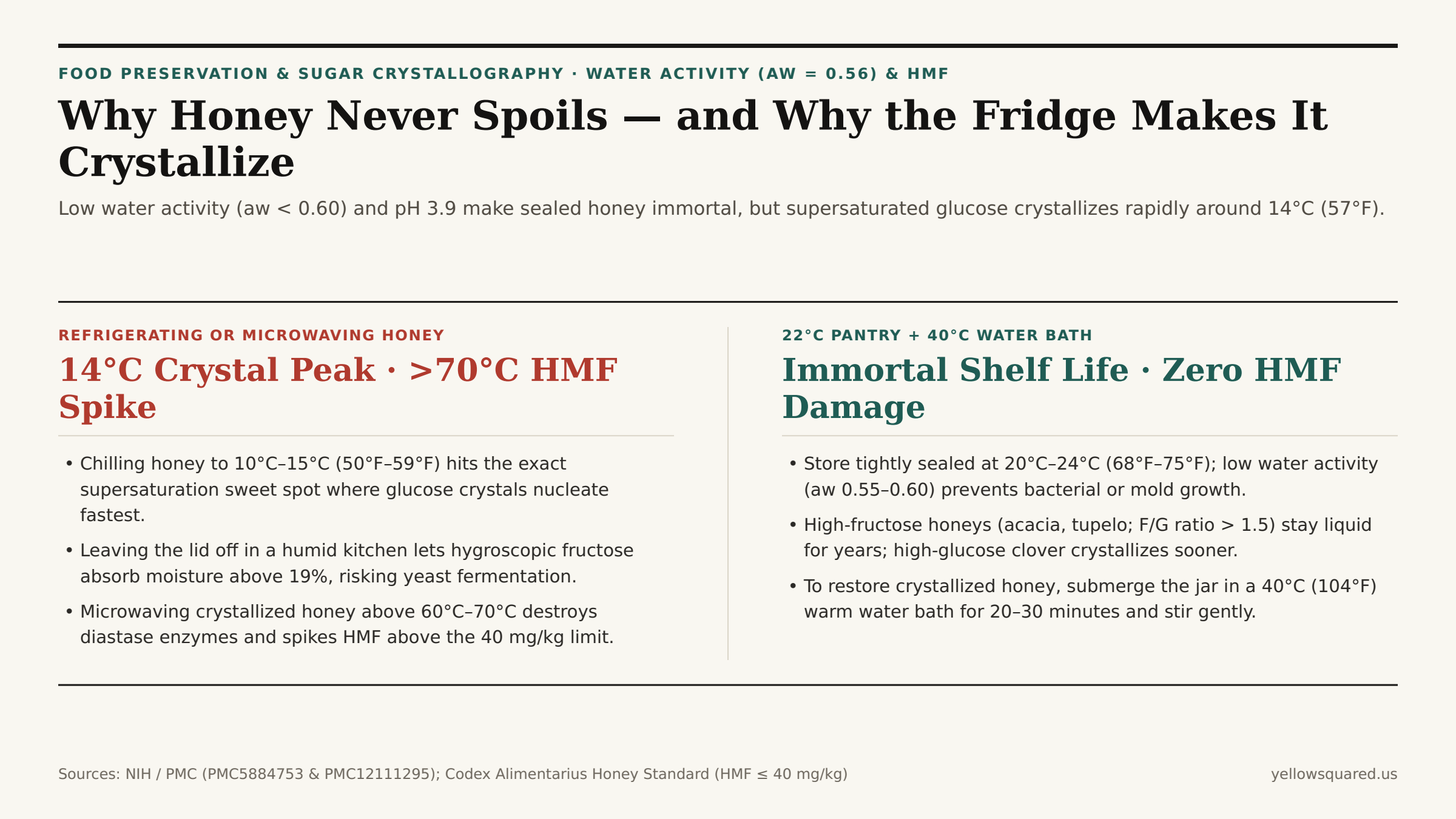
When honeybees transform floral nectar (~70%–80% water) into ripened honey (~17% water and ~80% sugars) before capping the honeycomb with wax, they engineer a triple antimicrobial barrier (PMC5884753):
- Ultra-Low Water Activity (aw ≈ 0.55–0.60): Microorganisms do not depend on total water percentage; they depend on water activity (aw) — the fraction of unbound water molecules available for biochemical reactions. Spoilage bacteria require aw ≥ 0.85–0.91, common molds require aw ≥ 0.75–0.80, and even extreme osmophilic yeasts require aw ≥ 0.61. Because honey's dense fructose and glucose molecules hydrogen-bond almost every water molecule in the jar, its water activity sits between
0.55 and 0.60(PMC12111295). Any bacterium or mold spore that lands in sealed honey has its internal water sucked out across its cell wall by osmotic pressure (plasmolysis). *(Important exception: dormant infant botulism endospores of Clostridium botulinum cannot grow in honey, but survive in dormancy — which is why honey must never be fed to infants under 12 months old.)* - Gluconic Acid Acidity (
pH 3.4 to 4.5): Honey averages apHof roughly3.9— more acidic than tomato sauce — blocking neutral-pH pathogens. - Enzymatic Hydrogen Peroxide (H2O2): Worker bees add the enzyme glucose oxidase from their hypopharyngeal glands, which reacts with trace free water to generate micro-doses of antimicrobial hydrogen peroxide.
2. Why Honey Crystallizes Fastest at 14°C (57°F) — and How to Re-Liquefy It at 40°C (104°F)
Why does pure honey turn solid and grainy over time? Honey contains two primary simple sugars: fructose (~38.5%) and glucose (~31.0%) dissolved in just ~17% water (PMC5884753). Fructose is highly soluble in water, whereas glucose is much less soluble and exists in honey as an unstable, supersaturated solution.
Whether a jar crystallizes in three weeks or stays liquid for three years depends on two variables (PMC12111295):
- The Fructose-to-Glucose (
F/G) and Glucose-to-Water (G/W) Ratios: Honeys with a highF/Gratio (>1.50) and lowG/Wratio (<1.60) — such as Tupelo, Acacia (Black Locust), and Sage honey — remain liquid for years. Honeys with high glucose (G/W > 1.9–2.1) — such as Clover, Canola/Rapeseed, Dandelion, and Alfalfa — precipitate white glucose monohydrate crystals around microscopic pollen grains or air bubbles within weeks. *(Ironically, when glucose crystallizes out, it releases unbound water into the remaining liquid phase, raising local water activity above0.62— so always keep crystallized honey sealed!)* - The
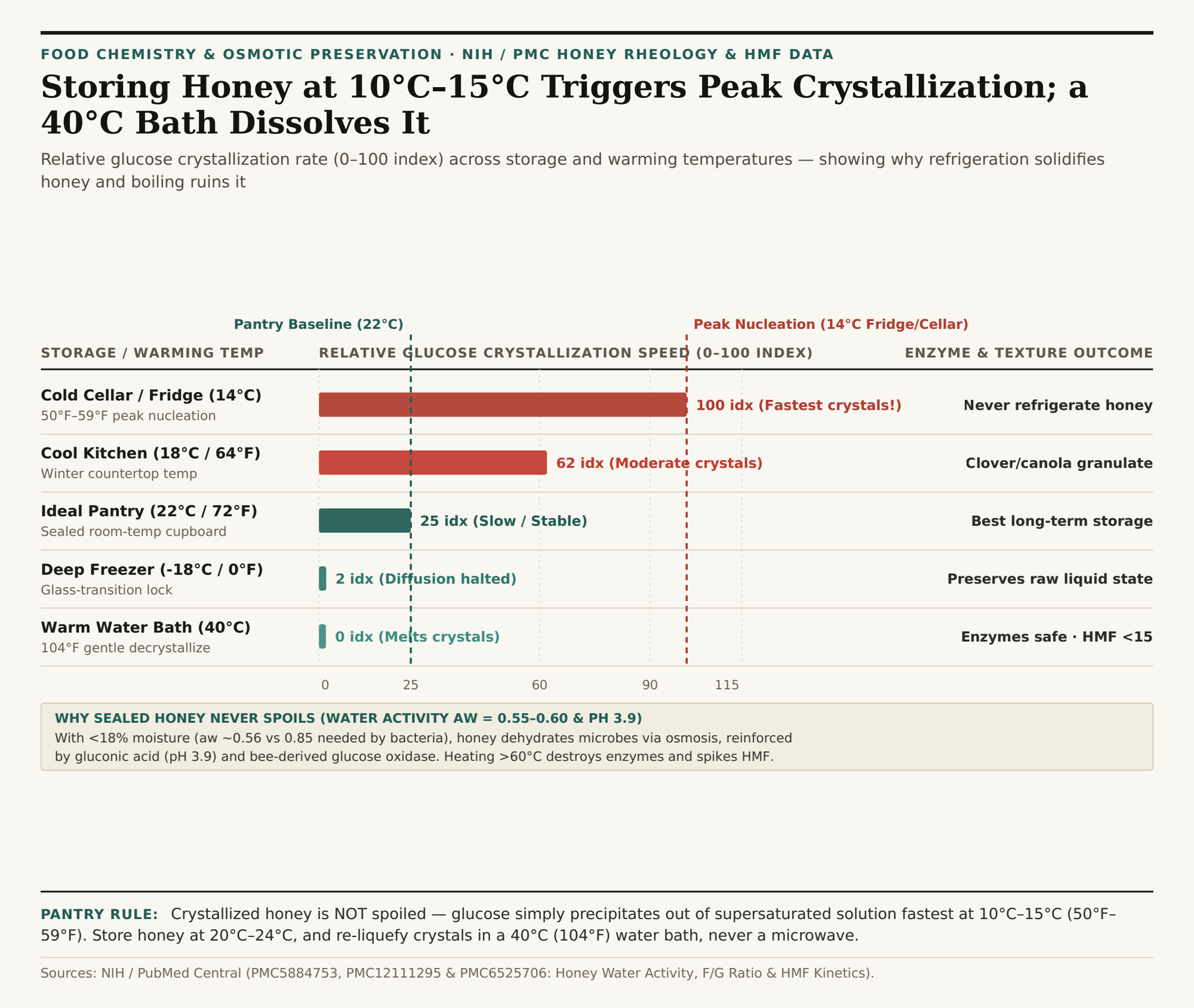
10°C–15°C (50°F–59°F)Nucleation Trap: Crystallization is governed by a tug-of-war between sugar solubility (which drops as honey gets colder) and viscosity (which thickens as honey gets colder, slowing molecular motion). Those two curves cross at10°C to 15°C (50°F–59°F): storing honey in a cool basement or refrigerator door maximizes crystal formation! At room temperature (21°C–24°C / 70°F–75°F), glucose stays dissolved much longer; in a deep freezer (-18°C / 0°F), viscosity becomes so high that molecules cannot diffuse to form crystals at all. - The
40°C (104°F)Water Bath Fix (Avoiding HMF Spikes): Never boil or microwave crystallized honey. As documented in PMC6525706, heating acidic honey above60°C–70°C (140°F–158°F)denatures natural diastase/invertase enzymes, darkens the color, and dehydrates fructose into 5-hydroxymethylfurfural (HMF) (regulated under Codex Alimentarius at≤40 mg/kg). Instead, place the glass jar in a bowl of warm tap water at40°C (104°F)(just above beehive temperature,35°C) for 20 to 30 minutes and stir once: every crystal melts back into clear golden liquid with zero enzyme loss.
"Crystallization is actually a badge of authentic, unpasteurized honey: ultra-filtered commercial syrups stay clear only because processors heat-flash them and strip out every microscopic pollen grain that glucose uses as a crystal seed."
| Temperature Zone | Celsius / Fahrenheit | Crystal Speed | Enzymes & HMF | Pantry Outcome |
|---|---|---|---|---|
| Deep Freezer | -18°C (0°F) | 2 / 100 (Halted) | 100% preserved (HMF ~0) | Locks raw liquid state indefinitely |
| Cool Cellar / Fridge Door | 10°C–15°C (50°F–59°F) | 100 / 100 (Peak!) | Preserved, but solidifies | Worst zone; rapid hard granulation |
| Ideal Room Pantry | 20°C–24°C (68°F–75°F) | 25 / 100 (Slow) | Low HMF; enzymes active | Best everyday sealed shelf storage |
| Gentle Warm Water Bath | 40°C (104°F) | 0 / 100 (Dissolves) | Safe (≤40°C beehive limit) | Restores clear liquid in 20–30 min |
| Microwave / Boiling Water | ≥70°C (158°F+) | 0 / 100 (Melted) | Enzymes killed; HMF >40 mg/kg | Caramelizes sugars & degrades quality |
Keeping Hygroscopic Pantry Staples Out of the Fridge
Just like bread, whole-bean coffee, and extra-virgin olive oil, honey is a staple that suffers physical texture damage when placed in a cold refrigerator. Track pantry and fridge storage rules in Redberi to keep every ingredient in its optimal temperature band, and download the honey water activity & crystallization CSV table.