
Why Does Iceland Never Change Its Clocks? How Reykjavik Ended Up on Permanent UTC+00:00
Look at a globe of the North Atlantic and you will notice that Iceland lies more than 1,500 kilometers northwest of Great Britain, stretching between longitudes 13.5°W and 24.5°W—far to the west of Ireland, Portugal, and Morocco, and directly north of the mid-Atlantic islands that use UTC−01:00 and UTC−02:00. Yet if you check the local time in Reykjavík (21.94°W) or land at Keflavík International Airport (22.61°W), Iceland is set to Greenwich Mean Time (UTC+00:00) 365 days a year, with zero Daylight Saving Time transitions in March or October.
Because Reykjavík sits nearly 22 degrees west of the 0° Greenwich meridian, locking the nation's clocks to UTC+00:00 means that Iceland is effectively living on permanent Daylight Saving Time—roughly 88 to 98 minutes ahead of local solar time. On the December 21 winter solstice, true solar noon in Reykjavík does not occur until 1:28 PM, and the sun does not clear the horizon until 11:22 AM (and in the Westfjords, after 12:00 PM noon!). Here is why Iceland adopted UTC−01:00 in 1908, why the Icelandic parliament (Althing) permanently locked the country onto UTC+00:00 on April 7, 1968, and why the government rejected a major campaign to move clocks back an hour in 2020.
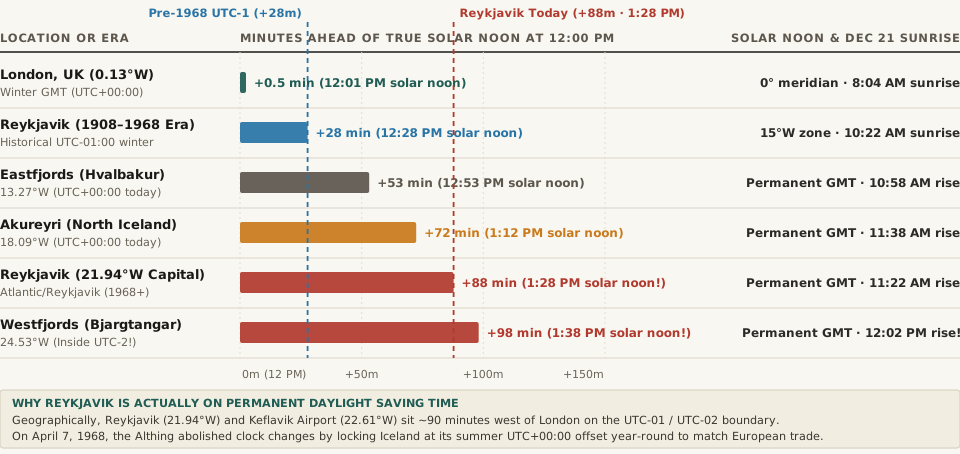
UTC+00:00 time zone (adopted April 7, 1968), compared against London and pre-1968 UTC−01:00 standard time. Download the raw dataset: iceland-permanent-utc-00-since-1968-reykjavik-solar-noon-and-solstice-hours.csv.1. From Local Solar Time to the 1907 Telephone Act (UTC−01:00)
For the first thousand years of Icelandic settlement, an island with no cross-border railways and scattered coastal towns had no need for a unified national time zone; each town set its clocks to local mean solar time (in Reykjavík at 21°56'W, local solar noon trailed Greenwich by 1 hour and 28 minutes). That changed in 1906 with the founding of Iceland's national telephone and telegraph company, Landssíminn, which connected Reykjavík to the Eastfjords and Europe via submarine cable.
As documented in the parliamentary history of Time in Iceland, the Althing passed a law on November 16, 1907 (taking effect in 1908) establishing UTC−01:00 (anchored to the 15°W meridian passing through eastern Iceland) as Iceland's official national standard time. First during World War I (1917–1921) and then continuously for 29 years from 1939 to 1968, Iceland observed seasonal Daylight Saving Time—advancing its clocks by one hour from UTC−01:00 to UTC+00:00 in spring (first Sunday in March or April) and turning them back to UTC−01:00 in late October.
2. Why the Althing Abolished Clock Shifts on April 7, 1968
By the late 1960s, the twice-yearly clock shift had become deeply unpopular across Iceland. Because Iceland lies just south of the Arctic Circle (64°N to 66.5°N), natural daylight swings from nearly 21–24 hours of continuous light in June to just 4 hours of low twilight in December. Moving a clock hand by one hour in spring and autumn did nothing to change the sub-Arctic sun cycle, yet—as summarized in the 1968 legislative record on Wikipedia—it created three constant headaches:
- Transatlantic Aviation Timetable Chaos: As Keflavík and Reykjavík became key North Atlantic stopover hubs between North America and Europe (through Loftleiðir / Icelandair), mismatched DST transition dates between Iceland, the UK, Continental Europe, and the U.S. scrambled flight schedules twice a year.
- Infant and Household Sleep Disruption: Parents and physicians complained that resetting clocks every April and October disrupted sleep rhythms across households without adding useful summer evening light (since June nights were already bright at midnight!).
- European Telephone & Trade Alignment: Iceland's business leaders wanted to keep the
UTC+00:00summer offset year-round so Reykjavík's workday remained synchronized with London and just one hour behind Copenhagen, Oslo, and Frankfurt during the winter trading season.
On April 5, 1968, the Althing voted to abolish seasonal clock shifts and lock Iceland permanently on UTC+00:00 (Greenwich Mean Time) starting on Sunday, April 7, 1968—a zone it has kept without a single clock change for nearly six decades.
“On April 7, 1968, Iceland advanced its clocks from UTC−01:00 to UTC+00:00 for the spring transition and simply never turned them back—locking Reykjavík 88 minutes ahead of true solar time year-round.”
3. The 1:28 PM Solar Noon Skew and the 2018–2020 Health Debate
What does living on permanent UTC+00:00 do to sunrise, solar noon, and sunset across Iceland's 11-degree longitudinal span? Compare the numbers across regions:
| Icelandic Location or Era | Longitude | Natural Solar Zone | Official Civil Zone | Solar Noon Delay After 12 PM | True Solar Noon Clock Time | Dec 21 Winter Solstice Sunrise & Sunset |
|---|---|---|---|---|---|---|
| London, UK (Reference) | 0.13°W | UTC+00:00 (0°) | UTC+00 (UTC+01 BST) | +0.5 min (Winter) | 12:01 PM | 8:04 AM sunrise · 3:53 PM sunset |
| Reykjavík Pre-1968 (1908–1968) | 21.94°W | UTC−01:00 (15°W) | UTC−01:00 Standard | +27.8 min | 12:28 PM | 10:22 AM sunrise · 2:29 PM sunset |
| Eastfjords (Hvalbakur / Seyðisfjörður) | 13.27°W | UTC−01:00 (15°W) | UTC+00:00 (Since 1968) | +53.1 min | 12:53 PM | 10:58 AM sunrise · 2:43 PM sunset |
| Akureyri (North Iceland) | 18.09°W | UTC−01:00 (15°W) | UTC+00:00 (Since 1968) | +72.4 min | 1:12 PM | 11:38 AM sunrise · 2:45 PM sunset |
| Reykjavík (Capital — Since 1968) | 21.94°W | UTC−01 / UTC−02 | UTC+00:00 Year-Round | +87.8 min | 1:28 PM! | 11:22 AM sunrise · 3:29 PM sunset |
| Keflavík International Airport (KEF) | 22.61°W | UTC−02:00 (30°W) | UTC+00:00 Year-Round | +90.4 min | 1:30 PM! | 11:24 AM sunrise · 3:33 PM sunset |
| Westfjords (Ísafjörður / Bjargtangar) | 24.53°W | UTC−02:00 (30°W) | UTC+00:00 Year-Round | +98.1 min | 1:38 PM! | 12:02 PM sunrise! · 2:57 PM sunset |
Notice a remarkable geographic fact: because the boundary between the geographical UTC−01:00 zone (7.5°W–22.5°W) and the geographical UTC−02:00 zone (22.5°W–37.5°W) runs right along the 22.5°W meridian through the Reykjanes Peninsula, Keflavík International Airport (22.61°W) and the Westfjords (24.53°W) actually sit inside the natural UTC−02:00 zone—two full hours west of their official UTC+00:00 clock!
In January 2018, a working group under Iceland's Ministry of Health (including sleep physiologist Björg Þorleifsdóttir) concluded that keeping Reykjavík 88 minutes ahead of solar time caused measurable social jet lag in teenagers during dark winter mornings (when students sit in school for three hours before the 11:22 AM sunrise), recommending a return to UTC−01:00. However, in September 2020, Prime Minister Katrín Jakobsdóttir's cabinet officially decided to keep UTC+00:00 after calculating that shifting clocks back an hour would reduce usable afternoon daylight during waking hours by 13% across spring, autumn, and winter.
Track Iceland, UK, and U.S. Seasonal Time Shifts in Tempo
Because Iceland stays on UTC+00:00 year-round (Atlantic/Reykjavik) while London switches between UTC+00:00 and UTC+01:00 (BST) and the United States shifts between March and November, the time gap between U.S. cities and Reykjavík changes twice a year even though Iceland never touches its clocks. Open Tempo in your browser to check exact flight and call overlaps with Reykjavík for any date of the year.